


A City of Sadness, the 1989 film, directed by the renowned director Hou Hsiao-hsien and based on a story during the 228 Incident, has been re-released after 33 years. With a new poster that reads “A must-see movie for all Taiwanese,” the 4K digital version is being screened in theaters across Taiwan from Feb. 24.
Hou’s A City of Sadness was the winner of the Golden Lion Award for Best Film at the 46th Venice Film Festival in 1989 with its unique visual style and political and historical views, and became the first Taiwanese film to win at one of the three major international film festivals.
It was 10 years after the US cut diplomatic ties with Taiwan in 1979, and Taiwan had become “the orphan of Asia.” During the 1989 Venice Film Festival, due to political interference from China, Taiwan’s national flag was not allowed to be hung outside the Festival venue along with those of other shortlisted films’ countries, leaving Taiwan’s flagpole empty. Despite that, the win made Taiwan’s name and story appear in major media around the world following the success at the film festival.
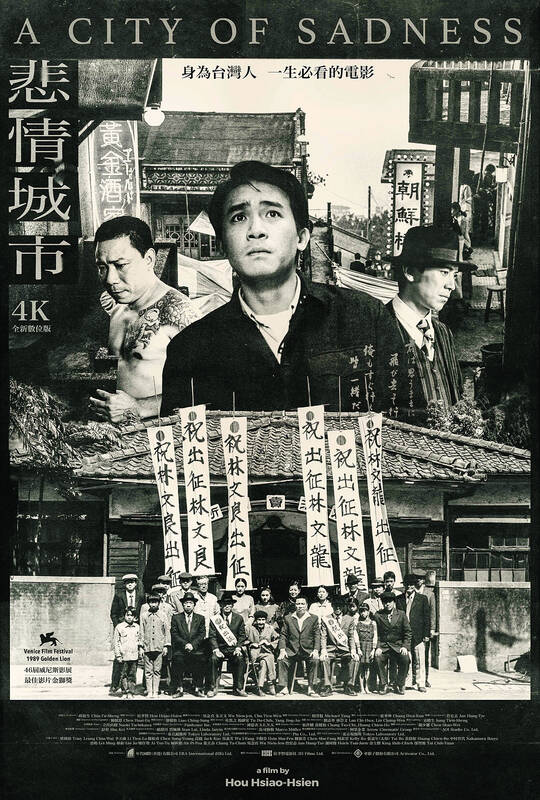
Photo courtesy of Activator Co. Ltd. 照片:牽猴子股份有限公司提供
A City of Sadness was the first film in Taiwan’s movie history to use synchronized sound technology, Hou’s first movie to tackle historical themes, and was the first film or television work to deal with the 228 Incident after the lifting of martial law in Taiwan in 1987.
The winning of the Golden Lion also laid an unshakable cornerstone for the “Taiwan New Cinema” (or Taiwanese New Wave Cinema) movement, which began in 1982.
It is from A City of Sadness, that Hou, who had already established his signature aesthetics of the “long take,” started to abandon the script during shooting, instead allowing the actors to make their own interpretations. Writer, film producer and entrepreneur Jan Hung-tze recalls that Hou did not show the script to amateur actors, so as to avoid rigid and unnatural acting. Hou described the character’s life and story to the amateur actors on the set, instead of asking them to memorize the dialogue in the script.
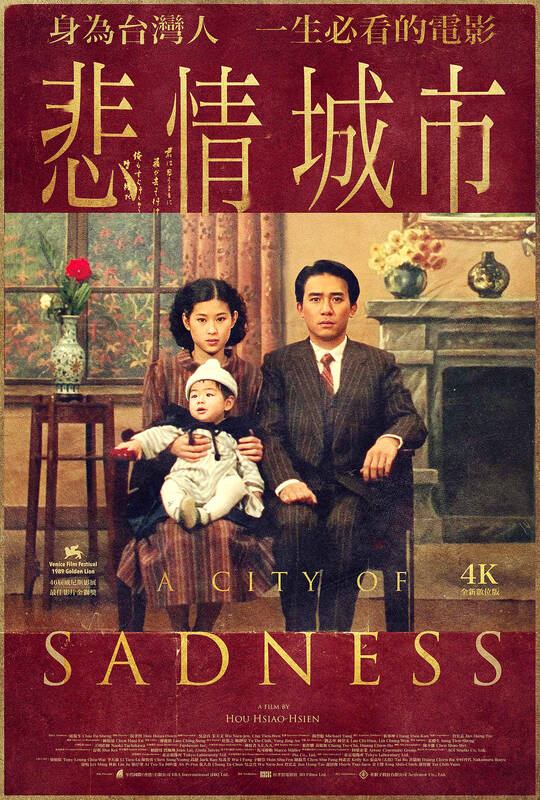
Photo courtesy of Activator Co. Ltd. 照片:牽猴子股份有限公司提供
In order to prevent actors from various backgrounds from “acting too hard” in front of the camera, Hou also began to “cheat” his actors, pretending to be rehearsing on the set of the film, but in fact taking advantage of their most relaxed moments to capture the most natural performance. This filming method earned Chen Sung-young the Best Actor of the Golden Horse Awards with his performance in the film.
(Translated by Lin Lee-kai, Taipei Times)
名導侯孝賢執導的「悲情城市」相隔33年重映,電影以二二八事件為背景,新款海報寫上「身為台灣人,一生必看的電影」,4K數位版於2月24日全台上映。
侯孝賢的「悲情城市」憑藉獨特的視覺風格與政治歷史觀點,在1989年摘下第46屆威尼斯影展最佳影片金獅獎,也成為台灣首部在世界三大影展獲獎的國片。
儘管那是1979年台美斷交的10年後,台灣在國際間地位如同「亞細亞的孤兒」,1989年的威尼斯影展,也因中國政治干預,場外懸掛入圍影片國家的旗杆上,原該懸掛中華民國國旗,卻是空空蕩蕩;但獲得金獅獎的《悲情城市》,仍讓台灣的名字、故事,隨著影展捷報,出現在全世界各大媒體。
它是台灣電影史上第一次採用同步錄音技術拍攝的電影,也是侯導第一次挑戰歷史題材,更是台灣在1987年解嚴後,第一部敘述二二八事件的影視作品。
《悲情城市》獲金獅獎,也為從1982年開始的「台灣新電影」運動,奠定了難以撼動的崇高地位。
彼時已確立長鏡頭美學的侯孝賢,也是從《悲情城市》開始,在現場漸漸捨棄劇本,讓演員自己發揮。詹宏志就曾回憶,侯導不給非演員看劇本,以免照本宣科。侯孝賢在拍攝現場是以口頭向非演員描述角色的生平、故事。
為了避免各種背景的演員,在鏡頭前演得太用力,侯孝賢也開始「騙」他的演員,在拍片現場假裝試戲,其實是趁他們最放鬆的情形下,拍下最自然的表現。這個拍法,也讓陳松勇以本片榮獲金馬獎影帝。
(中央社)

A: Taiwan legalized same-sex marriage on May 24, 2019, so this week marks the seventh anniversary of that milestone. By the end of 2024, a total of 32,126 LGBT couples had tied the knot. B: How many of them got married to foreign partners? A: In 2024, there were 504 cross-border same-sex marriages. By the end of that year, there were 130 cross-strait same-sex marriages between Taiwanese and Chinese — accounting for only about 0.4 percent of the total. B: I’ve heard that a seven-year marriage brings the “seven-year itch.” I bet some couples regret their decisions now. A:
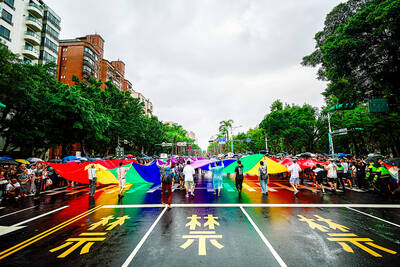
A: While Taiwan is celebrating the 7th anniversary of legalizing same-sex marriage, a poll shows that the support rate for same-sex marriage rose sharply from 37.4 percent seven years ago to 69.9 percent last year. B: Actually, I’m a bit curious about the size of Taiwan’s LGBT population. A: I’m not sure. But if we take a Gallup poll in the US as an example, 9.3 percent of American adults identified as LGBT in 2024. B: Wow, is it because the Americans are relatively open? In many other countries, the figures hover around 5 percent. A: Based on this,

Taiwan Travelogue, the novel by Taiwanese author Yang Shuang-zi and translated into English by Lin King, won the prestigious International Booker Prize in London on May 19. It marks the first time a Taiwanese literary work has received the International Booker Prize, setting a historic milestone both for Taiwanese literature and for the award itself. Prior to this achievement, Taiwan had only once appeared on the Booker radar, when Taiwanese author Wu Ming-yi was longlisted for the Booker Prize in 2018 with The Stolen Bicycle. The International Booker Prize honors works of fiction translated into English and published in the UK or Ireland.
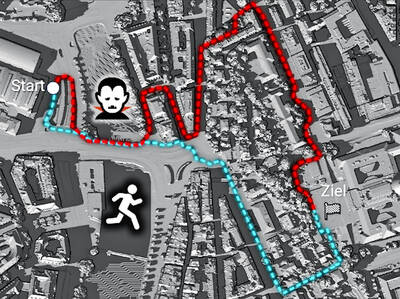
As climate change and urbanization push city temperatures higher, walking outdoors is becoming increasingly uncomfortable in many parts of the world, especially when prolonged time spent in sunlight is involved. As a result, outdoor lovers are now seeking cooler, shaded walking routes. However, most mainstream map apps still do not __1__ shaded footpaths. Enter routing.osm.ch — a Swiss web-based route planner that introduces a novel solution to this problem. Its “Vampire mode,” named after the legendary creatures’ fear of being __2__ natural light, was developed by a Swiss research team led by Professor Stefan Keller. The platform combines open data from


 RSS
RSS