


A man from Darwin, Northern Territory of Australia, Neville Sharp, decided to attempt the Guinness World Records title for the loudest burp after years of practicing. His voluminous burp was registered at 112.4 db, a sound level comparable to that made by an aircraft taking off, making him the new world record holder.
Sharp was taught how to burp at the age of six. His wife, KP, insisted he attempt the record to show off his talent. With the encouragement and coaching of his wife, Sharp spent the previous five years honing his skill. His attempt was carried out at a studio to ensure an accurate decibel reading, and his mighty belch was registered at a massive 112.4 db, which is enough to cause damage to people’s hearing.
Sharp has broken British man Paul Hunn’s longstanding record of 109.9 decibels from 12 years ago. The loudest burp by a female is 107.0 db, and was achieved by Elisa Cagnoni at a beer festival in Italy in 2009.
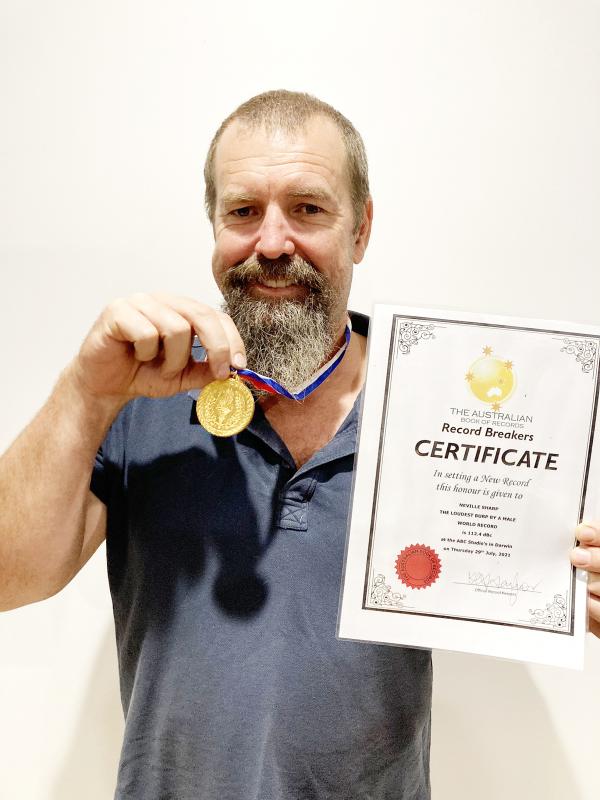
Photo: Neville Sharp’s Twitter 照片:夏普的推特
(Translated by Rita Wang, Taipei Times)
來自澳洲北領地達爾文的男子夏普,經過多年練習後,日前挑戰金氏世界紀錄最大打嗝聲,一舉打出一一二‧四分貝超大嗝聲,相當於飛機起降音量,成功打破金氏世界紀錄。
夏普六歲時學會大聲打嗝,他的妻子KP認為夏普應該嘗試打破世界紀錄,展示他獨特的才能,在太太的鼓勵及訓練下,花了五年時間準備這一刻,為了確保能準確錄下音量,他特地在錄音室進行挑戰,最後打出有紀錄以來最響亮的飽嗝,打嗝聲高達一一二‧四分貝,足以讓人聽力受損。
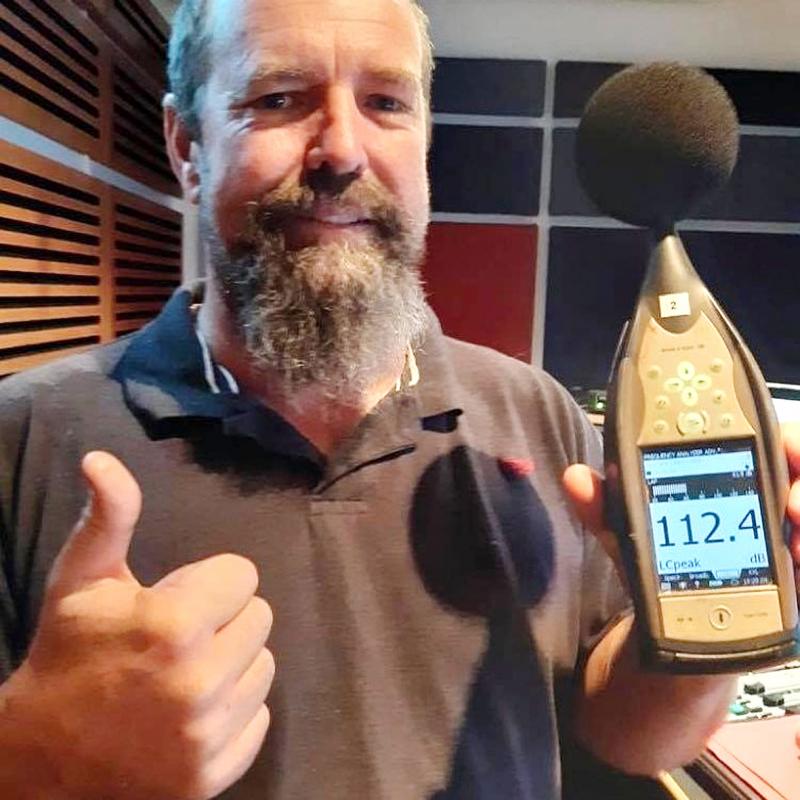
Photo: Neville Sharp’s Facebook 照片:夏普的臉書
夏普打破原先英國人漢恩在十二年前的一○九‧九分貝紀錄,而女性紀錄則是由卡尼奧尼於二○○九年在義大利的一場啤酒節上締造,當時卡尼奧尼的打嗝音量是一○七分貝。
(自由時報)
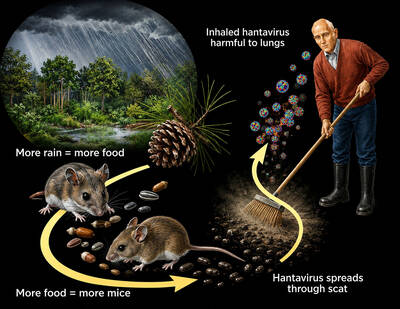
An outbreak aboard a cruise ship of a rare rodent-borne illness called hantavirus has left three passengers dead and sickened others, but global health officials say the risk to the general public remains low because the germ does not easily spread between people. “This is not the next COVID, but it is a serious infectious disease,” said Maria Van Kerkhove, director of epidemic and pandemic preparedness at the World Health Organization (WHO). “Most people will never be exposed to this.” The virus usually spreads when people inhale contaminated residue of rodent droppings. Hantaviruses have been around for centuries and are thought to

Have you ever wondered how people navigate the world when they can’t see a map? For individuals with visual impairments, conventional maps are nearly impossible to use. This is where tactile maps come in — essential tools that allow people to “see” the world through touch. A tactile map is specially designed with raised lines, textures, and symbols to represent geographical features such as roads, rivers, and buildings. Users explore it with their fingertips. However, these maps are not exclusively for people with visual disabilities. They serve as valuable multisensory learning tools that enhance spatial understanding for everyone, making

A: In early May, there were concerts by Icyball, Chyi Yu, Korea’s EXO and Japan’s Anisama, but I missed them all. What a shame. B: That’s OK. There are shows coming up by various artists, including Power Station, Accusefive, Japanese singer Mika Nakashima, Chinese-Icelandic jazzer Laufey, and even Singaporean diva Stefanie Sun. A: After a 12-year hiatus, Stefanie is finally returning to Taipei again. B: In late May, there will be more shows by Crowd Lu, WeiBird, Korea’s Donghae, 2AM, EXID, and Thailand’s BUS. A: The Thai boyband is so popular. It looks like “T-pop” is catching up with J-pop

Since 2005, the third Monday in January has come to be known as “Blue Monday.” In other words, that day is believed to be the most depressing day of the year. This concept seems logical at first. After all, Monday marks the start of the school or workweek after two days of rest and fun. Also, blue is a color that is often associated with sadness. Furthermore, in many parts of the world, January is a time when the weather is cold, rainy, and gloomy. But is there any scientific proof that this January day is truly sadder than any of


 RSS
RSS