


Actress Ruby Lin, who is a charity ambassador of the TVBS Foundation, has been promoting the foundation’s “Infinite Love” fundraising campaign, which is raising money for a total of 20 charity groups. Due to the COVID-19 pandemic, Lin said that public donations to charitable organizations have seriously declined this year, while many shelters have been forced to close.
To show her support for the disadvantaged, Lin recently visited the Institute for the Blind of Taiwan in Taichung, where she learned how to guide visually-impaired people in the street properly, including the five-word principle — “observe, ask, touch, guide, describe.” “It’s more blessed to give than to receive,” she said, calling on the public to give generously.
To help people get an understanding of the challenges faced by the blind, YouTuber “PY” last month also released a video of himself secretly protecting his visually-impaired brother, who attempted to walk home from school by himself for the first time. Their brotherly love has moved numerous viewers online.

Photo: CNA 照片︰中央社
(Eddy Chang, Taipei Times)
女星林心如是TVBS信望愛永續基金會公益大使,她近日宣傳該基金會「愛無限」募款活動,為總共二十家慈善團體來募款。受武漢肺炎(新冠病毒,COVID-19)影響,她說今年民眾對於慈善機構的捐款嚴重下滑,不少庇護所目前亦被迫關閉中。
為了用行動力挺弱勢,林心如親自造訪了台中市的台灣盲人重建院,並學習如何在街上正確引導視障人士,包括安全引導的五字訣——「觀、問、碰、引、述」。她還說︰「施比受更有福!」呼籲大家能踴躍捐款。
而為了幫助大眾了解盲人面臨的挑戰,網路創作者「P歪」上個月發布一支影片,記錄他的視障弟弟首次嘗試放學自己走回家,他則偷偷跟在後面保護他弟弟,兩人的兄弟情也讓許多網友大為感動。
(台北時報張聖恩〉

The debate surrounding Taipower’s recent corporate identity reboot has gone well beyond the design community. The controversy began after Taipower replaced the familiar “Taiwan Power Company” wording — widely regarded as the calligraphy of Yu You-ren (1879-1964), former Control Yuan president and master calligrapher — with a modern logotype by designer Aaron Nieh’s team, Aaron Nieh Workshop. Taipower said the change was not a wholesale replacement of old signage, but an “optimization of its identity system,” aimed at meeting the needs of digital media, electronic bills, apps, social media graphics and various small-format applications. Existing physical markings, such as building
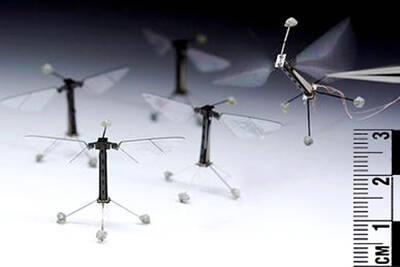
As bee populations around the world continue to decline at an alarming rate, scientists are developing an innovative solution: robotic bees. Recent advances at research institutions like Massachusetts Institute of Technology (MIT) in the US have produced tiny flying robots capable of performing pollination tasks similar to those of real bees. These tiny machines represent an impressive technological achievement. MIT’s latest models can hover in the air for over 1,000 seconds and perform complex movements, demonstrating the agility needed for successful pollination. The robots are designed to mimic the flight patterns of natural bees, offering potential support to agriculture

A: Taiwan legalized same-sex marriage on May 24, 2019, so this week marks the seventh anniversary of that milestone. By the end of 2024, a total of 32,126 LGBT couples had tied the knot. B: How many of them got married to foreign partners? A: In 2024, there were 504 cross-border same-sex marriages. By the end of that year, there were 130 cross-strait same-sex marriages between Taiwanese and Chinese — accounting for only about 0.4 percent of the total. B: I’ve heard that a seven-year marriage brings the “seven-year itch.” I bet some couples regret their decisions now. A:

A: While Taiwan is celebrating the 7th anniversary of legalizing same-sex marriage, a poll shows that the support rate for same-sex marriage rose sharply from 37.4 percent seven years ago to 69.9 percent last year. B: Actually, I’m a bit curious about the size of Taiwan’s LGBT population. A: I’m not sure. But if we take a Gallup poll in the US as an example, 9.3 percent of American adults identified as LGBT in 2024. B: Wow, is it because the Americans are relatively open? In many other countries, the figures hover around 5 percent. A: Based on this,


 RSS
RSS