


Following the electrification of Taiwan’s railway, a steam locomotive puffing along the tracks is a rare sight — two steam locomotives together is extraordinarily rare. On Monday, just such an event occurred when DT668, known as the “King of Locomotives,” coupled to CT273, the “Queen of Locomotives,” for a joint-outing on the Taiwan Railways Administration’s (TRA) Eastern Trunk line. The double appearance attracted a large number of appreciative train enthusiasts who hope it won’t be the last time to see such a beautiful sight.
However, the TRA’s Hualien Locomotive Depot says that following the restoration CT273, it has been difficult to gain regulatory approval for its operation on the railway. Monday’s operation was to retest and revise the locomotive’s performance and to gather other related data. The depot says it was a “chance event” and there is only a slim likelihood of a repeat performance in the future.
There are currently only two fully-restored steam locomotives within the TRA’s inventory. DT668, which on Saturday was dispatched to greet the arrival of the TRA’s new EMU900 commuter trains from South Korea, and CT273, which participated in this year’s Yilan Lanyang Matsu Festival. On Monday, Hualien Locomotive Depot coupled both locomotives together and assigned the special train service number 8782, which departed from Hualien Station at 10.20am bound for Guangfu Station. Large numbers of trainspotters lined the route, waiting to witness the thrilling sight of the two steam locomotives and record a precious moment of Taiwan’s locomotive history.
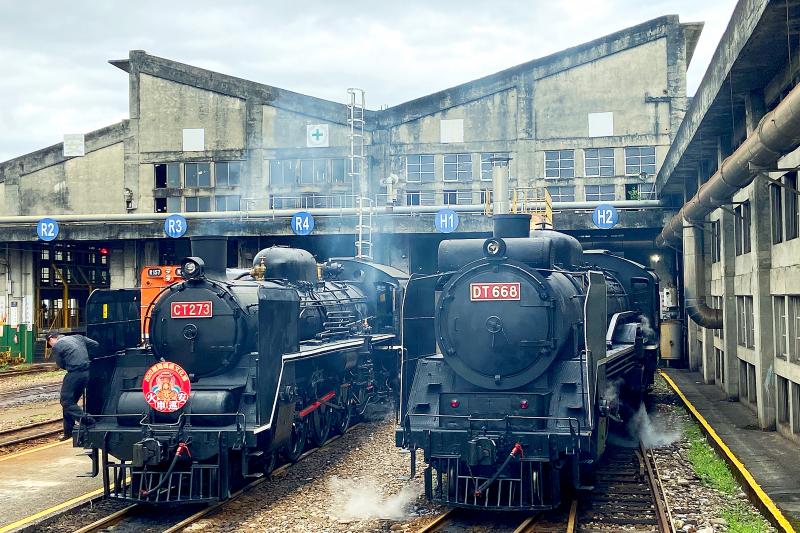
Photo courtesy of Hsiao Lin 照片:小林提供
DT668 was manufactured in 1941 by Japan’s Kawasaki Rolling Stock Company, and it has a maximum speed of 85km/hr and a heavy hauling capacity. It is the TRA’s heaviest train type by tonnage, hence the moniker “King of Locomotives.” DT668 initially operated on the Old Mountain Line, primarily hauling freight, but supplementary duties did involve operating passenger services.
Back in the day, CT273 was Taiwan’s fastest steam train and was capable of reaching speeds of up to 100km/hr. Due to her graceful, sleek lines, she is known variously as “The Lady” and “Queen of Locomotives.” CT273 is currently being preserved by Hualien Locomotive Depot and every summer operates a special sightseeing service in Taitung County, called the “Mid-summer Formosa Express.”
(Translated by Edward Jones, Taipei Times)
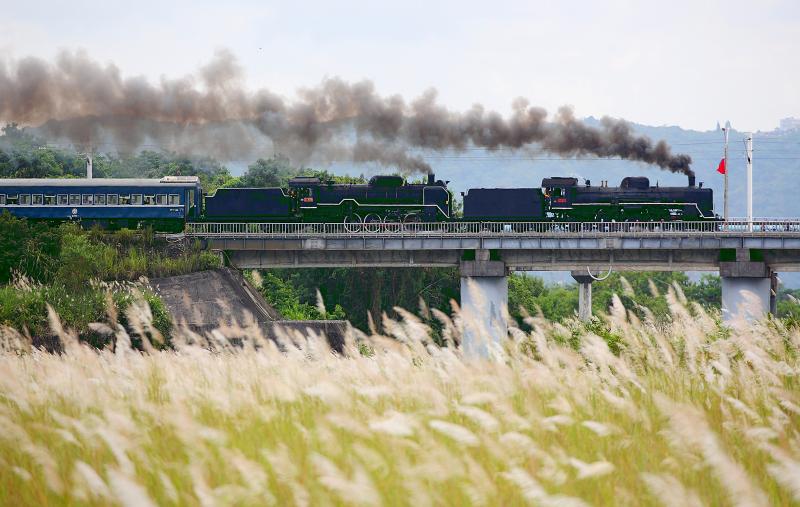
Photo: Yu Tai-lang, Liberty Times 照片:自由時報記者游太郎
一部蒸汽火車頭在鐵道上行駛,難得一見!兩部蒸汽火車頭合體的畫面,在台鐵電氣化後,則是破天荒首見!週一DT668(國王號)攜手CT273(機關車女王)首度雙連在東部鐵道奔馳,不但吸引了大批鐵道迷見證,讚嘆之餘也希望美景能持續下去。
不過,台鐵花蓮機務段表示,CT273修復後,一直未納入台鐵的規章範圍內,週一的測試,主要是為了重新測試及修訂包括性能等相關數據,兩部蒸汽火車頭雙連是「偶遇」,未來想要再有這種畫面機會渺茫。
台鐵已修復的蒸汽火車中,目前有兩部在花蓮,分別是上週六迎接從南韓新購的EMU900型電聯車的DT668,還有參加宜蘭蘭陽媽祖文化節的CT273,台鐵花蓮機務段週一將兩部蒸汽火車頭連接起來,編號8782車次,上午十點十二分從花蓮站出發前往光復站,沿途吸引大批鐵道迷守候,希望見證令人熱血澎湃的一刻,並記錄下珍貴的歷史畫面。
DT668是一九四一年由日本川崎車輛株式會社製造的蒸汽機車頭,時速可達八十五公里,是台鐵最大型牽引力、噸位最重的車型,獲封「國王」,早期常行駛於舊山線,以牽引貨物列車為主、旅客列車為輔。
CT273型蒸汽機車為當年臺鐵速度最快的蒸汽機車,時速可達一百公里,並因其優美且流線的外形而享有「貴婦人」、「蒸汽機車女王」等美譽。目前動態保存於花蓮機務段,並於每年暑假期間以仲夏寶島號(郵輪式列車)行駛台東線為主。
(自由時報游太郎)

The US-Israeli war with Iran, which began on Feb. 28, has killed thousands of people, destabilized the Middle East and rocked global energy markets by effectively closing the strait. WHAT IS THE STRAIT OF HORMUZ? Lying between Oman and Iran and linking the Gulf north of it with the Gulf of Oman to the south and the Arabian Sea beyond, the strait is 33km wide at its narrowest point, with a shipping lane just 3km wide in either direction. Perhaps the world’s most important energy shipping channel, the waterway is about 167km long. Following through on an old threat, Tehran effectively closed the strait

Have you ever found yourself desperately feeding coins into a claw machine just because you’ve already spent so much trying to win that stuffed animal? Or maybe you’ve continued watching a boring movie simply because you already paid for the ticket? If so, you’ve experienced the “sunk cost fallacy.” A sunk cost refers to time, money or effort that has already been spent and cannot be recovered. This psychological trap is surprisingly common. You might keep playing a video game you no longer enjoy because you’ve invested countless hours in building your character, or maintain a toxic friendship because you’ve known

A: Which TV drama series have been global hits so far this year? B: The US drama “Stranger Things 5,” South Korean drama “Can This Love Be Translated?” and Chinese megahit “Pursuit of Jade” are all popular lately. A: Isn’t “Pursuit of Jade” the costume idol drama about the romance between a charming marquis and a pig-slaughterer? Actor Zhang Linghe and actress Tian Xiwei are both so attractive. B: Plus, Netflix’s Korean-Japanese gay romance drama “Soul Mate” — starring Korea’s Ok Taec-yeon and Japan’s Hayato Isomura — is set to premiere in May. A: These hit international dramas

1. 他甚至還自認為是個了不起的領導人。 ˇ He even went so far as to think himself a great leader. ˇ He even went so far as to think of himself as a great leader. χ He even went so far as to think himself as a great leader. 註:認為某人或某事為何等樣人或何等樣事,可用 think+受詞+受詞補語,或 think of ... as ...,正句第一句比第二句普遍些。用了 of,後面用 as;沒有 of,就不可以用 as。又如: I thought him quite a joke. I thought of him as quite a joke. 2. 你不應該打擾他休息。 ˇ You should not intrude upon him during his time off. χ You should not intrude him during his time off. 註:intrude 作「闖進」、「打擾」、「侵入」解時,是不及物動詞,後面跟 upon。 3. 男孩正在玩陀螺。 ˇ The boy is playing with his top. χ


 RSS
RSS