


Most years, Taiwan is hit by typhoons during the summer and fall, but we have yet to see a typhoon this year. This unusual situation has put pressure on water supply levels in reservoirs around Taiwan.
Due to global warming, the typhoons generated in the Pacific Ocean this year have all moved northward, bypassing Taiwan. Although successive fronts and afternoon showers have brought rainfall, it was only fragmented, covering limited areas and did little to replenish reservoirs. As a result, the reservoir storage this year is lower than in previous years.
According to the Water Resource Agency, as of 2pm yesterday, the Shihmen Reservoir’s water storage was 44 percent of capacity, the Feicuei Reservoir’s was 62.3 percent and the Zengwen Reservoir’s was 31.3 percent. Two of the three major water reservoirs have less than 50 percent of their water storage capacity.
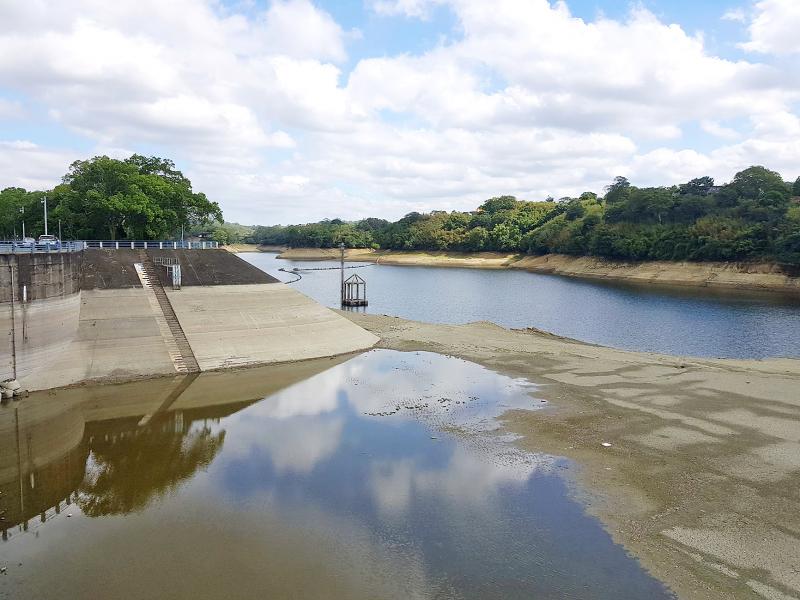
Photo: Peng Chien-li, Liberty Times 照片:自由時報記者彭健禮
In order to prepare for demand for water next year, the government has decided to implement three measures to control water usage. Firstly, starting from last Wednesday, night water pressure in the Taoyuan, Hsinchu and Miaoli areas was to be lowered from 11pm through to 5am the following day. Secondly, the irrigation of some areas of Taoyuan, Hsinchu and Miaoli was to be suspended, and farmers affected by the measures will receive government compensation. Thirdly, the Ministry of Economic Affairs is setting up a central drought response center to better respond to the crisis and to distribute water resources according to needs. Taiwanese are advised to take water-saving measures.
(Translated by Lin Lee-kai, Taipei Times)
台灣每年夏、秋兩季颱風頻繁,但詭異的是,今年截至目前為止,竟無任何一個颱風登陸台灣,造成水庫缺水問題。
這是因為全球暖化之影響,今年大平洋生成的颱風往北移,導致沒有任何一個颱風進來台灣,雖然陸續有鋒面及午後陣雨帶來雨量,但下雨範圍多為局部地區,導致水庫蓄水量較往年低。
水利署資料顯示,截至昨日下午二時為止,石門水庫蓄水量為百分之四十四,翡翠水庫蓄水量百分之六十二點三,曾文水庫蓄水率百分之三十一點三,三大水庫中有兩座儲水量低於五成。
為審慎因應明年用水需求,政府實施三項因應措施。第一,桃竹苗中自上週三起,每天晚上十一點至隔日清晨五點實施減壓供水;第二,桃竹苗部分地區的農田,將停止供灌,政府也會給予補償,維持農民生活;第三,經濟部將成立抗旱中央應變中心,拉高應變層級,做好調度節水,更請全民配合省水。
(自由時報)

In 2023, an 80-year-old woman in Taipei suffocated her paralyzed son after over five decades of caring for him. Turning herself in immediately, she confessed that worsening health and anxiety about who would care for him after her death had driven her to act. The court, acknowledging her difficult situation, sentenced her to two-and-a-half years in prison while recommending a presidential pardon. This rare judicial recommendation drew a complicated social response. Supporters argue that the mother’s half-century of caregiving renders her deserving of compassion instead of incarceration, believing that allowing her to live her final years in dignity and

A: Over 130,000 college graduates are about to enter the workforce upon graduation. B: According to a survey, the top 10 most desired careers among Taiwanese are: independent content creator, civil servant, information engineer, financial professional, medical worker, content planner, flight attendant, news anchor, designer and fitness trainer. A: What are the “dream jobs” for young Gen Zers? B: The top three for men are YouTuber, pro gamer and engineer. For women, they are writer, social media editor and YouTuber. A: Every profession has its champion. Just look at Taiwanese fire dancer Yang Li-wei — who was on fire

A: While AI is reshaping the world, “Money Talks News” revealed seven career fields that are “AI-proof.” First is the healthcare field, like nursing jobs, personal care aides, and social work specialists. B: This type of job is indeed in high demand. So what’s next? A: Up next are skill-based positions, like electricians, mechanics, and construction workers. Then there’s the field of education, like teachers, tutors, and education specialists. Fourth is the mental health field, like jobs in counseling, therapy, and social work. B: I didn’t expect teaching to be safe from AI. What else is

India has launched one of the world’s largest social policy experiments by transferring cash directly to housewives in recognition of their unpaid domestic labor. Across 12 states, an estimated 118 million adult women regularly receive 1,000 to 2,500 rupees (NT$348 to NT$871), equal to about 5% to 12% of household income. Surveys show Indian women devote nearly five hours per day to household tasks — over 7.6 times men’s contribution. This imbalance is a major factor in India’s low female labor force participation. Though modest in amount, the transfers symbolically acknowledge the hidden labor supporting families and society.


 RSS
RSS