


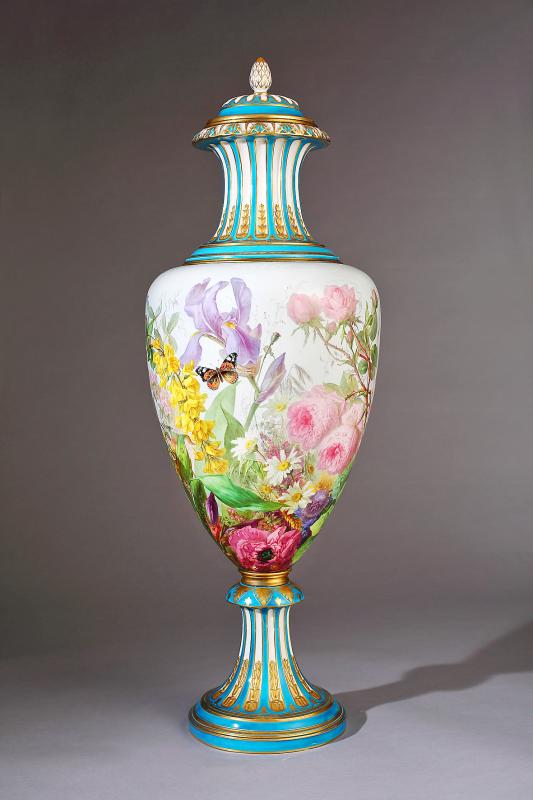
The New Taipei City Yingge Ceramics Museum has reopened, and the highlight is the launch of an exhibition entitled Subtropical Gardens: Painted Ceramics of Our Era. The exhibition features 43 sets of ceramics from private collections, including treasures of European royal kilns produced in the 19th and 20th centuries. Among the exhibits is a bronze dore (gilt bronze) porcelain ormolu-mounted large exposition vase previously displayed during the Exposition Universelle Paris World’s Fair of 1878. There will also be 36 sets of representative works from the Meizon Takano collection. The exhibition is on now and will run through Sept. 20.
According to the museum, the bronze dore large exposition vase is likely to be the most popular exhibit of all the pieces from private collections; the majestic piece is an excellent example of porcelains produced in the former royal factory of Sevres in Paris, France. The painted motifs are life-like and the glaze pigment has a gentle aesthetic, with the brightly painted butterfly fluttering among the flowers being extraordinarily realistic.
Another piece is the vase with blue ground and white glaze from the French royal kilns at Sevres, featuring flowers in a Napoleonic-era imperial blue ground and white glaze complementing gilt gold floral decorative elements, in addition to faces rendered in relief on two sides of the body of the vase, to impressive effect.
Photos courtesy of the Yingge Ceramics Museum 照片:鶯歌陶瓷博物館提供
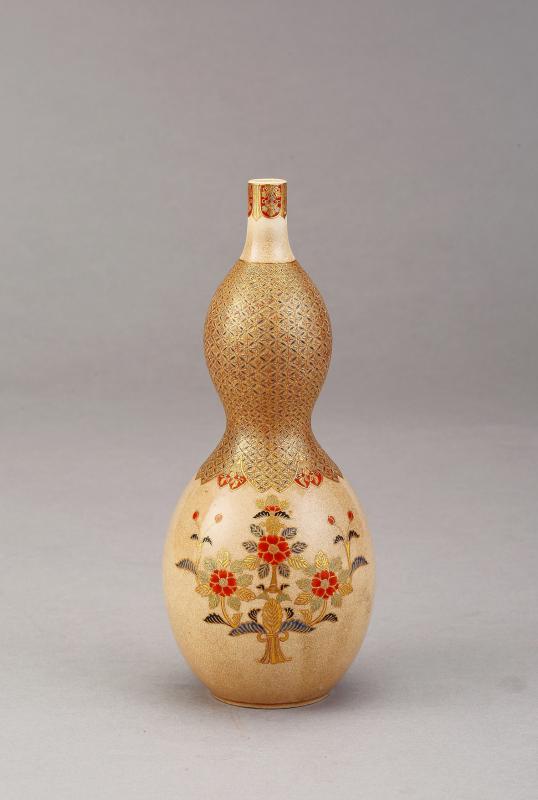
Of the Asian ceramics in the exhibition, the Kyoto Satsuma gourd-shaped vase with floral decor in gold from the Meizon Takano collection was originally used in the 1867 coronation of Emperor Meiji of Japan. The gourd shape is a symbol for preventing calamity; the sakura buds in the floral design are a metaphor for wealth in later life. These, together with the delicate gilt gold decorative technique used on the upper half of the vase, impart the distinctly understated yet luxuriant Japanese aesthetic.
The exhibition also features 18 classic works of painted pottery and ceramic from the Chinese Neolithic period all the way through the Han, Tang, Song, Jin and Yuan dynasties, and into the Ming and Qing, on loan from the National Museum of History. These are a must-see.
Museum director Wu Hsiu-tzu says that the more than 400 painted pottery works in this exhibition include pieces from the very origins of painted pottery, through exquisite works from the 19th and 20th centuries, and encompasses the development of the painted porcelain industry in Yingge during the 1970s, as well as creative works by modern ceramic artists using a range of painting techniques. Visitors to the museum will feel as if they were traveling in a time machine, going on a journey through the history of painted ceramics.
Photos courtesy of the Yingge Ceramics Museum 照片:鶯歌陶瓷博物館提供
(Translated by Paul Cooper, Taipei Times)
新北市鶯歌陶瓷博物館重新開館,由重頭戲「亞熱帶花園─彩繪陶瓷展」揭開序幕,展出私人藏家提供的四十三組,產自十九、二十世紀歐洲皇室御用瓷窯珍品,當中更包含一八七八年巴黎萬國博覽會上參展的《花卉大瓶》,此外,高野美術典藏的三十六組件代表作品,展覽即日起至九月二十日止。
陶博館表示,私人藏家提供的藏品,最引人注目的莫過於首次在台展出的《花卉大瓶》,氣勢磅礡的作品帶有強烈的賽弗爾瓷窯風格,畫風寫實、釉色柔美,羽色鮮豔的蝴蝶穿插在花叢之中,顯得格外的生動。
另外,從法國皇家賽弗爾瓷窯的《藍底白釉瓶》,以拿破崙時期的「帝王藍」底色、白釉的花朵搭配鍍金的枝葉作裝飾,瓶身兩側生動的人面雕飾,令人為之驚豔。
亞洲瓷器藏品的部分,高野美術典藏的《京薩摩金描木瓜寶相花瓢形花生》,是一八六七年明治天皇登基獻禮,瓢形帶有息災、櫻苞有納福的寓意,結合瓢形上部的細膩鎏金繪畫技術,帶出日式獨有的低調奢華感。
同時,國立歷史博物館借展十八件從中國新石器時代至漢、唐、宋金、元、明、清等的經典彩繪陶瓷,也很值得觀眾細細品味。
陶瓷博物館長吳秀慈表示,這次展出四百多組件彩瓷作品,包括彩繪陶瓷起源、十九到二十世紀彩繪精品、一九七○年代鶯歌彩瓷產業發展,以及現代藝術家運用各種彩繪技法的創作,觀眾來一趟陶博館,仿佛搭上時光機,輕鬆走過彩繪陶瓷的歷史風貌。
(自由時報)
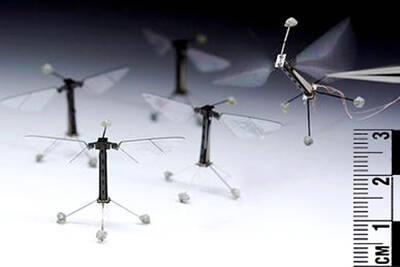
As bee populations around the world continue to decline at an alarming rate, scientists are developing an innovative solution: robotic bees. Recent advances at research institutions like Massachusetts Institute of Technology (MIT) in the US have produced tiny flying robots capable of performing pollination tasks similar to those of real bees. These tiny machines represent an impressive technological achievement. MIT’s latest models can hover in the air for over 1,000 seconds and perform complex movements, demonstrating the agility needed for successful pollination. The robots are designed to mimic the flight patterns of natural bees, offering potential support to agriculture

A: Taiwan legalized same-sex marriage on May 24, 2019, so this week marks the seventh anniversary of that milestone. By the end of 2024, a total of 32,126 LGBT couples had tied the knot. B: How many of them got married to foreign partners? A: In 2024, there were 504 cross-border same-sex marriages. By the end of that year, there were 130 cross-strait same-sex marriages between Taiwanese and Chinese — accounting for only about 0.4 percent of the total. B: I’ve heard that a seven-year marriage brings the “seven-year itch.” I bet some couples regret their decisions now. A:

A: While Taiwan is celebrating the 7th anniversary of legalizing same-sex marriage, a poll shows that the support rate for same-sex marriage rose sharply from 37.4 percent seven years ago to 69.9 percent last year. B: Actually, I’m a bit curious about the size of Taiwan’s LGBT population. A: I’m not sure. But if we take a Gallup poll in the US as an example, 9.3 percent of American adults identified as LGBT in 2024. B: Wow, is it because the Americans are relatively open? In many other countries, the figures hover around 5 percent. A: Based on this,

As climate change and urbanization push city temperatures higher, walking outdoors is becoming increasingly uncomfortable in many parts of the world, especially when prolonged time spent in sunlight is involved. As a result, outdoor lovers are now seeking cooler, shaded walking routes. However, most mainstream map apps still do not __1__ shaded footpaths. Enter routing.osm.ch — a Swiss web-based route planner that introduces a novel solution to this problem. Its “Vampire mode,” named after the legendary creatures’ fear of being __2__ natural light, was developed by a Swiss research team led by Professor Stefan Keller. The platform combines open data from


 RSS
RSS