


Thousands of people, many dressed for a traditional masked ball, crowded into Saint Mark’s Square on Sunday to witness “the flight of the angel,” the opening event of the annual Venice Carnival.
The first Sunday of the carnival, a young woman chosen as “Marie” has the honor of performing the stunt, gliding through the air on a harness attached to a cable from the 99m bell-tower of Saint Mark’s Basilica to a stage below.
As she soars overhead, the angel tosses confetti at the onlookers below.
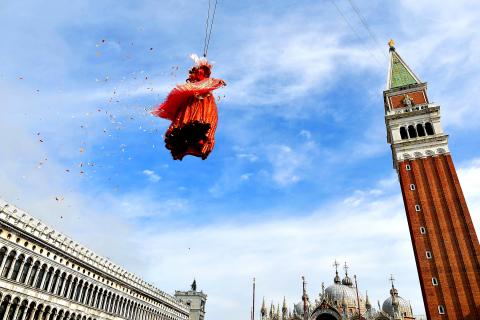
Photo: AFP
照片:法新社
“This is pure energy, I feel the energy rise from my feet as if I’m floating on air,” this year’s angel Linda Pani told AFP-TV.
“It was extraordinary, I felt the wind, the sea, the ground and the fire in me,” she added, describing the experience as “perhaps the happiest three minutes of my life.”
The centuries-old Venice Carnival, rooted in Christian festivities ahead of the fasting period of Lent, attracts crowds of foreign and Italian tourists to its masked balls and theatrical performances.
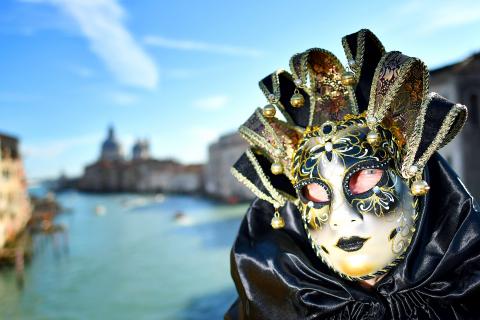
Photo: AFP
照片:法新社
The carnival, which lasts until Feb. 25, was created in Venice in 1162, the day after a military victory.
(AFP)
數千人上週日湧入聖馬可廣場──其中許多人是一身傳統化妝舞會的行頭──來見證「飛翔的天使」,為一年一度的威尼斯狂歡節揭開序幕。
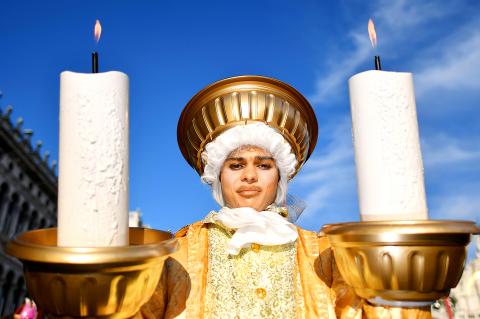
Photo: AFP
照片:法新社
狂歡節的第一個星期日,獲選為「瑪麗」的年輕女子,肩負表演此絕技的榮譽──吊掛著從聖馬可大教堂九十九公尺高的鐘樓沿纜線一滑而下,抵達廣場上的舞台。
她由眾人頭頂飛過,一邊向仰望的群眾灑下五彩碎紙。
今年獲選擔任天使的琳達‧帕尼對法新社電視台說:「這純粹是種能量,我感覺到腳下升起一股能量,讓我就像飄浮在空中一樣」。
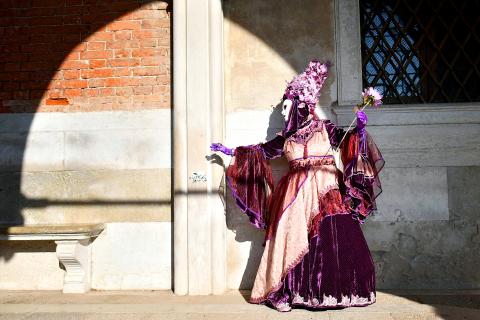
Photo: AFP
照片:法新社
「這真是美妙絕倫,我感覺到自己內在有風、海、土地與火」,她補充說,這段體驗「也許是我一生中最快樂的三分鐘」。
有數百年歷史的威尼斯狂歡節,源於齋期前的基督宗教慶典活動。威尼斯狂歡節的面具化妝舞會與戲劇表演,吸引了義大利國內外眾多遊客。
將於二月二十五日落幕的威尼斯狂歡節,首次舉行是在西元一一六二年,打了一場勝仗後的次日。
(台北時報林俐凱譯)
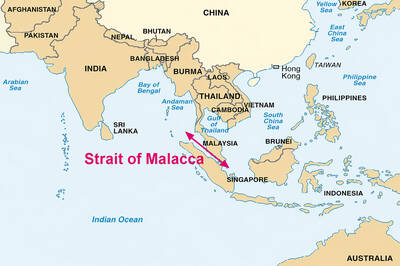
The closure of the Strait of Hormuz has forced policymakers in Asia to face questions over the security of other maritime chokepoints, including the Strait of Malacca, which is the world’s busiest waterway for international trade. WHAT IS THE MALACCA STRAIT? The 900km long Malacca Strait, bounded by Indonesia, Thailand, Malaysia and Singapore, provides the shortest sea route from East Asia to the Middle East and Europe. It carries nearly 22 percent of the world’s maritime trade, according to the Center for Strategic and International Studies (CSIS). This includes oil and gas shipments from the Middle East to the energy-hungry economies of China,
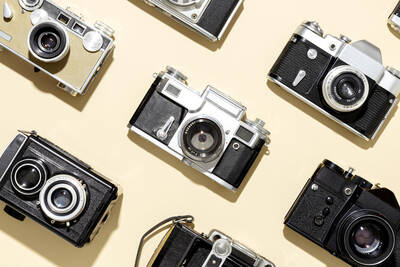
Cameras are everywhere — in our pockets, on our walls and even in space. They capture emotions, preserve history and reflect culture. Through these devices, photography is now essential to modern life, influencing how we perceive ourselves and the world. To understand the root of their power, let’s explore the camera’s remarkable journey. The story begins with the camera obscura, a dark room with a tiny hole. Light passing through the opening projected an inverted image on the opposite wall. Renaissance artists used this principle to paint accurate scenes. However, these images couldn’t be preserved as photographs. That changed
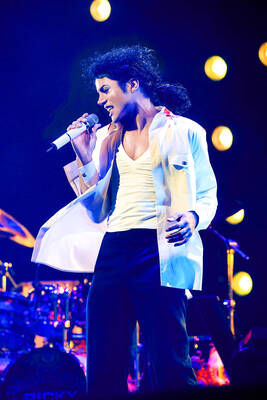
A: This year’s two most anticipated films have finally hit theaters in Taiwan. “Michael” premiered last Wednesday, while “The Devil Wears Prada 2” premiered this Wednesday ahead of its global release. B: Isn’t “Michael” the biopic about the late King of Pop Michael Jackson? A: Yup, it tells the story of Michael’s legendary life, from child star to global icon. And the role is in fact played by his nephew, Jaafar Jackson. B: Michael caused a sensation when touring Taiwan twice in 1993 and 1996. His classic hits, dance moves and music videos reshaped global pop culture at that time. A: I’m gonna
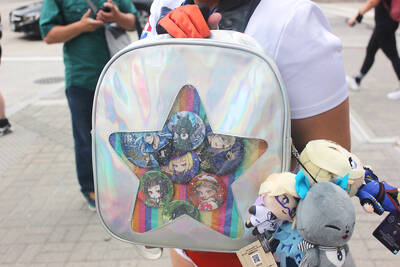
對話 Dialogue 華華:欸,你最近有沒有發現,路上很多人背的包包上還有一個透明的小包包? Huáhua: Èi, nǐ zuìjìn yǒu méiyǒu fāxiàn, lùshàng hěn duō rén bēi de bāobāo shàng hái yǒu yí ge tòumíng de xiǎo bāobāo? 清清:我上次去逛街,也注意到了。我看到好多人把吊飾、照片或娃娃什麼的放進小包裡,掛在包包上。那叫什麼啊? Qīngqīng: Wǒ shàngcì qù guàngjiē, yě zhùyì dào le. Wǒ kàndào hǎo duō rén bǎ diàoshì, zhàopiàn huò wáwa shénme de fàng jìn xiǎo bāo lǐ, guà zài bāobāo shàng. Nà jiào shénme a? 華華:聽說有兩種,一種叫「痛包」,一種叫「娃包」或「曬娃包」。 Huáhua: Tīngshuō yǒu liǎng zhǒng, yì zhǒng jiào “tòngbāo”, yì zhǒng jiào “wábāo” huò “shàiwábāo”. 清清:「痛包」這個說法我聽過,就是在包包上大量展示自己喜歡的東西。但「曬娃包」還是第一次聽到。為什麼叫「曬娃包」? Qīngqīng: “Tòngbāo” zhège shuōfǎ wǒ tīng guò, jiù shì zài bāobāo shàng dàliàng zhǎnshì zìjǐ xǐhuān de dōngxi. Dàn “shàiwábāo” háishì dì yí cì tīng dào. Wèishéme jiào “shàiwábāo”? 華華:因為很多人會把自己喜歡的娃娃放進透明包裡,帶出去拍照,曬給大家看。 Huáhua: Yīnwèi hěn


 RSS
RSS