


Children who experience severe deprivation early in life have smaller brains in adulthood, researchers have found.
The findings are based on scans of young adults who were adopted as children into UK families from Romania’s orphanages that rose under the regime of the dictator Nicolae Ceausescu.
Now experts say that despite the children having been adopted into loving, nurturing families in the early 1990s, the early neglect appears to have left its mark on their brain structures.
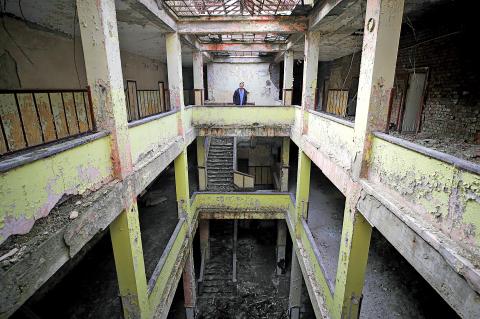
Photo: AP
照片:美聯社
“I think the most striking finding is … that the effects on the brain have persisted,” said Prof Edmund Sonuga-Barke, a co-author of the study from King’s College London, who added that the results showed neuroplasticity had limits.
“The idea that everything is recoverable, no matter what your experience … isn’t necessarily true — even with the best care you can still see those signs of that earlier adversity,” he said.
The plight of the undernourished children, who had little social contact and received insufficient care, shocked the world when it came to light after the fall of the communist government in 1989. Ceausescu’s oppressive policies had banned abortion and contraception, while those without children were taxed. As a result, large numbers of children ended up in orphanages living in terrible conditions.
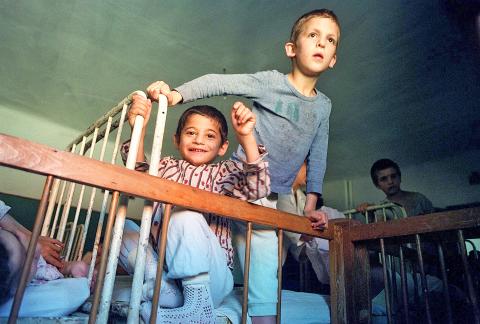
Photo: AFP
照片:法新社
Previous studies involving the adoptees have shown they had marked cognitive difficulties as children — although these improved considerably into adulthood — while they also had high rates of conditions including attention deficit hyperactivity disorder (ADHD) and, as adults, high levels of anxiety and depression.
Writing in the journal Proceedings of the National Academy of Sciences, Sonuga-Barke and colleagues told how they carried out brain scans and other measures of 67 Romanian adoptees who had spent between three and 41 months living in severe deprivation as children. At the time of the scans the adoptees were between 23 and 28 years old.
The team also took brain scans from 21 adults of a similar age who had been born and adopted in the UK before they were six months old. The results revealed the Romanian adoptees had on average an 8.6 percent smaller brain overall than their UK peers. The team also found the size of the reduction was linked to the length of time spent in the Romanian orphanages: each additional month was linked to a 3cm3 lower total brain volume. “The more deprivation they had, the smaller their brains are,” said Sonuga-Barke.

Photo: AP
照片:美聯社
The team’s analysis showed the smaller brain size explained the reduced IQ and, at least in part, the higher rates of ADHD found among the Romanian adoptees.
Prof Denis Mareschal, from Birbeck, University of London, said the study highlighted the importance of providing enriched environments in early infancy and childhood.
(The Guardian)
研究人員發現,幼年時受到嚴重剝奪的兒童,在成年後,其大腦較小。
這項發現是根據一些年輕人的腦部掃描,他們幼時被收留在羅馬尼亞獨裁者尼古拉‧希奧塞古政權所設立的孤兒院,後來被英國家庭收養。
專家們如今說,即便這些孩子已在一九九○年代初被充滿愛心的家庭收養、受到悉心照顧,但幼時的疏於照料,似乎已在他們的大腦結構留下了印記。
這項研究的共同作者、倫敦大學國王學院的艾德蒙‧索努加─巴克教授表示:「我認為最顯著的發現是……對大腦所造成的影響持續存在」。他補充說,研究結果顯示,「神經可塑性」是有其侷限的。
他說:「認為無論經歷了什麼,一切都得以康復……這種觀念不見得是正確的──即便〔後來〕受到最好的照顧,你還是可以看到幼時的苦難所留下的痕跡」。
這些營養不良、少有社會接觸、得不到足夠照料的兒童,其慘況在一九八九年共產黨政府垮台後曝光,震驚了世界。希奧塞古的苛政禁止墮胎及避孕,沒有孩子的人則被課稅。結果造成大量兒童淪落孤兒院,生活在惡劣的環境中。
先前對這些被收養者的研究顯示,他們在兒童時期就有明顯的認知困難(雖然這些問題在成年後已有顯著改善),也有很高的機率患有注意力不足過動症(ADHD),以及在成年後患有焦慮及憂鬱症。
索努加─巴克及其同仁在《美國國家科學院院刊》上寫道,他們對六十七名羅馬尼亞被收養者進行腦部掃描和其他測量,這些被收養者童年時曾生活在嚴重缺乏照顧的情況中,為期三個月至四十一個月不等。他們在接受腦部掃描時,年齡在二十三至二十八歲之間。
研究小組另外也對二十一個年齡相仿的成人進行了腦部掃描,這些人是在英國出生,並在六個月大之前被收養。
結果顯示,被收養的羅馬尼亞人,其大腦之平均大小,比那組英國同齡者小了百分之八點六。研究小組還發現,大腦所減少的體積,與在羅馬尼亞孤兒院中所待的時間長短有關:在孤兒院的時間每增加一個月,大腦的總體積便減少三立方公分。索努加─巴克說:「他們被剝奪得越多,大腦就越小」。
研究小組的分析顯示,較小的大腦可解釋為何其智商較低,以及至少部分解釋了,為何被收養的羅馬尼亞人患有ADHD的比率較高。
倫敦大學伯貝克學院的丹尼斯‧馬勒沙教授說,這項研究凸顯出在嬰幼兒早期與兒童時期提供富足環境的重要性。
(台北時報林俐凱編譯)
Follow up
讀後練習
Did you know?
Babies raised with insufficient stimulation due to a lack of human contact will often self-stimulate, such as hand flapping or rocking back and forth. Children who spent time in Romanian orphanages and who displayed these characteristics were often misdiagnosed as having mental disabilities.
According to attachment theory, an infant needs to develop a relationship with at least one primary caregiver for the child’s successful social and emotional development. The children in the Romanian orphanages were denied the opportunity to develop such a relationship.
(Lin Lee-kai, Taipei Times)

In 2023, an 80-year-old woman in Taipei suffocated her paralyzed son after over five decades of caring for him. Turning herself in immediately, she confessed that worsening health and anxiety about who would care for him after her death had driven her to act. The court, acknowledging her difficult situation, sentenced her to two-and-a-half years in prison while recommending a presidential pardon. This rare judicial recommendation drew a complicated social response. Supporters argue that the mother’s half-century of caregiving renders her deserving of compassion instead of incarceration, believing that allowing her to live her final years in dignity and

★ Bilingual Story is a fictionalized account. 雙語故事部分內容純屬虛構。 The mango looked perfect. It sat on the fruit stand like a small sunset, red on one side and gold on the other. “I’ll take this one,” said Daniel. The fruit seller shook her head. “Not that one.” Daniel was surprised. “Why not? It looks beautiful.” “Yes,” she said, “but beautiful is not always ready.” She picked up another mango and held it near his nose. “First, smell here.” Daniel smelled the top of the mango. It was sweet and warm. “Good mangoes have a smell,” she said. “Next, feel the weight.”

Put the Cart Before the Horse 本末倒置 Iris: I think I’m in love. Carl: What? Iris: We just have so much in common. We like all of the same things. Carl: Yes, but you’ve only chatted with him online. Iris: It doesn’t matter. I know we’ll end up getting married. Carl: I’m afraid you’re putting the cart before the horse. You should at least meet him first. Iris: OK, OK. I’ll do that. 艾瑞絲: 我想我戀愛了。 卡 爾: 什麼? 艾瑞絲: 我們就是有那麼多的共通點。我們喜歡的東西都一樣。 卡 爾: 是沒錯,不過妳和他只在網路上聊過天而已。 艾瑞絲: 那不重要。我知道我們最後一定會步入禮堂。 卡 爾: 妳恐怕是本末倒置了吧。妳至少應該先跟他見個面。 艾瑞絲: 好啦,好啦。我會的啦。 A tough cookie 強悍的人∕堅強的人 Tracy: I heard you went out with Iris last night. Justin: Yeah. We

A: Over 130,000 college graduates are about to enter the workforce upon graduation. B: According to a survey, the top 10 most desired careers among Taiwanese are: independent content creator, civil servant, information engineer, financial professional, medical worker, content planner, flight attendant, news anchor, designer and fitness trainer. A: What are the “dream jobs” for young Gen Zers? B: The top three for men are YouTuber, pro gamer and engineer. For women, they are writer, social media editor and YouTuber. A: Every profession has its champion. Just look at Taiwanese fire dancer Yang Li-wei — who was on fire


 RSS
RSS