


Side by side, the Allies and former enemy Germany together marked the 75th anniversary of one of the most important battles in World War II, the Battle of the Bulge, which stopped Adolf Hitler’s last-ditch offensive to turn the tide of the war.
At dawn on Dec. 16, 1944, over 200,000 German soldiers started the most unexpected breakthrough through the dense woods of Belgium and Luxembourg’s hilly Ardennes. Making the most of the surprise move, the cold, freezing weather and wearied US troops, the Germans pierced the front line so deeply it came to be known as the Battle of the Bulge.
Initially outnumbered, US troops delayed the attack enough in fierce fighting to allow reinforcements to stream in and turn the tide of the battle by Christmas. After a month of fighting, the move into Germany was unstoppable.

Photo: AFP
照片:法新社
Hitler had hoped the advance would change the course of World War II by forcing US and British troops to sue for peace, thus freeing Germany to focus on the rapidly advancing Soviet armies in the east. Yet somehow, the Americans blunted the advance and started turning back the enemy for good, setting Allied troops on a roll that would end the war in Europe less than five months later.
(AP)
同盟國和過去的敵人德國,肩並肩共同紀念「突出部之役」七十五週年。此為第二次世界大戰中最重要的戰役之一,粉碎了阿道夫‧希特勒想逆轉頹勢的最後一擊。

Photo: EPA-EFE
照片:歐新社
一九四四年十二月十六日破曉時分,二十多萬名德國士兵穿越比利時與盧森堡交界阿登丘陵的茂密森林,展開最令人措手不及的突襲。突擊行動、寒冷冰凍的天氣,再加上疲憊的美軍,德軍充分利用這樣的情勢進攻而穿透了前線,推進之深,讓此役被稱作「突出部之役」。
美軍最初的兵力寡不敵眾,但仍頑強抵抗、拖延德軍攻勢,撐到增援部隊趕來,而在耶誕節前扭轉了戰役的局勢。交戰一個月後,盟軍攻入德國已勢不可擋。
希特勒原本希望藉由這次進攻來迫使美英聯軍求和,以改變第二次世界大戰的進程,好讓德國能夠專心對付東面迅速逼近的蘇聯軍隊。但美軍卻想辦法阻擋了德軍的進攻,並讓德軍之後再也沒有反擊之地,於是盟軍連連獲勝,此後不到五個月便結束了二戰在歐洲的戰事。

Photo: Reuters
照片:路透
(台北時報林俐凱譯)
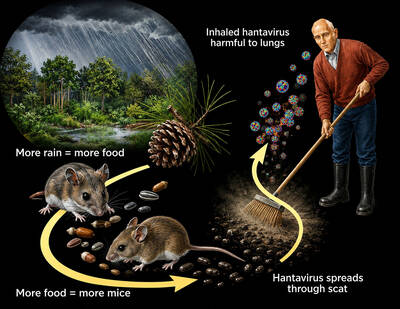
An outbreak aboard a cruise ship of a rare rodent-borne illness called hantavirus has left three passengers dead and sickened others, but global health officials say the risk to the general public remains low because the germ does not easily spread between people. “This is not the next COVID, but it is a serious infectious disease,” said Maria Van Kerkhove, director of epidemic and pandemic preparedness at the World Health Organization (WHO). “Most people will never be exposed to this.” The virus usually spreads when people inhale contaminated residue of rodent droppings. Hantaviruses have been around for centuries and are thought to

Have you ever wondered how people navigate the world when they can’t see a map? For individuals with visual impairments, conventional maps are nearly impossible to use. This is where tactile maps come in — essential tools that allow people to “see” the world through touch. A tactile map is specially designed with raised lines, textures, and symbols to represent geographical features such as roads, rivers, and buildings. Users explore it with their fingertips. However, these maps are not exclusively for people with visual disabilities. They serve as valuable multisensory learning tools that enhance spatial understanding for everyone, making

1. 他病了三天。 ˇ He has been sick for three days. χ He has been sick since three days. 註︰這裡現在完成時態 have / has been 表示從過去某一時日到現在的一段時間存在的行為或狀態,與它連用的時間副詞應為 「for +若干時」,如 for a year, for three hours 等,意思是歷時多少。 2. 他自從星期三以來都很忙。 ˇ He has been busy since Wednesday. χ He has been busy from Wednesday. 註︰「自從……以來」,該用 since。說從某一天(某一時刻)到某一天(某一時刻)才用 from,如 from Monday till Friday。 3. 房間角落裡散放著一些零星物件。 ˇ There were some odds and ends lying in the corner of the room. χ There were some odds and ends lying at the corner of the room. 註︰「在房間角落裡」該用介詞 in。例如: He stood in the corner. There is a lamp in the corner of the room. at the corner 指房子外部的拐角。例如: A little boy

A: In early May, there were concerts by Icyball, Chyi Yu, Korea’s EXO and Japan’s Anisama, but I missed them all. What a shame. B: That’s OK. There are shows coming up by various artists, including Power Station, Accusefive, Japanese singer Mika Nakashima, Chinese-Icelandic jazzer Laufey, and even Singaporean diva Stefanie Sun. A: After a 12-year hiatus, Stefanie is finally returning to Taipei again. B: In late May, there will be more shows by Crowd Lu, WeiBird, Korea’s Donghae, 2AM, EXID, and Thailand’s BUS. A: The Thai boyband is so popular. It looks like “T-pop” is catching up with J-pop


 RSS
RSS