


When the plans for the Taiwan Railway Administration’s (TRA) NT$79 million (US$2.6 million) 29 “Formosa Express” passenger tour carriages were revealed earlier this year, the designs were met with an avalanche of criticism. In response, TRA director Chang Cheng-yuan announced in April that the company would hold consultations on the design, and that the most vehement detractors would be invited to contribute.
Headed by designer Han Wu, the team of consultants brought together experts from various fields, and the award-winning Taiwanese design firm J. C. Architecture was invited to undertake an aesthetic makeover, designing the 13 cars yet to be converted.
Unveiled on Friday, the newly designed TRA Tour Train sports a black and orange exterior, imparting an air of gravitas to its new look. Redundant signs distracting from the minimalist interior design were removed, and soft lighting was introduced to create a comfortable, relaxing ambience, to give passengers the impression of being in a hotel.
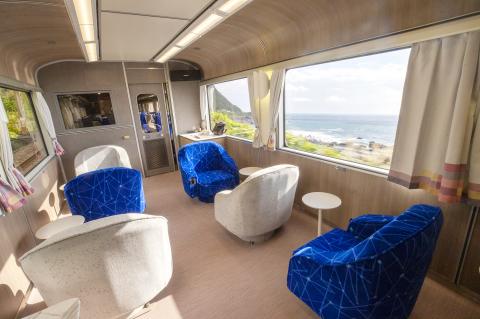
Photo: CNA
照片:中央社
The curtains in the carriages are based on the works of Yuma Taru, an aboriginal craftswoman, employing geometric shapes suggestive of mountains, while the upholstery utilizes blues and grays, a reference to Taiwan’s oceans, rocks and mountains. The overall effect goes beyond that of a simple means of transportation, and now has more of an emotional impact.
Commenting on why black and orange were chosen for the exterior, Nora Wang, co-founder of J. C. Architecture, says that black imparts a sense of mystery and sobriety, and that old photos of TRA train carriages show that black was widely used for train exteriors in the past. The orange, meanwhile, is a reference to the Chu Kuang Express train designs. The tour train’s black and orange theme is therefore a link to railway history, reinvented from and recombining older design elements.
Wang’s favorite design is the bar counter area, reminiscent of a hotel reception, featuring a small lamp on the dining table, giving boarding passengers the impression they are entering a hotel. Passengers get to experience the hotel-like service, too, reclining in the train’s parlor car accompanied by friends and family, leisurely sipping coffee. The windows offer magnificent ocean views to the east and vistas of rice paddies and mountains to the west.
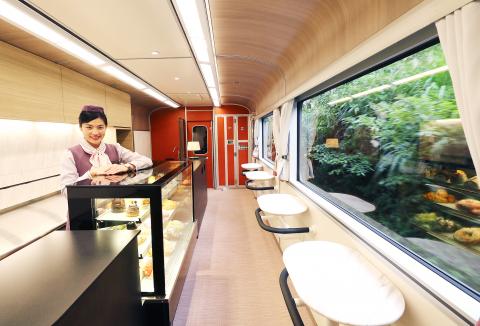
Photo: CNA
照片:中央社
Wang says, “The TRA train is not just a means of transportation, it is a starting point for a journey.” She hopes that the TRA Tour Train will help promote rail travel in Taiwan. Tour trains in countries such as Japan and Italy attract visitors from all over the world every year, and Wang believes Taiwan has the potential to be like this. “Taiwan’s landscape is so beautiful,” she says, and “some scenery can only be seen from the train.”
(Translated by Lin Lee-kai, Taipei Times)
台鐵局今年耗資新台幣七千九百萬元,打造二十九輛環島之星觀光列車,曝光後設計卻遭批評。台鐵局長張政源在今年四月宣布,成立台鐵美學設計諮詢審議小組,「把罵台鐵最凶的統統找來」。由設計師吳漢中為代表,齊聚各界專家,把二十九輛當中尚未施作完工的十三輛列車,邀請在國內外得過許多設計大獎的台灣設計團隊「柏成設計」,導入美學概念重新改造。
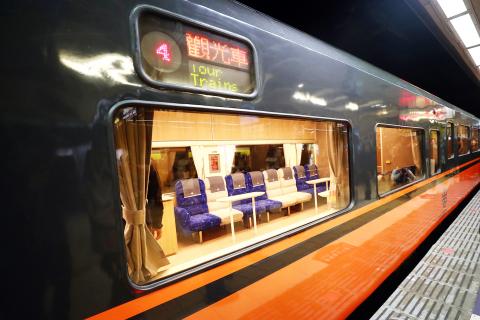
Photo: CNA
照片:中央社
新設計的台鐵觀光列車上週五亮相,外觀改用尊榮感十足的黑、橘色,內裝採減法設計,去掉多餘的指標,燈光使用溫和的色溫,讓旅客有如進到飯店的舒適氛圍。
車廂中的窗簾,是參考原住民工藝家尤瑪.達陸的作品,以幾何圖形堆疊出山脈造型;座椅顏色為藍、灰色,象徵台灣的海洋、石頭與山,讓火車不再只是生硬的交通工具,同時也富有情感。
列車外觀使用黑、橘二色,柏成設計合夥創辦人王菱檥表示,黑色具有神秘的尊榮感,尤其觀察過往台鐵車體照片時,發現有一段時期大量採用黑色設計,因此激盪出新的想法。經典橘色則是延續莒光號原有的橘,保有車輛的歷史,將舊元素重新組合,迸出新的設計火花。
有如飯店接待大廳的吧台區是王菱檥最喜愛的設計,餐桌台上放了一盞小燈,當旅客踏上這輛觀光列車時,感覺就像是踏進飯店一樣。跟親朋好友坐在客廳車,悠閒喝著咖啡,從觀景窗往外望,東邊有海岸線壯闊海景,西邊則有稻穗、山脈,帶給大家有如旅館式的服務體驗。
王菱檥說:「台鐵不只是交通工具,而是旅遊的起始點。」她希望未來可帶動民眾搭乘火車在島內旅遊的風氣,放眼各國的觀光列車如日本、義大利等,每年吸引全球民眾到訪,「相信台灣有這方面的潛力,台灣景觀太美了,有些景色只有坐火車才看得到」。(中央社)
Questions
1. Where is your favorite travel destination in Taiwan? How do you usually get there?
2. Do you like the design of the new TRA tour train? Why/why not? ?
3. Have you traveled by train abroad? How did the experience compare to traveling by train in Taiwan?
4. In your opinion, how does a tour train differ from a commuter train? How would you design a tour train if given the opportunity to do so??
(Lin Lee-kai, Taipei Times)
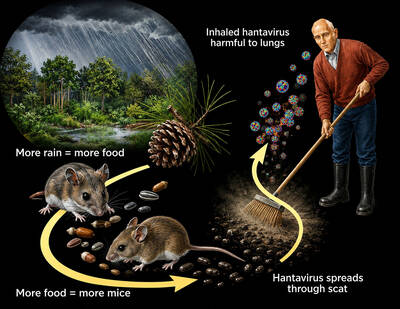
An outbreak aboard a cruise ship of a rare rodent-borne illness called hantavirus has left three passengers dead and sickened others, but global health officials say the risk to the general public remains low because the germ does not easily spread between people. “This is not the next COVID, but it is a serious infectious disease,” said Maria Van Kerkhove, director of epidemic and pandemic preparedness at the World Health Organization (WHO). “Most people will never be exposed to this.” The virus usually spreads when people inhale contaminated residue of rodent droppings. Hantaviruses have been around for centuries and are thought to
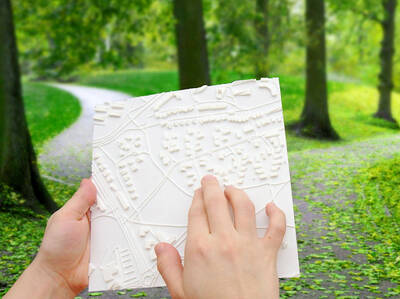
Have you ever wondered how people navigate the world when they can’t see a map? For individuals with visual impairments, conventional maps are nearly impossible to use. This is where tactile maps come in — essential tools that allow people to “see” the world through touch. A tactile map is specially designed with raised lines, textures, and symbols to represent geographical features such as roads, rivers, and buildings. Users explore it with their fingertips. However, these maps are not exclusively for people with visual disabilities. They serve as valuable multisensory learning tools that enhance spatial understanding for everyone, making

1. 他病了三天。 ˇ He has been sick for three days. χ He has been sick since three days. 註︰這裡現在完成時態 have / has been 表示從過去某一時日到現在的一段時間存在的行為或狀態,與它連用的時間副詞應為 「for +若干時」,如 for a year, for three hours 等,意思是歷時多少。 2. 他自從星期三以來都很忙。 ˇ He has been busy since Wednesday. χ He has been busy from Wednesday. 註︰「自從……以來」,該用 since。說從某一天(某一時刻)到某一天(某一時刻)才用 from,如 from Monday till Friday。 3. 房間角落裡散放著一些零星物件。 ˇ There were some odds and ends lying in the corner of the room. χ There were some odds and ends lying at the corner of the room. 註︰「在房間角落裡」該用介詞 in。例如: He stood in the corner. There is a lamp in the corner of the room. at the corner 指房子外部的拐角。例如: A little boy

A growing green movement allows hotel guests to fund tree planting projects simply by opting out of daily room cleans. This approach turns an ordinary hotel stay into a direct contribution to nature. Founded in the Netherlands, the nonprofit “Hotels for Trees” operates on the principle that one skipped cleaning equals one new tree. It has planted more than 750,000 trees since 2021. Similarly, Sarnia Hotels in Guernsey donates £2 per refused clean. Since 2024, over 3,300 services have been cancelled, raising sufficient money to plant 1,100 native trees and hedgerows. Simplicity has been central to this success.


 RSS
RSS