


In 1907, Georges Braque (1882-1963) visited Pablo Picasso’s (1881-1973) studio to see his new work Les Demoiselles d’Avignon, which was notorious at the time (see Bilingual Arts on Oct. 26 for photo). The two artists immediately built up a rapport and worked closely together until 1914, experimenting with new artistic styles.
The inconsistent perspective, disjointed body shapes, and the reference to traditional African masks in Les Demoiselles d’Avignon preluded Cubism. The works of Paul Cezanne (1839-1906), shown at retrospective exhibitions in 1903 and 1907, further indicated a set of visual methodologies, leading to the birth of Cubism. As Picasso put it, Cezanne was “the father of us all.”
Cezanne’s lesson to “treat nature in terms of the cylinder, the sphere, and the cone” was taken by the Cubists as a formula for reinterpreting what they saw in daily life. Subject matter included objects, landscapes, people and musical instruments, which the Cubists turned into geometric shapes and other variations on the theme, resulting in ambiguous and abstract appearances.
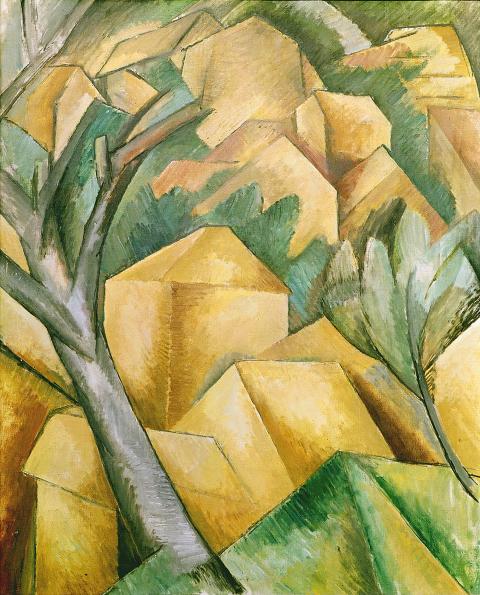
Photo: Wikimedia Commons
照片:維基共享資源
Cezanne’s influence can be seen more clearly in early Cubism. Comparing Braque’s Houses at L’Estaque (1908, photo 1) and Cezanne’s Houses in Provence: The Riaux Valley near L’Estaque (photo 2), we can see that Cezanne’s houses on the hill are depicted with simple cubes and shadows, just enough to communicate the sense of volume. In contrast, the hill and houses in Braque’s hands are minimalist and more cubic, like flattened cartons filling up the picture. The tree on the left was depicted with Cezannian cylinders.
The intial reception of Braque’s Houses at L’Estaque was negative: art critic Louis Vauxcelles called Braque a daring man who despises form, “reducing everything, places and figures and houses, to geometric schemas, to cubes.” This was where Cubism got its name from.
Cezanne is said to be the bridge connecting the 19th century’s Impressionism and the 20th century’s new line of artistic inquiry. Mill on the River (c. 1906, photo 3) demonstrates typical impressionist short, thick strokes of paint to create a highly blended finish. A similar technique can be seen in the greens in Braque’s The Castle in La Roche Guyon (1909, photo 4), yet the uneven and jumbled houses on the hill demonstrate the repetitiveness and variation of cubes, hinting at the more sophisticated Cubist compositions to come.
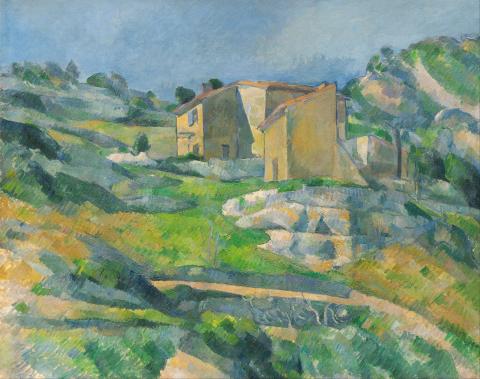
Photo: Wikimedia Commons
照片:維基共享資源
(Lin Lee-kai, Taipei Times)
一九○七年,喬治‧布拉克(一八八二~一九六三)造訪帕布羅‧畢卡索(一八八一~一九七三)的工作室參觀畢卡索當時惡名昭彰的新作《亞維儂的姑娘》(圖片請參見十月二十六日的「雙語藝術」),兩人一見如故,開啟了此後至一九一四年間對新風格的共同實驗。
《亞維儂的姑娘》所觸碰的畫面切割、不連貫的身體形狀,以及原始非洲面具,成為立體派的前奏。而一九○三及○七年的保羅‧塞尚(一八三九~一九○六)回顧展,更明確指出一套視覺方法學,催生了立體派,畢卡索即說道:「塞尚是我們所有人的父親」。
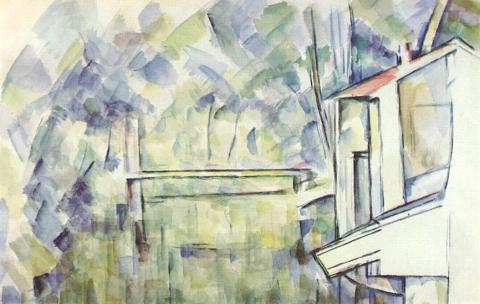
Photo: Wikimedia Commons
照片:維基共享資源
塞尚將自然形式簡化∕歸納為「圓柱體、球體和圓錐體」,立體派藝術家們便據此程式將週遭重新改造──物品、風景、人物、樂器等人們習以為常的事物,轉換為幾何形狀及其變奏,其面貌曖昧而抽象。
早期的立體派作品中,更可以看到這種從塞尚汲取的養份。比較布拉克的《埃斯塔克的房屋》(一九○八年)(圖一),以及塞尚的《普羅旺斯的房屋:埃斯塔克近郊之希奧谷》(一八八三年)(圖二),我們可以看到塞尚作品中山丘上的房舍,是以簡略的光影塑造出來的方塊體積來處理;而到了布拉克手中,山丘與房屋變得更簡略、更抽象、更方塊,像壓扁的紙盒填滿整個畫面。而布拉克畫幅左方的樹木,便是以塞尚所說的圓柱體構成。
布拉克的《埃斯塔克的房屋》最初即招致批評,藝評家路易‧沃克塞爾說布拉克膽大妄為、對形式不屑一顧,「把風景、人物和房子等一切都簡化成幾何圖形與方塊(cubes)」,立體派(Cubism)之名便是由此而來。
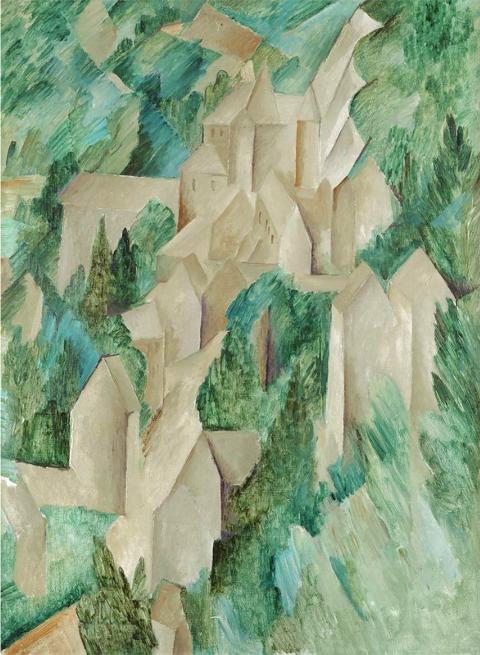
Photo: Wikimedia Commons
照片:維基共享資源
塞尚被認為是連接十九世紀印象派與二十世紀現代藝術的樞紐,《河畔的磨坊》(約一九○六年)(圖三)即可見印象派特有的以小面積色塊建構出的畫面整體。布拉克《拉侯舍吉永城堡》(一九○九年)(圖四)中的綠色樹木,也是筆觸重複堆疊而成,錯落的房屋呈現了立體方塊造型的重複與變奏,預示了立體派後來更複雜的構圖。
(台北時報林俐凱)
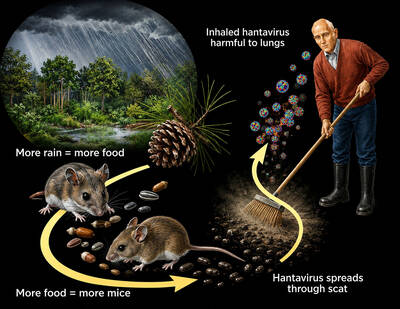
An outbreak aboard a cruise ship of a rare rodent-borne illness called hantavirus has left three passengers dead and sickened others, but global health officials say the risk to the general public remains low because the germ does not easily spread between people. “This is not the next COVID, but it is a serious infectious disease,” said Maria Van Kerkhove, director of epidemic and pandemic preparedness at the World Health Organization (WHO). “Most people will never be exposed to this.” The virus usually spreads when people inhale contaminated residue of rodent droppings. Hantaviruses have been around for centuries and are thought to
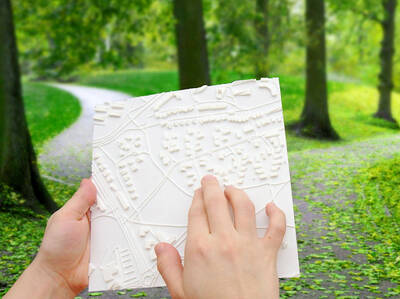
Have you ever wondered how people navigate the world when they can’t see a map? For individuals with visual impairments, conventional maps are nearly impossible to use. This is where tactile maps come in — essential tools that allow people to “see” the world through touch. A tactile map is specially designed with raised lines, textures, and symbols to represent geographical features such as roads, rivers, and buildings. Users explore it with their fingertips. However, these maps are not exclusively for people with visual disabilities. They serve as valuable multisensory learning tools that enhance spatial understanding for everyone, making

A growing green movement allows hotel guests to fund tree planting projects simply by opting out of daily room cleans. This approach turns an ordinary hotel stay into a direct contribution to nature. Founded in the Netherlands, the nonprofit “Hotels for Trees” operates on the principle that one skipped cleaning equals one new tree. It has planted more than 750,000 trees since 2021. Similarly, Sarnia Hotels in Guernsey donates £2 per refused clean. Since 2024, over 3,300 services have been cancelled, raising sufficient money to plant 1,100 native trees and hedgerows. Simplicity has been central to this success.
1. 他病了三天。 ˇ He has been sick for three days. χ He has been sick since three days. 註︰這裡現在完成時態 have / has been 表示從過去某一時日到現在的一段時間存在的行為或狀態,與它連用的時間副詞應為 「for +若干時」,如 for a year, for three hours 等,意思是歷時多少。 2. 他自從星期三以來都很忙。 ˇ He has been busy since Wednesday. χ He has been busy from Wednesday. 註︰「自從……以來」,該用 since。說從某一天(某一時刻)到某一天(某一時刻)才用 from,如 from Monday till Friday。 3. 房間角落裡散放著一些零星物件。 ˇ There were some odds and ends lying in the corner of the room. χ There were some odds and ends lying at the corner of the room. 註︰「在房間角落裡」該用介詞 in。例如: He stood in the corner. There is a lamp in the corner of the room. at the corner 指房子外部的拐角。例如: A little boy


 RSS
RSS