


One of the functions of the present perfect tense (“I have done”) is to say that something which happened in the past, and is now complete, has significance that stretches to the present. One simple example of this is the sentence “I have eaten a lot of food.” Here, the eating part has finished, but the point of the sentence is that the speaker is no longer hungry, or is feeling a little uncomfortable, or is worried about putting on weight, or is no longer able to eat a large meal, or is saying that they really enjoyed the meal. Note that the specific nature of the significance to the present is not explicitly stated. To simply communicate the fact of having eaten, the speaker could just say “I ate a lot of food,” using the past simple tense (“I did”).
Grammatically speaking, this also means that, when using the present perfect — when the result, and not the action itself, is the important thing — we should not use a specific time reference such as “yesterday” or “an hour ago.” Again, this is where the simple past is used: “I ate a lot of food yesterday.”
The above apply to both American and British English. However, the present perfect is used much more regularly in British English; the use of the simple past is commonly used to communicate this function of the present perfect in American English.
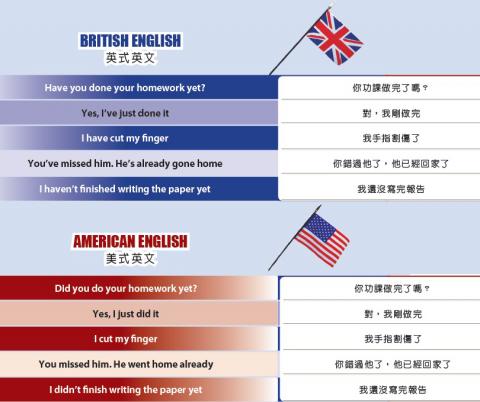
That is, an exchange in British English might go:
“Have you registered to vote yet?”
“Yes, I registered last week.”
In American English, the same exchange might be:
“Did you register to vote yet?”
“Yes, I registered last week.”
(Paul Cooper, Taipei Times)
現在完成式(例如「I have done」,我已經完成)的功能之一,是表示過去發生的事,現在已經完成,有從過去延伸到現在的意涵,例如「I have eaten a lot of food」(我已經吃了很多東西)這個簡單的句子。此處「吃」這個動作已經完成,但這句話的目的是表示說這話的人已經不餓了,或感覺有點不舒服,或擔心體重增加,或沒辦法多吃,或表示這頓飯吃得很開心。請注意,雖然此例句的過去完成式賦予它這些言外之意,但這句話字面上並未明確表達這些意義。若單純只是要表達已經吃過飯這個事實,只要說「I ate a lot of food」(我吃了很多食物)就可以了,所用的是簡單過去式(I did)。
就文法而言,這也表示我們不應把「yesterday」或「an hour ago」等時間參照用在現在完成式,因為現在完成式的重點是結果,而不是動作本身。時間參照是像這樣用在簡單過去式的句子:「I ate a lot of food yesterday」(我昨天吃了很多食物)。
以上的描述對美式和英式英文皆適用,但英式英文更常用現在完成式。在美式英文中,通常是以簡單過去式來表達現在完成式的這個功能。
這也就是說,一段對話在英式英文中大概會是這樣:
「Have you registered to vote yet?」(你登記投票了嗎?)
「Yes, I registered last week.」(對,我上週登記了。)
相同的對話用美式英文,可能會是這麼說的:
「Did you register to vote yet?」(你登記投票了嗎?)
「Yes, I registered last week.」(對,我上週登記了。)
(台北時報林俐凱譯)

The US-Israeli war with Iran, which began on Feb. 28, has killed thousands of people, destabilized the Middle East and rocked global energy markets by effectively closing the strait. WHAT IS THE STRAIT OF HORMUZ? Lying between Oman and Iran and linking the Gulf north of it with the Gulf of Oman to the south and the Arabian Sea beyond, the strait is 33km wide at its narrowest point, with a shipping lane just 3km wide in either direction. Perhaps the world’s most important energy shipping channel, the waterway is about 167km long. Following through on an old threat, Tehran effectively closed the strait

Have you ever found yourself desperately feeding coins into a claw machine just because you’ve already spent so much trying to win that stuffed animal? Or maybe you’ve continued watching a boring movie simply because you already paid for the ticket? If so, you’ve experienced the “sunk cost fallacy.” A sunk cost refers to time, money or effort that has already been spent and cannot be recovered. This psychological trap is surprisingly common. You might keep playing a video game you no longer enjoy because you’ve invested countless hours in building your character, or maintain a toxic friendship because you’ve known

A: Which TV drama series have been global hits so far this year? B: The US drama “Stranger Things 5,” South Korean drama “Can This Love Be Translated?” and Chinese megahit “Pursuit of Jade” are all popular lately. A: Isn’t “Pursuit of Jade” the costume idol drama about the romance between a charming marquis and a pig-slaughterer? Actor Zhang Linghe and actress Tian Xiwei are both so attractive. B: Plus, Netflix’s Korean-Japanese gay romance drama “Soul Mate” — starring Korea’s Ok Taec-yeon and Japan’s Hayato Isomura — is set to premiere in May. A: These hit international dramas

1. 他甚至還自認為是個了不起的領導人。 ˇ He even went so far as to think himself a great leader. ˇ He even went so far as to think of himself as a great leader. χ He even went so far as to think himself as a great leader. 註:認為某人或某事為何等樣人或何等樣事,可用 think+受詞+受詞補語,或 think of ... as ...,正句第一句比第二句普遍些。用了 of,後面用 as;沒有 of,就不可以用 as。又如: I thought him quite a joke. I thought of him as quite a joke. 2. 你不應該打擾他休息。 ˇ You should not intrude upon him during his time off. χ You should not intrude him during his time off. 註:intrude 作「闖進」、「打擾」、「侵入」解時,是不及物動詞,後面跟 upon。 3. 男孩正在玩陀螺。 ˇ The boy is playing with his top. χ


 RSS
RSS