


In 372 BC, Alexander the Great advanced his troops over the Gandhara Kingdom in northwestern India, which would be the eastern boundary of the Alexandrian Empire. After Alexander’s death, his empire, stretching out across three continents, Europe, Asia, and Africa, was divided and ruled by his generals, during what has become known as the Hellenistic period.
The ancient state of Gandhara, located on the banks of the Indus River, encompassed present-day northwest India, northwest Pakistan and eastern Afghanistan. From 180 BC to 110 AD, Gandhara was split into several dynastic polities, loosely described as the Indo-Greek Kingdom.
Alexander’s fusion policy, including marriage between Greek soldiers and conquered locals, fused together traditional ancient Greek culture with the colony’s local culture, changing both of them and spawning the Hellenistic civilization. (The Nike of Samothrace discussed on Jan. 26 in Bilingual Arts is a well-known Hellenistic sculpture.)
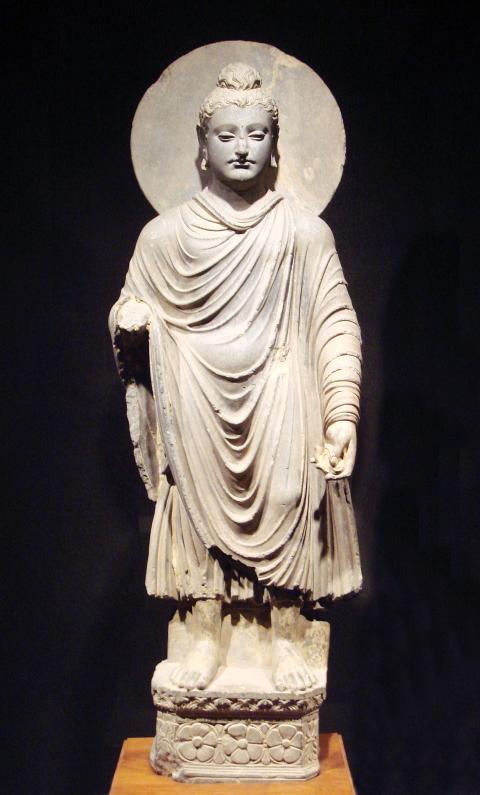
Photo: Wikimedia Commons
照片:維基共享資源
Buddhism was founded in the sixth century BC, and Buddha was born in the border region of modern-day Nepal and India. In the beginning, Buddhists did not worship Buddha’s imagery; instead, Buddha was depicted indirectly or symbolically with footprints, the Bodhi tree, wheels and so on.
The first anthropomorphic representations of Buddha were developed between the second century BC and the first century AD in the Indo-Greek Kingdom, after the spread of Buddhism to the area. The Buddha represented by the statues were in Hellenistic himation dress, with a drape and posture that were typically Greek — were it not for small details such as the topknot and long earlobes that represented Buddha. [Photo 1]
The Greeks naturally applied their unparalleled craftsmanship of realism to visualize Buddha. Thus, Buddha, Bodhisattvas and dharmapalas were depicted like the gods in Greek mythology, representing the gods in human form. [Photo 2 and 3]
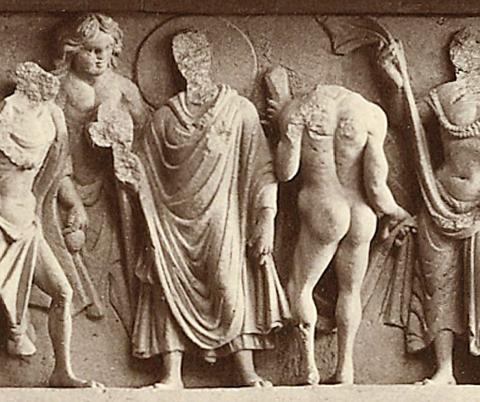
Photo: Wikimedia Commons
照片:維基共享資源
The Gandharan Buddhist art that was born through the fusion of Greek culture and Buddhism was the first paradigm of Buddhist imagery, which would later spread throughout Asia with the spread of Buddhism.
In the Bamiyan Valley of Afghanistan, there were two monumental statues of Buddha carved into the side of a cliff, and they were 53m and 35m tall, respectively. Built in the sixth century BC, the statues represented classic Gandaran art. They were the tallest standing Buddha statues in the world, designated as a UNESCO World Cultural Heritage Site. However, in 2001, the Buddhas of Bamiyan were blown up by the Taliban regime and were completely destroyed. [Photo 4]
(Lin Lee-kai, Taipei Times)
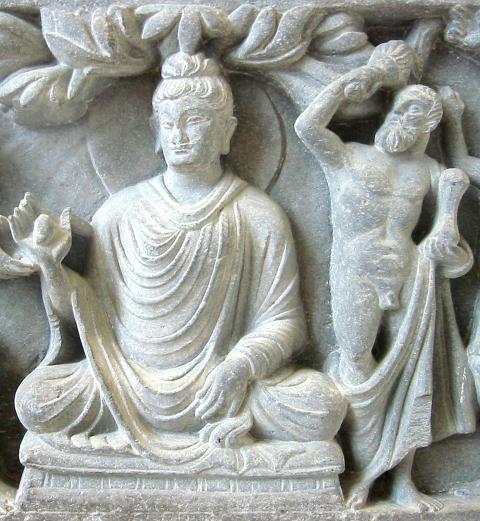
Photo: Wikimedia Commons
照片:維基共享資源
西元前三二七年,馬其頓國王亞歷山大率軍推進印度西北部的犍陀羅王國,這便是亞歷山大帝國的極東疆界。亞歷山大死後,其橫跨歐、亞、非三洲的帝國版圖由其將領分據,建立王國統治,史家稱為希臘化世界。
位於印度河畔的犍陀羅,其範圍約在今印度西北、巴基斯坦西北及阿富汗東部。西元前一八○年至西元一○年,該地區分裂成數個小國,統稱為印度-希臘王國。
亞歷山大所建立的文化融合、異族通婚政策,使希臘本土的文化傳到殖民地後,與當地的文化融合、互相發明,所產生的文化,便稱為希臘化文化。(希臘化文化現存名作《勝利女神像》之介紹,可參見一月二十六日的「雙語藝術」單元。)
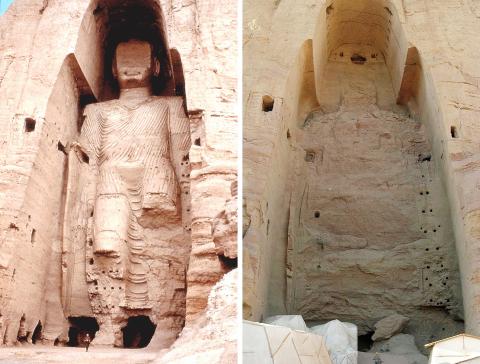
Photo: Wikimedia Commons
照片:維基共享資源
佛教創立於西元前六世紀(約為中國的春秋時代),創教者釋迦牟尼佛出生於今印度北部與尼泊爾邊境。原始佛教並未將佛陀具象化來膜拜,頂多是以佛的腳印、菩提樹、法輪等間接或抽象的形式,來代表佛陀。
佛教傳到印度-希臘王國後,大約在西元前二世紀至西元一世紀之間,開始出現了佛陀的造像——身著希臘式衣袍——要不是因為有髮髻、垂肩大耳等代表佛陀的特徵,其衣著姿態看起來就像是希臘雕塑。【圖一】
希臘工藝舉世無雙的寫實技術,應用在佛陀的形象化,想來理所當然。於是,呈現佛陀與護法菩薩的方式,便像是希臘神話中的諸神,將神與人的形象合一。【圖二、圖三】
希臘文化和佛教文化融合而產生的犍陀羅式佛像,是佛教造像的最初典範,隨著佛教的傳布開枝散葉,影響亞洲各地。
阿富汗的巴米揚谷,有兩尊大佛沿著山崖鑿出,分別高五十三公尺及三十五公尺,建於西元六世紀,是犍陀羅式佛像的代表,也是世界上最高的站立佛像,被聯合國教科文組織登錄為世界文化遺產。然而,巴米揚大佛已在二○○一年被塔利班政權炸毀,完全消失。【圖四】
(台北時報林俐凱)
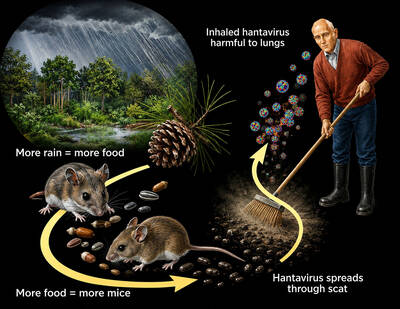
An outbreak aboard a cruise ship of a rare rodent-borne illness called hantavirus has left three passengers dead and sickened others, but global health officials say the risk to the general public remains low because the germ does not easily spread between people. “This is not the next COVID, but it is a serious infectious disease,” said Maria Van Kerkhove, director of epidemic and pandemic preparedness at the World Health Organization (WHO). “Most people will never be exposed to this.” The virus usually spreads when people inhale contaminated residue of rodent droppings. Hantaviruses have been around for centuries and are thought to
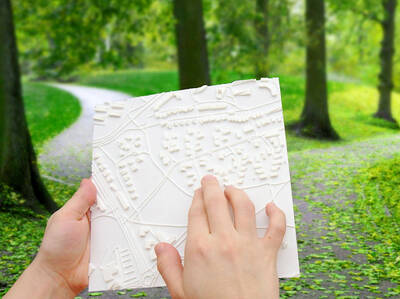
Have you ever wondered how people navigate the world when they can’t see a map? For individuals with visual impairments, conventional maps are nearly impossible to use. This is where tactile maps come in — essential tools that allow people to “see” the world through touch. A tactile map is specially designed with raised lines, textures, and symbols to represent geographical features such as roads, rivers, and buildings. Users explore it with their fingertips. However, these maps are not exclusively for people with visual disabilities. They serve as valuable multisensory learning tools that enhance spatial understanding for everyone, making

A growing green movement allows hotel guests to fund tree planting projects simply by opting out of daily room cleans. This approach turns an ordinary hotel stay into a direct contribution to nature. Founded in the Netherlands, the nonprofit “Hotels for Trees” operates on the principle that one skipped cleaning equals one new tree. It has planted more than 750,000 trees since 2021. Similarly, Sarnia Hotels in Guernsey donates £2 per refused clean. Since 2024, over 3,300 services have been cancelled, raising sufficient money to plant 1,100 native trees and hedgerows. Simplicity has been central to this success.

1. 他病了三天。 ˇ He has been sick for three days. χ He has been sick since three days. 註︰這裡現在完成時態 have / has been 表示從過去某一時日到現在的一段時間存在的行為或狀態,與它連用的時間副詞應為 「for +若干時」,如 for a year, for three hours 等,意思是歷時多少。 2. 他自從星期三以來都很忙。 ˇ He has been busy since Wednesday. χ He has been busy from Wednesday. 註︰「自從……以來」,該用 since。說從某一天(某一時刻)到某一天(某一時刻)才用 from,如 from Monday till Friday。 3. 房間角落裡散放著一些零星物件。 ˇ There were some odds and ends lying in the corner of the room. χ There were some odds and ends lying at the corner of the room. 註︰「在房間角落裡」該用介詞 in。例如: He stood in the corner. There is a lamp in the corner of the room. at the corner 指房子外部的拐角。例如: A little boy


 RSS
RSS