


Hundreds of thousands of Filipinos joined an annual procession in Manila, the Philippine capital, to kiss or touch a centuries-old black wooden statue of Jesus Christ, believed to have miraculous healing powers, in a grand display of Catholic devotion on Wednesday.
The devotees, mostly walking barefoot, surrounded the carriage bearing the life-sized image of the “Black Nazarene” shouldering a heavy cross as it paraded through the city. Many of them, in yellow and maroon shirts, threw white towels to people on the carriage to wipe on the statue, while others jostled to touch the thick ropes used to pull the carriage, believing the slightest touch would bless and heal their illnesses.
About 80 percent of the more than 100 million people of the Philippines are Roman Catholic. The Philippines is renowned for its colorful religious rituals, and the celebration of the “Black Nazarene” is a tradition in the former Spanish colony that goes back more than two centuries.

Photo: AP
照片:美聯社
The increasing number of devotees showed the growing strength of the Catholic faith, Manila auxiliary bishop Broderick Pabillo said in response to criticism that the procession borders on idolatry. “Let’s deepen our understanding of spirituality,” Pabillo was quoted by DZMM radio station as saying.
It is not known why the statue, which was carved in Mexico, turned black. There are myths that the original statue donated by Spanish priests was burned as a fire erupted on the ship that carried it to the Philippines in the early 17th century.
(Reuters)
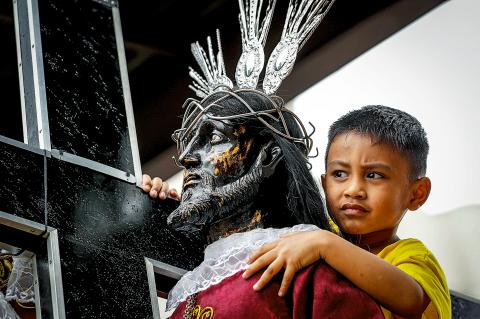
Photo: EPA
照片:歐新社
數十萬名菲律賓信徒日前齊聚首都馬尼拉,參與一場年度出巡儀式,期盼能親吻或觸摸一尊數百年歷史、據信擁有神奇治癒能力的黑色耶穌基督木雕,展現出當地虔誠天主教信仰的盛大規模。
信徒們大多打著赤腳,簇擁著座駕,上頭載著一尊真人大小、肩負沉重十字架的「黑拿撒勒人」木雕,一路遊行穿過市區。許多信徒穿著黃色與紅褐色相間的襯衫,把白色毛巾丟向座駕上的人們以擦拭雕像,不少信徒則向前推擠,只為摸到拉著座駕前行的粗麻繩。人們相信,就算是最輕微的碰觸也能為他們賜福並治癒疾病。
在菲律賓超過一億的人口中,大約有百分之八十信奉羅馬天主教。菲律賓以色彩繽紛的宗教儀式聞名,而「黑拿撒勒人」的慶祝儀式可追溯到這個西班牙前殖民地兩百多年前留下的傳統。
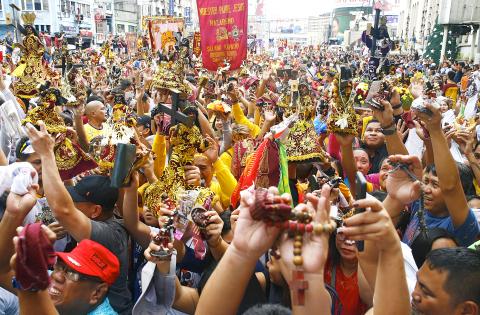
Photo: AP
照片:美聯社
面對木雕出巡恐近似偶像崇拜的批評,馬尼拉輔理主教博德瑞克‧巴比略回應表示,信徒數量增加證明天主教信仰的力量不斷茁壯。根據菲律賓的DZMM廣播電台引述,巴比略指出:「是時候加深我們對於靈修的理解。」
至今人們仍不清楚這尊雕於墨西哥的神像為何後來變成黑色的。傳說在十七世紀初期,這尊由西班牙神父供獻的雕像,在載往菲律賓的船上,被突然發生的火災燻黑。
(台北時報章厚明譯)
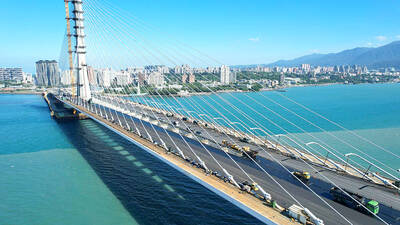
A: The Danjiang Bridge in New Taipei City is to open on May 12, and the MRT Sanying Line (Light Blue Line) will also open in June. Isn’t that great? B: Is that the bridge connecting the city’s Tamsui and Bali Districts? What’s so special about this new landmark spanning the Tamsui River? A: The Danjiang Bridge will become the world’s longest-span single-mast asymmetric cable-stayed bridge — with a total river-crossing section of 920 meters and main span of 450 meters. B: The news says there are sidewalks and bike lanes on both sides. Watching the sunset from the
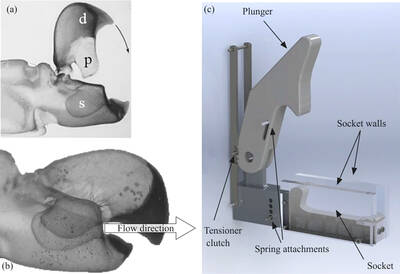
Few sea creatures of their size have as much destructive power as pistol shrimp. These small animals, usually measuring around four centimeters long, produce shock waves that can stun or even kill their prey. The attack begins when the shrimp opens its specialized claw, allowing water to fill a chamber inside. Then the claw closes rapidly. A bump on the claw strikes the chamber, forcing the trapped water out through a narrow opening at a high speed of about 25 meters per second. The rapid movement forms a bubble in the water that collapses almost instantly under the pressure of the

In the dense forests of Tanzania, a young researcher sat quietly among the trees, her gaze fixed on a troop of chimpanzees. It was 1960, and Jane Goodall, armed with nothing but a notebook and endless curiosity, was about to change science forever. Inspired by childhood stories like the Dr. Dolittle series, she had dreamed of Africa — and now, thanks to the encouragement of anthropologist Louis Leakey, she was there, face-to-face with the wild. What Jane discovered shocked the world. Chimpanzees weren’t mere creatures of instinct; they were individuals with emotions, families, and even the capacity for tool
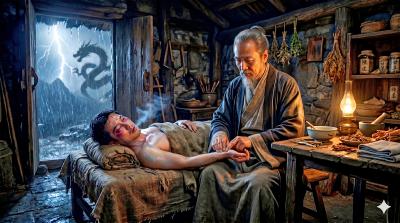
★ Bilingual Story is a fictionalized account. 雙語故事部分內容純屬虛構。 Rain hammered the roof in hard, uneven bursts. “Hold him still!” Baosheng pressed one hand against the stranger’s brow as the man twisted on the wooden bed. His left eye was swollen shut. The right one burned red like a coal. “It feels like fire,” the man gasped. “Like something is clawing inside.” Thunder rolled across the mountain. Baosheng leaned closer. The man’s skin was cold, but heat rose from his face. A strange smell hung in the air. He began the four methods of diagnosis: looking, listening/smelling,


 RSS
RSS