


As the whole country gears up to prevent the African swine fever virus from entering Taiwan, sniffer dogs are playing a very important part. To make a good sniffer dog, in addition to having a powerful sense of smell, dogs that love to eat and are playful, curious and unaggressive are the top choice for dog handlers.
With their keen sense of smell, sniffer dogs can detect up to a dozen kinds of animal products and more than 80 kinds of plant products, with an average accuracy rate of over 80 percent, making them the most helpful assistants for border inspection personnel.
An inspector says that when a sniffer dog finds hidden meat, fruit or seeds on the baggage carousel, it stops by the baggage and waits for the inspectors to open it for inspection.
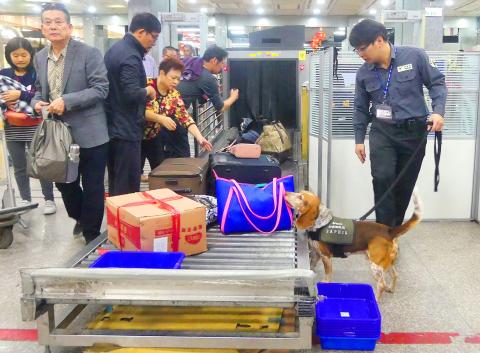
Photo: Wu Cheng-ting, Liberty Times
照片:自由時報記者吳正庭
Hsiao Shu-chiung, a technical specialist with the Council of Agriculture’s Bureau of Animal and Plant Health Inspection and Quarantine, says that Taoyuan International Airport is in effect the country’s front door, so its sniffer dogs bear a heavier responsibility than those of other border control units. Sniffer dogs’ training is aimed at identifying fresh fruit, vegetables, seeds, meat and live animals, in order to effectively intercept potential epidemics such as bird flu, foot-and-mouth disease and African swine fever.
There are currently 47 sniffer dogs in Taiwan, including 29 beagles, 10 Labradors and eight mixed-breed dogs, which carry out their duties at airports, sea ports and international parcel centers all over the country. Taoyuan International Airport has the most sniffer dogs — 25 in all. Even the Shuitou Pier in Kinmen County, a port for the “small three links” with China, has three sniffer dogs.
A sniffer dog’s training is carried out in tandem with that of the dog handler. They are trained separately for the first one or two months. The dog must learn to sniff and obey commands, while the dog handler learns to guide the dog to do its duties in the form of a game, as well as how to take care of the dog’s health. In the following 10 to 12 weeks, the dog and its handler are trained together and learn on the spot. In most cases, a sniffer dog starts working at two years old and serves for four to seven years.
Most of the sniffer dogs are beagles. The beagles are bred by the National Pingtung University of Science and Technology, while the Labradors are bred by the Customs Administration. Mixed-breed dogs in shelters may also be chosen, as well as dogs donated by the public.
(Translated by Lin Lee-kai, Taipei Times)
為防止非洲豬瘟病毒入侵,在全面提升國境防疫層級之際,檢疫犬扮演的角色吃重。要成為好的檢疫犬的條件,除了嗅覺靈敏、活動力強外,嗜吃、好玩、常保好奇心、無攻擊性,更是領犬員心目中的首選。
檢疫犬藉由靈敏的嗅覺,可以偵測標的物可達十多種動物產品及八十多種植物產品,平均偵測正確率為八成以上,是國境防檢人員最有力的助手。
防檢人員表示,檢疫犬若在行李轉盤發現暗藏肉品、水果、種子時,會停在行李原地,等待防檢人員進一步開箱查驗。
農委會動植物防疫檢疫局技正蕭淑瓊說,桃園機場屬於國家大門,檢疫犬每天執勤的責任比其他國境單位來得吃重,而檢疫犬平日訓練,則針對如何辨識鮮果、蔬菜、種子、肉類與動物活體,以有效攔截禽流感、口蹄疫、非洲豬瘟等不同疫情。
台灣現有四十七隻檢疫犬,犬種包含二十九隻米格魯、十隻拉布拉多、八隻米克斯混種,分工在全國機場、港口、國際郵包中心執勤,數量最多的是桃園機場,分派二十五隻執勤,就連金門縣小三通的水頭碼頭也有三隻。
檢疫犬的培訓是與領犬員同步進行,剛開始的一到二個月分別受訓,狗狗要學會聞、聽從命令等;領犬員要會引領狗狗樂於在遊戲中執勤、照顧其健康起居;再十到十二週一起受訓,並現場學習。檢疫犬通常是自兩歲起,服務四到七年。
檢疫犬的犬種以米格魯較多,米格魯由屏東科技大學、拉布拉多由海關育種,也會從收容中心尋找米克斯,或由民眾捐贈。
(中央社)
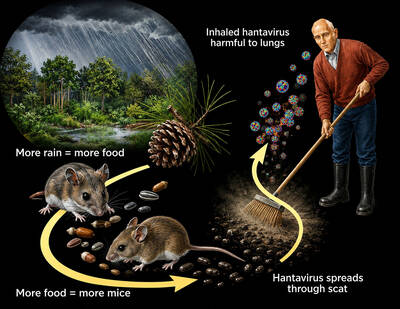
An outbreak aboard a cruise ship of a rare rodent-borne illness called hantavirus has left three passengers dead and sickened others, but global health officials say the risk to the general public remains low because the germ does not easily spread between people. “This is not the next COVID, but it is a serious infectious disease,” said Maria Van Kerkhove, director of epidemic and pandemic preparedness at the World Health Organization (WHO). “Most people will never be exposed to this.” The virus usually spreads when people inhale contaminated residue of rodent droppings. Hantaviruses have been around for centuries and are thought to

Have you ever wondered how people navigate the world when they can’t see a map? For individuals with visual impairments, conventional maps are nearly impossible to use. This is where tactile maps come in — essential tools that allow people to “see” the world through touch. A tactile map is specially designed with raised lines, textures, and symbols to represent geographical features such as roads, rivers, and buildings. Users explore it with their fingertips. However, these maps are not exclusively for people with visual disabilities. They serve as valuable multisensory learning tools that enhance spatial understanding for everyone, making

A growing green movement allows hotel guests to fund tree planting projects simply by opting out of daily room cleans. This approach turns an ordinary hotel stay into a direct contribution to nature. Founded in the Netherlands, the nonprofit “Hotels for Trees” operates on the principle that one skipped cleaning equals one new tree. It has planted more than 750,000 trees since 2021. Similarly, Sarnia Hotels in Guernsey donates £2 per refused clean. Since 2024, over 3,300 services have been cancelled, raising sufficient money to plant 1,100 native trees and hedgerows. Simplicity has been central to this success.

1. 他病了三天。 ˇ He has been sick for three days. χ He has been sick since three days. 註︰這裡現在完成時態 have / has been 表示從過去某一時日到現在的一段時間存在的行為或狀態,與它連用的時間副詞應為 「for +若干時」,如 for a year, for three hours 等,意思是歷時多少。 2. 他自從星期三以來都很忙。 ˇ He has been busy since Wednesday. χ He has been busy from Wednesday. 註︰「自從……以來」,該用 since。說從某一天(某一時刻)到某一天(某一時刻)才用 from,如 from Monday till Friday。 3. 房間角落裡散放著一些零星物件。 ˇ There were some odds and ends lying in the corner of the room. χ There were some odds and ends lying at the corner of the room. 註︰「在房間角落裡」該用介詞 in。例如: He stood in the corner. There is a lamp in the corner of the room. at the corner 指房子外部的拐角。例如: A little boy


 RSS
RSS