


A group of lizards inhabiting the island of New Guinea boasts one of the most exotic traits of any animal: green blood. Scientists have been trying hard to figure out what benefit this characteristic — caused by high levels of an ordinarily toxic green bile pigment — may give them.
But these lizards are beginning to give up some of their secrets, including their evolutionary history. Researchers said on May 16 a DNA study resolved their family tree, finding that green-bloodedness evolved four different times among lizards called skinks on New Guinea.
“Our key finding was that green-blooded lizards are not each other’s closest relatives, and they all likely evolved from an ancestor that had red blood. This means that green blood likely emerged independently in different lizards, suggesting that green blood has beneficial properties,” said evolutionary biologist Zachary Rodriguez of Louisiana State University’s Museum of Natural Science.
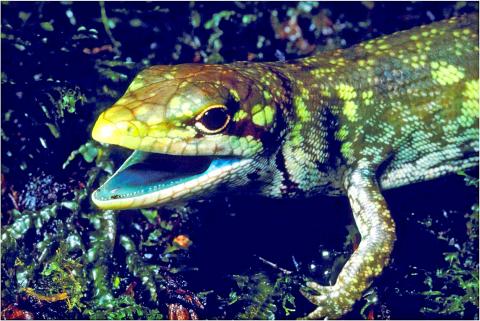
Photo: Reuters
照片:路透
The high blood concentration of the green bile pigment biliverdin overwhelms the intense crimson color of red blood cells, resulting in a striking lime-green coloration of their blood, muscles, bones and mucosal tissues, said LSU biologist Christopher Austin, the head curator of amphibians and reptiles section at the museum.
High levels of biliverdin cause jaundice in most animals. But these lizards thrive despite biliverdin levels many times greater than the lethal concentration in people. Scientists remain uncertain about the advantage green blood may provide the lizards. Several fish, frog and insect species also are green-blooded. “Our current hypothesis is that this novel and toxic physiology might have evolved to reduce or preclude the infection of blood parasites such as malaria,” Austin said.
The researchers examined DNA from the six green-blooded lizard species and 45 closely related red-blooded species. They are now looking into the genes responsible for green-bloodedness, hoping an understanding of the genetic factors that let these lizards remain jaundice-free may lead to a cure for jaundice.
(Reuters)
棲息在新幾內亞島上的一群蜥蜴,擁有動物界中最奇異的生物性狀之一:綠色的血液。長久以來,科學家一直努力想要找出這個特徵可能帶給它們什麼益處──該特徵是由通常帶有毒性的高濃度綠色膽汁色素所導致。
這些蜥蜴最近開始透露出屬於它們的一些秘密,其中包括它們的演化史。研究人員在五月十六日表示,一份DNA研究解開這群蜥蜴的系統樹,發現綠色血液是新幾內亞島上的長尾蜥蜴經過四次演化後的結果。
路易斯安那州立大學自然科學博物館的演化生物學家扎卡里‧羅德里格斯表示:「我們的關鍵發現在於綠血蜥蜴彼此之間並非是最接近的親屬,而且它們可能全部都演化自某種流著紅色血液的祖先。也就是說,綠色的血液可能是在不同種類的蜥蜴中獨立出現,暗示出綠色的血液很可能具備有益的特性。」
該校的生物學家克里斯多福‧奧斯汀,同時任職為該校博物館兩棲動物與爬蟲類部門的總管理員,他指出血液中高濃度的綠色膽汁色素,或稱「膽綠素」,壓倒性地蓋過了紅血球濃烈的深紅色,導致這些蜥蜴的血液、肌肉、骨骼,以及黏膜組織都帶有鮮明的萊姆綠色澤。
對大多數動物而言,膽綠素過量會導致黃疸。不過,儘管這些蜥蜴體內的膽綠素含量遠遠超過人類致死濃度的許多倍,它們還是能繁衍茁壯。科學家至今仍無法對綠色血液對這些蜥蜴提供的優勢下定論。奧斯汀說:「我們目前提出的假設是,這個新穎而帶有毒性的生理機制,或許是為了降低或防止發生瘧疾等血液寄生菌感染而演化出來的。」
研究人員目前已經檢驗了六個綠血蜥蜴物種的DNA,以及四十五種親屬關係接近的紅血蜥蜴物種。他們現在正深入探究導致綠色血液的基因,希望釐清讓這些蜥蜴們遠離黃疸的遺傳因子可以帶來黃疸的解藥。
(台北時報章厚明譯)


★ Bilingual Story is a fictionalized account. 雙語故事部分內容純屬虛構。 Lucas was already on the ground before he fully understood what was happening. “Hurry! Kneel down!” someone shouted. The asphalt was warm against his knees. Around him, dozens of people lay flat in the narrow street outside Jenn Lann Temple in Dajia. Some pressed their hands together in prayer. Others closed their eyes. Lucas had only come to look at the temple. An hour earlier he had stepped into the noisy courtyard out of curiosity. Inside the main hall, people held incense sticks, bowed three times,

A: Apart from the musical The Phantom of the Opera, off-Broadway classic “I Love You, You’re Perfect, Now Change” and musical-themed concert “Broadway Hits Live” are also touring Taiwan. B: Musical-themed concert? That sounds interesting. A: Set for April 18 and 19, the show will feature a group of Broadway vocalists and dancers — with British singer Keala Settle as a special guest. B: So the audience can enjoy all the timeless hits from various shows at one concert. . . I like that. A: And there’s more: Andrew Lloyd Webber’s classic musical Jesus Christ Superstar will finally visit Taiwan for the first time

Visitors walking down the streets of London and other major English cities might notice a curious sight. Many of the old __1__ have some of their windows boarded up. What’s even stranger is that there doesn’t appear to be any consistent pattern as to which windows get covered. This architectural __2__ dates back over 300 years during a time when “coin clipping” was a common crime in England. Back then, silver coins had simple designs with __3__, unmarked edges. Without any pattern extending to the coins’ rims, it was difficult to tell if the edges had been __4__. This

Despite being a basic tool, pens come in a wide variety of forms. Classic styles include fountain pens, which deliver liquid ink smoothly through metal tips. Another common type is the ballpoint pen, which is easy to use. There are even special felt pens that are especially popular among artists. __1__ They have a small hole at the top. So why is it there in the first place? Could it actually be a design flaw? __2__ Since 1991, companies such as BIC have been producing ballpoint pens with holes in their caps for two main reasons: quality control


 RSS
RSS