


There is a Hindu legend about a woman named Holika, who was the sister of a demon king called Hiranyakashipu. Hiranyakashipu had been granted immortality, and he was told he could not be killed by either animals or humans, indoors or outdoors, during the day or at night, on land, water or in the air, or by either projectiles or handheld weapons.
Hiranyakashipu allowed his powers go to his head. He would kill anyone who disobeyed him. He discovered his son, Prahlad, planned to kill him, to put a stop to his excesses. Hiranyakashipu concocted a plan with Holika to kill Prahlad, but the plan failed.
At this point the Hindu Lord Vishnu intervened. Appearing in the form of Narasimha, who was half-human and half-lion, Vishnu met the demon king on a doorstep, at dusk, placed him on his lap, and killed him with his lion claws. He had circumvented all five of the demon king’s powers.

Photo: AFP
照片:法新社
The legend is widely regarded as the origin of the ancient Hindu festival of Holi, known as the “festival of colors.” Hiranyakashipu and Holika represented evil; Prahlad and Vishnu represented good. The Holi festival signifies the victory of good over evil, the arrival of spring — therefore the beginning of the year — and a chance to forgive, forget and start anew. The date is decided according to the Hindu calendar. This year it fell on March 1.
(Paul Cooper, taipei times)
在印度神話中,霍莉卡相傳是魔王希蘭亞卡西普的妹妹。希蘭亞卡西普曾被賜予永生,並且被告知說:無論是動物還是人類,無論在室內或室外,無論是白天或黑夜,無論在陸地上、水裡、還是空中,無論是用投石機還是手持武器,都無法將希蘭亞卡西普殺死。

Photo: AFP
照片:法新社
希蘭亞卡西普逐漸變得權慾薰心,甚至隨意殺死任何不服從命令的人。某天,他發現自己的兒子普拉訶羅陀計畫殺死他,以阻止他無法無天的行徑。希蘭亞卡西普於是與其妹霍莉卡密謀暗殺普拉訶羅陀,只是計畫以失敗告終。
就在此刻,大神毗濕奴決定介入這場紛爭。毗濕奴以半人半獅的「那羅希摩」之形,於薄暮中現身,在門檻處一把攫起希蘭亞卡西普,在膝蓋上用獅子的利爪殺死魔王。毗濕奴以智取勝,完全抑制魔王的特殊能力。
這段傳說故事被廣泛視為古老印度節慶「灑紅節」(又稱「色彩節」)的起源。希蘭亞卡西普與霍莉卡代表邪惡的一方,而普拉訶羅陀和毗濕奴則代表正義。灑紅節彰顯出正義戰勝邪惡,同時宣告春天的來臨──也就是一年的初始──是人們原諒、遺忘、重新開始的好時機。灑紅節的日期由印度曆法決定,今年落在三月一日。

Photo: AFP
照片:法新社
(台北時報章厚明譯)
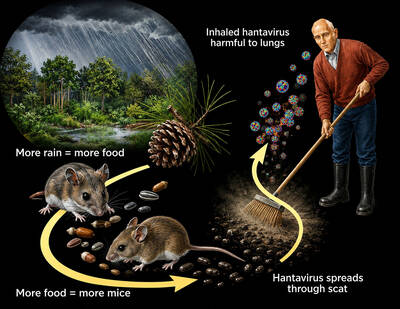
An outbreak aboard a cruise ship of a rare rodent-borne illness called hantavirus has left three passengers dead and sickened others, but global health officials say the risk to the general public remains low because the germ does not easily spread between people. “This is not the next COVID, but it is a serious infectious disease,” said Maria Van Kerkhove, director of epidemic and pandemic preparedness at the World Health Organization (WHO). “Most people will never be exposed to this.” The virus usually spreads when people inhale contaminated residue of rodent droppings. Hantaviruses have been around for centuries and are thought to

Have you ever wondered how people navigate the world when they can’t see a map? For individuals with visual impairments, conventional maps are nearly impossible to use. This is where tactile maps come in — essential tools that allow people to “see” the world through touch. A tactile map is specially designed with raised lines, textures, and symbols to represent geographical features such as roads, rivers, and buildings. Users explore it with their fingertips. However, these maps are not exclusively for people with visual disabilities. They serve as valuable multisensory learning tools that enhance spatial understanding for everyone, making

1. 他病了三天。 ˇ He has been sick for three days. χ He has been sick since three days. 註︰這裡現在完成時態 have / has been 表示從過去某一時日到現在的一段時間存在的行為或狀態,與它連用的時間副詞應為 「for +若干時」,如 for a year, for three hours 等,意思是歷時多少。 2. 他自從星期三以來都很忙。 ˇ He has been busy since Wednesday. χ He has been busy from Wednesday. 註︰「自從……以來」,該用 since。說從某一天(某一時刻)到某一天(某一時刻)才用 from,如 from Monday till Friday。 3. 房間角落裡散放著一些零星物件。 ˇ There were some odds and ends lying in the corner of the room. χ There were some odds and ends lying at the corner of the room. 註︰「在房間角落裡」該用介詞 in。例如: He stood in the corner. There is a lamp in the corner of the room. at the corner 指房子外部的拐角。例如: A little boy

A: In early May, there were concerts by Icyball, Chyi Yu, Korea’s EXO and Japan’s Anisama, but I missed them all. What a shame. B: That’s OK. There are shows coming up by various artists, including Power Station, Accusefive, Japanese singer Mika Nakashima, Chinese-Icelandic jazzer Laufey, and even Singaporean diva Stefanie Sun. A: After a 12-year hiatus, Stefanie is finally returning to Taipei again. B: In late May, there will be more shows by Crowd Lu, WeiBird, Korea’s Donghae, 2AM, EXID, and Thailand’s BUS. A: The Thai boyband is so popular. It looks like “T-pop” is catching up with J-pop


 RSS
RSS