


The Islamic New Year marks the beginning of a new Islamic calendar year, the day the year count is incremented. This year it was celebrated on Sept. 21 for most Islamic countries. Last year it started on Oct. 3, while in 2008 it was as late as Dec. 29. The reason for the discrepancy is that it is based upon the Islamic, Muslim or Hijri calendar, a lunar calendar with 12 months of 354 or 355 days, compared to the 365 days (366 in leap years) of the Gregorian calendar followed elsewhere. The Islamic calendar year, then, is shorter than the Gregorian calendar by 11 to 12 days.
The Islamic calendar is retrospectively dated back to the Islamic New Year of 622AD, the year of the Hijrah, when the Prophet Mohammed and his followers traveled from Mecca to Medina and established the first Muslim community. The Gregorian calendar is divided into the era before Jesus Christ was supposed to have been born, designated as BC (before Christ) and AD (Anno Domini, which is Medieval Latin for “in the year of the lord”). In English, the Islamic calendar is similarly designated, using the Hijrah as a reference. Thus, years are marked as BH (before the Hijrah) and AH (Anno Hegirae, Latin for “in the year of the Hijrah”). This new Islamic year is therefore written as 1439AH.
(Paul Cooper, Taipei Times)
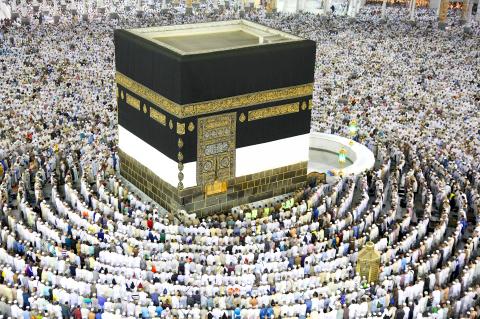
Photo: AFP
照片:法新社
伊斯蘭新年是伊斯蘭曆的一年之始,在這天,計年數字又添一年。今年大多數伊斯蘭教國家在九月二十一日過新年。去年的新年是在十月三日,在二○○八年還遲至十二月二十九日。之所以有這樣的差異是因為伊斯蘭日期的計算是基於伊斯蘭曆法—這是一種陰曆,一年有十二個月,共三五四或三五五天。這跟其他地方所採用的,一年有三六五天(閏年則有三六六天)的現行公曆有所不同。因此伊斯蘭曆的一年比公曆的一年少了十一至十二天。
伊斯蘭曆可追溯到在西元六二二年稱為「希吉拉」的事件—先知穆罕默德及其追隨者從麥加遷往麥地那,並建立第一個穆斯林社群,該年於是被定為伊斯蘭元年。現行公曆按照據信為耶穌基督的出生年,劃分為西元前(BC,before Christ,在耶穌出生前)、西元後(AD,為中世紀拉丁文Anno Domini,意為「主的年」)兩種紀元。在英語中,伊斯蘭曆也有類似的劃分,是以「希吉拉」做為時間點,因此,伊斯蘭曆的紀年標為BH(希吉拉之前),以及AH(拉丁文Anno Hegirae,意為希吉拉之年)。因此,伊斯蘭曆這新的一年寫為一四三九AH。
(台北時報編譯林俐凱譯)

Photo: AFP
照片:法新社
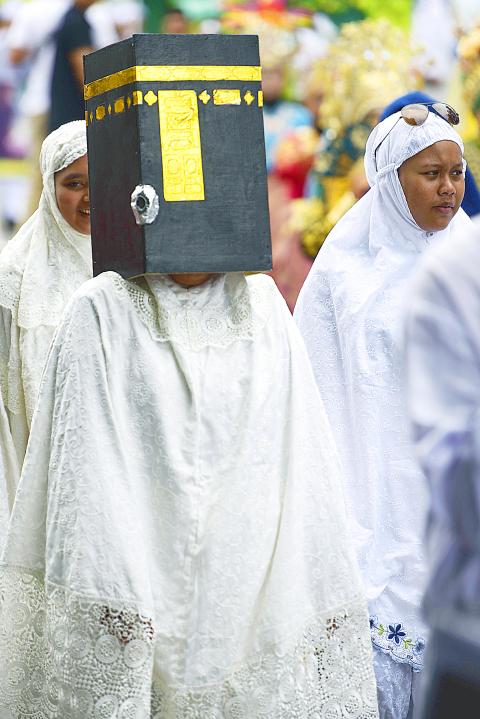
Photo: AFP
照片:法新社

The US-Israeli war with Iran, which began on Feb. 28, has killed thousands of people, destabilized the Middle East and rocked global energy markets by effectively closing the strait. WHAT IS THE STRAIT OF HORMUZ? Lying between Oman and Iran and linking the Gulf north of it with the Gulf of Oman to the south and the Arabian Sea beyond, the strait is 33km wide at its narrowest point, with a shipping lane just 3km wide in either direction. Perhaps the world’s most important energy shipping channel, the waterway is about 167km long. Following through on an old threat, Tehran effectively closed the strait

Have you ever found yourself desperately feeding coins into a claw machine just because you’ve already spent so much trying to win that stuffed animal? Or maybe you’ve continued watching a boring movie simply because you already paid for the ticket? If so, you’ve experienced the “sunk cost fallacy.” A sunk cost refers to time, money or effort that has already been spent and cannot be recovered. This psychological trap is surprisingly common. You might keep playing a video game you no longer enjoy because you’ve invested countless hours in building your character, or maintain a toxic friendship because you’ve known

A: Which TV drama series have been global hits so far this year? B: The US drama “Stranger Things 5,” South Korean drama “Can This Love Be Translated?” and Chinese megahit “Pursuit of Jade” are all popular lately. A: Isn’t “Pursuit of Jade” the costume idol drama about the romance between a charming marquis and a pig-slaughterer? Actor Zhang Linghe and actress Tian Xiwei are both so attractive. B: Plus, Netflix’s Korean-Japanese gay romance drama “Soul Mate” — starring Korea’s Ok Taec-yeon and Japan’s Hayato Isomura — is set to premiere in May. A: These hit international dramas

1. 他甚至還自認為是個了不起的領導人。 ˇ He even went so far as to think himself a great leader. ˇ He even went so far as to think of himself as a great leader. χ He even went so far as to think himself as a great leader. 註:認為某人或某事為何等樣人或何等樣事,可用 think+受詞+受詞補語,或 think of ... as ...,正句第一句比第二句普遍些。用了 of,後面用 as;沒有 of,就不可以用 as。又如: I thought him quite a joke. I thought of him as quite a joke. 2. 你不應該打擾他休息。 ˇ You should not intrude upon him during his time off. χ You should not intrude him during his time off. 註:intrude 作「闖進」、「打擾」、「侵入」解時,是不及物動詞,後面跟 upon。 3. 男孩正在玩陀螺。 ˇ The boy is playing with his top. χ


 RSS
RSS