


Model fan second-year junior high school student Chiu Hsien-chun spent two months making his Gundam model “Over War,” which he entered into the Gunpla00 Builders World Cup 2016 (2016GBWC) final in Japan at the end of last year. Chiu distinguished himself from among contestants from 13 countries, winning first prize in the junior category.
In order to give a sense of the desolation of having gone through a war, Chiu used paint and a piece of rotten wood to give the model an aged feel, and the judges rated his technique as being mature beyond his years, compared to the contestants from other countries. His model successfully beat over 1,000 other entries, crowning him world champion.
Chiu’s modeling instructor Lin Tse-chiao said that building models is extremely complex, and requires a lot of thought and skill. Even though models are already painted, but Chiu added paint to change the feel of the piece, to give it a stronger sense of realism, to make it comply more completely with his original concept.
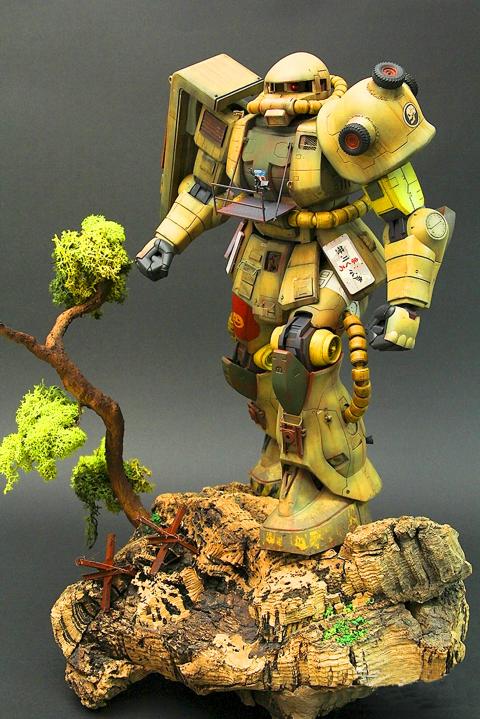
Photo courtesy of Lin Tse-chiao
照片:模型指導老師林子喬提供
(Liberty Times, translated by Paul Cooper)
熱愛模型的國中二年級學生邱顯鈞,耗時兩個月打造鋼彈模型作品「OVER WAR」,去年底首次赴日參加「二○一六年GBWC鋼彈模型製作家全球盃」總決賽。自全球十三國參賽選手中脫穎而出,拿下青少年組全球冠軍。
為了呈現戰爭過後的荒涼感,邱顯鈞利用漆料特性搭配朽木營造「仿舊」感,在各國參賽選手中,以「超齡」製作手法獲評審青睞,成功打敗上千件參賽作品,一舉拿下世界冠軍。
模型指導老師林子喬表示,模型製作相當複雜,需要手腦並用,雖然一般模型原本就有顏色,但顯鈞會為了作品真實感,會用顏料特性改變作品色澤,讓成品完全符合他原本的構想。(自由時報)


A: Isn’t the 2026 Coachella Valley Music and Arts Festival — a massive music event held every April — about to open in California? B: Yeah the festival is set to take place over two weekends, from April 10 to 12 and 17 to 19, US time. A: I heard this year’s main stage headliners include Sabrina Carpenter, Justin Bieber, Karol G and EDM DJ Anyma. B: The K-pop army is also making an appearance, with legendary group BigBang, SHINee member Taemin and girl group Katseye debuting for the first time. A: Isn’t Coachella also live-streamed on its YouTube

A: Several Japanese and South Korean acts, such as BigBang, are participating in this year’s Coachella Music Festival. Have any Mando-pop singers ever performed at Coachella? B: Yup, K-pop group GOT7’s Hong Kong member Jackson Wang, and Taiwanese band Sunset Rollercoaster, which primarily performs in English, attended the festival before. A: It’s a pity that we didn’t fly to Coachella. But in fact, Taipei has also gradually become an Asian music hub in recent years. B: That’s true. K-pop sensation Twice just held three concerts at the Taipei Dome, followed by Hong Kong singer G.E.M., who is going

Concertgoers know the rush all too well — the moment the first notes play, your heart races, and nothing else seems to matter. For many, the excitement doesn’t end when the lights come back on. Some fans try to relive the performance by listening to the same songs for days afterward. __1__ A few days after an amazing show, they begin to feel unexpectedly low. Psychologists have coined a term for this phenomenon: “post-concert depression,” or “PCD.” PCD is primarily related to hormone levels. When you’re at a concert, the excitement causes your brain to release feel-good chemicals like

A new study suggests that chimpanzees can weigh evidence and make rational judgments. In the experiment, researchers placed two boxes in front of the chimpanzees. One box was set up to give strong evidence, such as letting the chimpanzees actually see food inside. The other was designed to provide weak evidence, like producing a rattling sound when it was shaken. The chimps consistently chose the box with strong evidence, even when the weaker clue appeared first. This indicated that they were not fooled by the order of presentation. In another trial where no strong evidence was available, the chimps


 RSS
RSS