


There might be a ninth planet in the solar system after all, and it is not Pluto.
Two astronomers reported in January last year that they had compelling signs of something bigger and farther away — something that would satisfy the current definition of a planet, where Pluto falls short.
“We are pretty sure there’s one out there,” said Michael E. Brown, a professor of planetary astronomy at the California Institute of Technology.
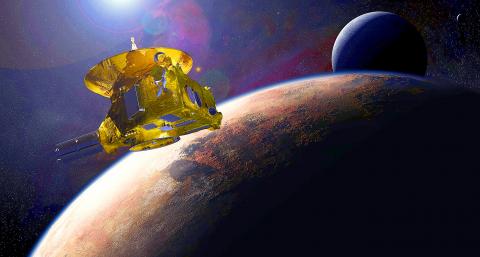
Photo: Reuters
照片:路透社
What Dr. Brown and a fellow Caltech professor, Konstantin Batygin, have not done is actually find that planet, so it would be premature to start revising mnemonics of the planets.
In a paper published in the Astronomical Journal, Brown and Batygin lay out a detailed circumstantial argument for the planet’s existence in what astronomers have observed: a half-dozen small bodies in distant elliptical orbits.
What is striking, the scientists said, is that the orbits of all six loop outward in the same quadrant of the solar system and are tilted at about the same angle. The odds of that happening by chance are about 1 in 14,000, Batygin said.
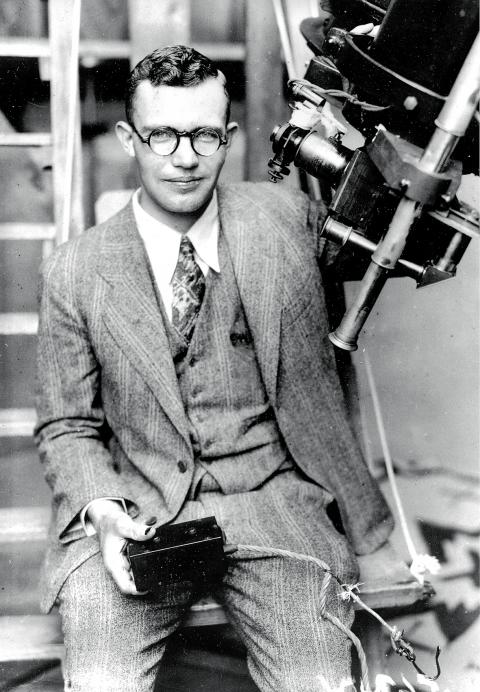
Photo: AP
照片:美聯社
A ninth planet could be gravitationally herding them into these orbits.
For the calculations to work, the planet would be at least an equal to Earth, and most likely much bigger:perhaps a mini-Neptune with a mass about 10 times that of Earth. That would be 4,500 times the mass of Pluto.
Alessandro Morbidelli of the Cote d’Azur Observatory in France, an expert in dynamics of the solar system, said he was convinced. “I think the chase is now on to find this planet,” he said.
Pluto, at its most distant, is 4.6 billion miles from the sun. The potential ninth planet, at its closest, would be about 20 billion miles away; at its farthest, it could be 100 billion miles away. One trip around the sun would take 10,000 to 20,000 years.
Morbidelli said a possible ninth planet could be the core of a gas giant that started forming during the infancy of the solar system; a close pass to Jupiter could have ejected it. Back then, the sun resided in a dense cluster of stars, and the gravitational jostling could have prevented the planet from escaping to interstellar space.
This article is an edited version of a piece that originally appeared in the New York Times
(Kenneth Chang, New York Times)
太陽系或許還有第九顆行星,且不是冥王星。
兩名天文學家於去年一月通報,他們發現了令人信服的跡象,顯示存在一顆更大、更遙遠的天體,該星體滿足目前對行星的定義,而冥王星則不符合。
「我們相當確定有那麼一顆行星,」加州理工學院的行星天文學教授邁克·布朗說。
布朗博士和他的同事康斯坦丁·巴蒂金尚未真正找到那顆行星,所以現在修改行星名單還為時過早。
布朗和巴蒂金在《天文學雜誌》上聯合發表了一篇論文,提出詳細的旁證,指出天文學家們觀測到遙遠的橢圓軌道上運行的六個小天體,間接證明這顆行星的存在。
這兩位科學家稱,一個突出的現象是,這六個天體的軌道全部位於太陽系的同一象限內,並且傾斜角度大致一樣。巴蒂金表示,這種情況純屬巧合的機率大約是一萬四千分之一。
可能有第九顆行星通過引力將這些天體拉入這樣的軌道。
要想理論成立,這顆行星至少要和地球尺寸相當,很可能要大得多,大概相當於一顆小海王星,質量是地球的十倍、冥王星的四千五百倍。
法國蔚藍海岸天文台的太陽系動力學專家亞歷山德羅·莫比德利覺得可信。「我認為現在的目標是找到這顆行星,」他說。
冥王星運行到遠日點時,距離太陽四十六億英里。這顆有望成為第九行星的天體距離太陽最近時是兩百億英里,最遠時可能是一千億英里。繞行太陽一周需要一萬到兩萬年。
莫比德利表示,可能存在的第九行星,也許是一個氣態巨行星的核心,自太陽系初期就開始形成;可能當它經過木星時被引力拋遠了。當時的太陽處在密集的恆星群中,而引力的推擠可能阻止了這顆行星跑到星際空間。
(本文為編輯後的版本,原文已於紐約時報刊登/紐約時報中文網譯)
DID YOU KNOW?
你知道嗎?
Pluto, discovered in 1930 by Clyde Tombaugh, was originally considered to be the ninth planet from the Sun. Questions over its classification as a planet led the International Astronomical Union to formally define the word “planet.” One of the conditions was that a body must have “cleared the neighborhood around its orbit,” that is, it has become “gravitationally dominant,” and there are no bodies of similar size — apart from its satellites — in its proximity that are not under its gravitational influence. This is the only condition that Pluto doesn’t satisfy: it has therefore since been classified as a “dwarf planet.”


A: Isn’t the 2026 Coachella Valley Music and Arts Festival — a massive music event held every April — about to open in California? B: Yeah the festival is set to take place over two weekends, from April 10 to 12 and 17 to 19, US time. A: I heard this year’s main stage headliners include Sabrina Carpenter, Justin Bieber, Karol G and EDM DJ Anyma. B: The K-pop army is also making an appearance, with legendary group BigBang, SHINee member Taemin and girl group Katseye debuting for the first time. A: Isn’t Coachella also live-streamed on its YouTube

A: Several Japanese and South Korean acts, such as BigBang, are participating in this year’s Coachella Music Festival. Have any Mando-pop singers ever performed at Coachella? B: Yup, K-pop group GOT7’s Hong Kong member Jackson Wang, and Taiwanese band Sunset Rollercoaster, which primarily performs in English, attended the festival before. A: It’s a pity that we didn’t fly to Coachella. But in fact, Taipei has also gradually become an Asian music hub in recent years. B: That’s true. K-pop sensation Twice just held three concerts at the Taipei Dome, followed by Hong Kong singer G.E.M., who is going

Concertgoers know the rush all too well — the moment the first notes play, your heart races, and nothing else seems to matter. For many, the excitement doesn’t end when the lights come back on. Some fans try to relive the performance by listening to the same songs for days afterward. __1__ A few days after an amazing show, they begin to feel unexpectedly low. Psychologists have coined a term for this phenomenon: “post-concert depression,” or “PCD.” PCD is primarily related to hormone levels. When you’re at a concert, the excitement causes your brain to release feel-good chemicals like

A new study suggests that chimpanzees can weigh evidence and make rational judgments. In the experiment, researchers placed two boxes in front of the chimpanzees. One box was set up to give strong evidence, such as letting the chimpanzees actually see food inside. The other was designed to provide weak evidence, like producing a rattling sound when it was shaken. The chimps consistently chose the box with strong evidence, even when the weaker clue appeared first. This indicated that they were not fooled by the order of presentation. In another trial where no strong evidence was available, the chimps


 RSS
RSS