


A popular tradition during the lunar new year is to, before settling down to the new year’s eve feast, put up chuanlian — New Year’s couplets — on the front door or windows, and inside the house.
The tradition of putting up chuanlian can be traced all the way back to the taofu talismans of the Zhou dynasty. These taofu were plaques of peach wood on which were written the names of gods or their painted likenesses. These would then be hung around door frames, and were meant to invite fortune and repel evil. In the Song dynasty, this tradition evolved into writing phrases to be placed around doors the night before New Year’s Day. By the Qing dynasty, chuanlian had morphed into a kind of refined literary form.
Today, the couplets blend traditional beliefs and poetry, and also entail a lot of creativity.
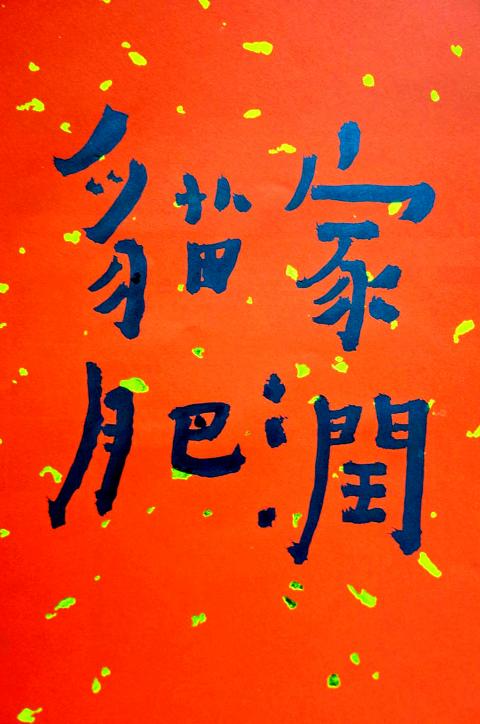
Photo courtesy of Ho Ching-chwang
照片:何景窗提供
Common traditional chunlian include small, square sheets of paper — doufang — especially for the purpose, with a single Chinese character written on them, such as the doufang written with the word for “full” (滿) pasted on rice storage jars; the inverted (倒) character for “spring” (春到了, spring has arrived) pasted on walls; four-character phrases such as liu chu xing wang (六畜興旺) expressing a wish for the continued health of one’s livestock, and often seen on the walls of pig pens and chicken coops; and composite characters of phrases such as zhao cai jin bao (招財進寶), a wish for much wealth to come one’s way. If true couplets, the first and second lines must be the same length, consist of the same word types, and have complementing level and oblique tones. There should be no repetition of meaning in the two lines.
New year couplets can also be very modern. The progressive Taiwanese poet and calligrapher Ho Ching-chwang has penned the four-character couplets mao fei jia run (貓肥家潤) and gou gou wang jia (狗勾旺家), using gentle humor to link the health of animals — well-fed cats in the first, yapping puppies in the second — to health and prosperity at home, cleverly echoing liu chu xing wang. Ho’s lively yet elegant calligraphy imparts her couplets with a distinctly modern feel.
(Translated by Paul Cooper)
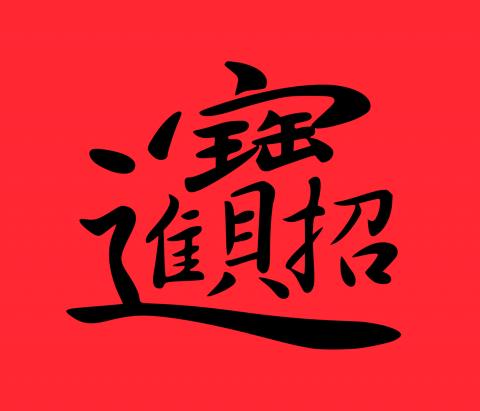
Photo: Wikimedia Commons
照片:維基共享資源
依過年傳統,除夕日吃團圓飯前,家家戶戶都會在大門、窗子或屋內貼上全新的春聯。
春聯的習俗最早可追溯至周朝的「桃符」。所謂桃符,即寫上神名或畫上神像的桃木板,掛在門邊作趨吉避兇之用。在宋朝,過年前夕在門上題詞演變為普遍的習俗。而到了清朝,春聯已發展為一種精緻的文學形式。
今日的春聯結合了傳統信仰與詩歌藝術,且不乏精采的創新者。
傳統常見的春聯包括只有一字的「斗方」,如通常貼在米缸上的「滿」,或倒貼在牆上的「春」;也有四字的春聯,如豬舍、雞寮等處常貼的「六畜興旺」;或組合字如「招財進寶」。若為對聯,則上下聯須字數相等、詞性一致、平仄相對,且不能語意重複。
春聯也可以充滿現代感。台灣新銳詩人暨書法家何景窗即曾創作「貓肥家潤」及「狗勾旺家」等四字春聯,題材溫暖幽默,並以爽朗優美的書法體寫成,別具現代詩意。
(台北時報編譯涂宇安)

The US-Israeli war with Iran, which began on Feb. 28, has killed thousands of people, destabilized the Middle East and rocked global energy markets by effectively closing the strait. WHAT IS THE STRAIT OF HORMUZ? Lying between Oman and Iran and linking the Gulf north of it with the Gulf of Oman to the south and the Arabian Sea beyond, the strait is 33km wide at its narrowest point, with a shipping lane just 3km wide in either direction. Perhaps the world’s most important energy shipping channel, the waterway is about 167km long. Following through on an old threat, Tehran effectively closed the strait
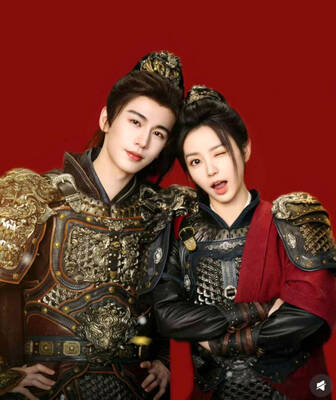
A: Which TV drama series have been global hits so far this year? B: The US drama “Stranger Things 5,” South Korean drama “Can This Love Be Translated?” and Chinese megahit “Pursuit of Jade” are all popular lately. A: Isn’t “Pursuit of Jade” the costume idol drama about the romance between a charming marquis and a pig-slaughterer? Actor Zhang Linghe and actress Tian Xiwei are both so attractive. B: Plus, Netflix’s Korean-Japanese gay romance drama “Soul Mate” — starring Korea’s Ok Taec-yeon and Japan’s Hayato Isomura — is set to premiere in May. A: These hit international dramas
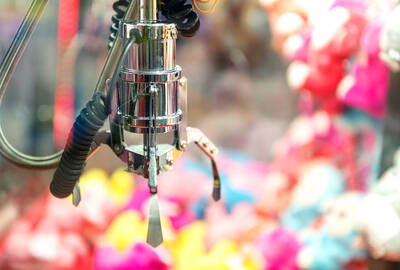
Have you ever found yourself desperately feeding coins into a claw machine just because you’ve already spent so much trying to win that stuffed animal? Or maybe you’ve continued watching a boring movie simply because you already paid for the ticket? If so, you’ve experienced the “sunk cost fallacy.” A sunk cost refers to time, money or effort that has already been spent and cannot be recovered. This psychological trap is surprisingly common. You might keep playing a video game you no longer enjoy because you’ve invested countless hours in building your character, or maintain a toxic friendship because you’ve known
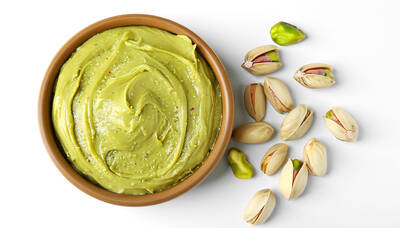
It seems like every year, new foods or drinks start trending and suddenly show up everywhere. A decade ago, avocado __1__ restaurant menus, while oat milk became the must-have addition to your coffee in cafes around five years back. The latest trend to hit this list is the pistachio. This flavorful green nut now features in everything from chocolate bars to Indian curries. While pistachios have long played a central role in certain regional cuisines, their recent global __2__ can be traced to Dubai. There, a specialty chocolate shop went __3__ on TikTok for one of its chocolate bars


 RSS
RSS