


When you think of Wanhua, Longshan Temple, always filled with worshipers, and the hustle and bustle of Ximending with its constant flow of tourists, often spring to mind. However, if you walk toward the intersection of Zhonghua Rd. Sec. 1 and Changsha St. Sec. 2, you will discover a square so serene that it almost feels like an otherworldly paradise. Its lush grass, its neat, quaint brick walkways, and its time-honored Japanese architecture will make you begin to wonder whether you are in Japan. It’s known as Nishi Honggan-ji Temple Square.
An online search for “Nishi Honggan-ji” will tell you that Taipei is not the only city with a Nishi Honggan-ji Temple. There is another one in Kyoto, Japan. In fact, the temple near Ximending was a branch temple established in Taiwan by the Nishi Honggan-ji in Kyoto.
The renovation of the Nishi Honggan-ji was completed in July, 2013, and it was opened to the public. In March, 2014, the Taipei City Archives along with its collections moved in. The square, then, is more than just a wonderful, comfortable place to relax: it also holds a treasure trove of Taipei’s history.
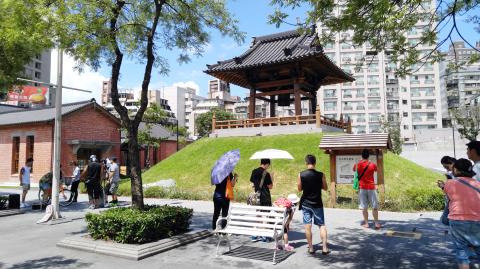
Photo: Ethan Zhan, Taipei Times
照片:台北時報詹豐造
The Taipei City Archives designated the Nishi Hongganji’s Shuxin Hall a place to hold exhibitions. It will also have permanent exhibitions and an archive room, introducing the public to how Taipei has evolved and developed through its rich collections and documents.
Source: Liu Tzu-li, Department of Information and Tourism, Taipei City Government, originally in the Taipei Pictorial, 557 edition.
(Translated by Ethan Zhan, Taipei Times)
說到萬華,總是讓人想到香火鼎盛的龍山寺及人聲鼎沸的西門町,充滿喧囂熱鬧。但行經中華路一段和長沙街二段交叉口,會發現一座靜謐猶如世外桃源的廣場,綠油油的草地、整齊而樸實的石磚步道和古色古香的日式建築,彷彿來到日本一般,這裡就是「西本願寺廣場」。
上網搜尋關鍵字「西本願寺」,會發現西本願寺不僅存在於臺北市,日本京都也有一座。事實上,位於西門町附近的西本願寺,是日本京都西本願寺來臺建立的別院。
二零一三年七月西本願寺修復完成,正式對外開放,二零一四年三月臺北市文獻委員會及其典藏的蒐藏品進駐,讓西本願寺廣場不但成為優美舒適的休憩空間,也是珍藏臺北回憶的寶庫。
文獻會將西本願寺中的「樹心會館」規劃為不定期展覽的空間,另外還有常設展區及文獻資料室,民眾可透過豐富的典藏品和文史藏書了解臺北市的變遷和發展。
文/劉子立,臺北市政府觀光傳播局《台北畫刊》第557期
(台北時報記者詹豐造英譯)

A: Which TV drama series have been global hits so far this year? B: The US drama “Stranger Things 5,” South Korean drama “Can This Love Be Translated?” and Chinese megahit “Pursuit of Jade” are all popular lately. A: Isn’t “Pursuit of Jade” the costume idol drama about the romance between a charming marquis and a pig-slaughterer? Actor Zhang Linghe and actress Tian Xiwei are both so attractive. B: Plus, Netflix’s Korean-Japanese gay romance drama “Soul Mate” — starring Korea’s Ok Taec-yeon and Japan’s Hayato Isomura — is set to premiere in May. A: These hit international dramas
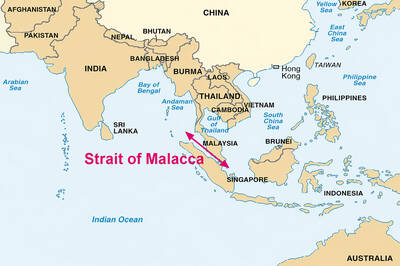
The closure of the Strait of Hormuz has forced policymakers in Asia to face questions over the security of other maritime chokepoints, including the Strait of Malacca, which is the world’s busiest waterway for international trade. WHAT IS THE MALACCA STRAIT? The 900km long Malacca Strait, bounded by Indonesia, Thailand, Malaysia and Singapore, provides the shortest sea route from East Asia to the Middle East and Europe. It carries nearly 22 percent of the world’s maritime trade, according to the Center for Strategic and International Studies (CSIS). This includes oil and gas shipments from the Middle East to the energy-hungry economies of China,
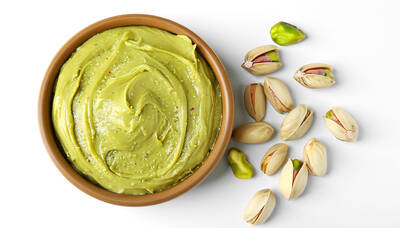
It seems like every year, new foods or drinks start trending and suddenly show up everywhere. A decade ago, avocado __1__ restaurant menus, while oat milk became the must-have addition to your coffee in cafes around five years back. The latest trend to hit this list is the pistachio. This flavorful green nut now features in everything from chocolate bars to Indian curries. While pistachios have long played a central role in certain regional cuisines, their recent global __2__ can be traced to Dubai. There, a specialty chocolate shop went __3__ on TikTok for one of its chocolate bars

One reason pistachios have taken the food world by storm compared to other nuts is their soft, green color. When ground down into a cream or butter, the green hue __6__ nicely with golden pastries or dark-brown chocolate, making it perfect for Instagram photos and TikTok videos. Their labor-intensive cultivation and __7__ also contribute to their image as a premium ingredient. Thus, buying a pistachio-based product often feels like a __8__ treat. Pistachios also stand out for their distinct flavor and health __9__. They have a subtle, sweet, earthy flavor that goes well with both sweet desserts and


 RSS
RSS