


N ot many people are aware that behind the walls of the seemingly mysterious and closed-off National Police Agency, there is a Historic Police Museum which is open to the public. In addition to a collection of more than 2000 police-related paraphernalia, there is also a drink driving simulator and an interactive police shoot-out simulator. People would do well to find time to visit the museum after the Lunar New Year holiday period.
The museum occupies a space of 405 square meters, and of the 2000-plus historical relics on display the oldest dates from the Japanese colonial era. The design is extremely well thought out. The exhibiton space floor plan is actually in the shape of a vast Jinwu bird, and from the ceiling are suspended 89 model Jinwu birds. While the dove symbolizes peace, the Jinwu bird represents the “elimination of evil,” so the flock of Jinwu birds soaring through the sky of the museum hall embodies the resolve of the police force to eradicate evil.
Inside the museum is a BMW police motorcycle: Originally intended to be auctioned off, it was kept especially for the exhibition, brought in by suspending it from a crane outside of a window, while seven muscular individuals got it inside.
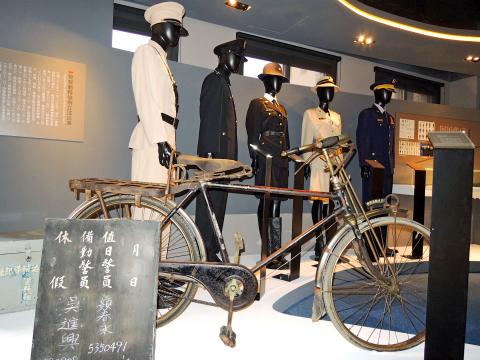
Photo: Huang Tun-yen, Taipei Times
照片:自由時報記者黃敦硯攝
There are a large number of retro relics on display within the oval exhibition space, such as a portable hand-cranked siren from the Japanese colonial era. There are currently only three such police sirens in existence in the whole of Taiwan. Following a good oiling, the siren still works perfectly well, and it emits a sound that is extremely “robust.”
Inside the museum, one can also see Taiwanese police uniforms spanning several generations, for example the khaki police uniform in use for many years.
Aside from viewing exhibits from a distance, visitors can also have a lot of fun inside the museum. Due to the common occurrence of drink-driving accidents in recent years, inside the exhibition is a drink driving simulator. Visitors can put on a “drunken eye mask” that simulates a blood-alcohol content of between 0.25 and 0.55 milligrams and experience what it feels like to drive a car while drunk, so as to understand the dizzying degree to which drink driving is dangerous. While playing on the simulator, many visitors smash into cars and even find it difficult to drive in a straight line. After removing the eye mask, many exclaim, “Drink driving really is incredibly dangerous.”
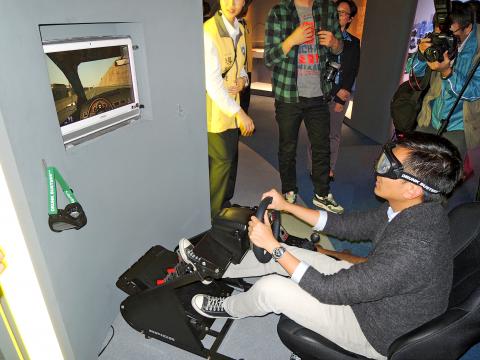
Photo: Huang Tun-yen, Taipei Times
照片:自由時報記者黃敦硯攝
To one side is a situational photographic zone. Visitors simply stand in front of a screen and have their photo taken, and can then — with the help of a computer — add the accoutrements of a police officer and create a photograph that can then be emailed to the visitor. Visitors can also select a background of their choosing, which feels rather like the photo sticker machines that were all the rage many years ago in Taiwan.
Nothing can surpass the police shoot-out simulation zone, which leaves the deepest impression on visitors. Aside from the more common circular shooting targets, there are also human-shaped moving targets. To one side, there is also a computer game version of the interactive police shoot-out, so that adults and children alike can experience a realistic gun fight. After firing at targets, visitors can move across to the SWAT team area and watch members of a police SWAT team launch an assault. They can then have their photo taken with life-size cardboard cut-out models of SWAT team police officers and serve for a day within the Thunder Squad special forces unit.
(Liberty Times, translated by Edward Jones)
許多民眾並不清楚,向來給人神秘、封閉形象的警政署,裡面卻設置一個可以參觀又可以玩的「警察史蹟館」,不但收藏了兩千多件警察歷史文物,更有模擬酒駕與射擊的互動模擬裝置,民眾在春節假期結束後,不妨找個時間預約參觀。
警察史蹟館占地123坪,收藏兩千多件文物,最古老的來自日治時代。展館設計大有玄機;若由展館空間平面圖來看,其實是一隻碩大無比的「金吾鳥」,天花板也懸掛了89隻「金吾鳥」模型。「金吾鳥」不同於鴿子,鴿子象徵的是「和平」,「金吾鳥」則代表「除害」,館場內眾多「金吾鳥」在空中飛翔,像是展現警察除害的決心。
博物館內收藏一輛BMW警用機車。原本是要拍賣售出的,但為了展出特地留了下來。館方以吊車將機車吊起,然後從窗戶搬進去,再由七名彪形大漢扛進展場。
蛋形展示區上,有不少「古早味」文物,像是「攜帶式手搖警報器」就是來自日治時代,目前全台僅存三個;經上油保養後還能正常運作發出聲響,十分「勇健」。
館內還能看到歷代台灣警察制服,像是沿用多年的卡其色警察制服就在眼前。
警察史蹟館內,除了可以看外,也可以「玩」。有鑑於近年來酒駕事件頻傳,館內便設置一款酒駕模擬器,民眾能戴上代表酒測值0.25與0.55毫克的「酒醉眼罩」可體會酒醉開車情形,了解「天旋地轉」的危險程度。不少民眾試玩時,不停撞車,甚至根本很難直線行駛,脫下眼罩後不禁說道:「酒駕真的太危險了。」
一旁還有情境拍照區,只要站在螢幕前拍照,就能藉由電腦合成警察配件製成照片再藉由電子郵件發送,背景也能任君挑選,頗有早期風靡台灣的「拍貼機」風味。
最令人印象深刻的,莫過於館內的模擬射擊區。除了一般常見的圓心靶外,還有動態人形靶,一旁也有電玩版的互動射擊遊戲區,讓大人跟小朋友都能體會逼真的射擊場景。打靶完後還可以到一旁的「維安特勤區」觀看特勤隊員的攻堅佈陣圖,也能跟特勤人型看板合照,充當「一日霹靂小組」。
(自由時報綜合報導)
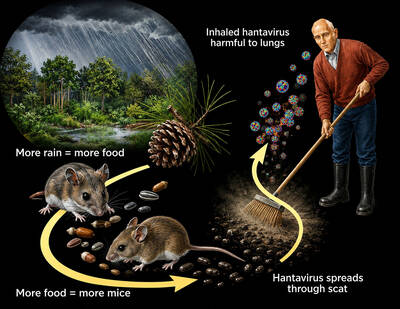
An outbreak aboard a cruise ship of a rare rodent-borne illness called hantavirus has left three passengers dead and sickened others, but global health officials say the risk to the general public remains low because the germ does not easily spread between people. “This is not the next COVID, but it is a serious infectious disease,” said Maria Van Kerkhove, director of epidemic and pandemic preparedness at the World Health Organization (WHO). “Most people will never be exposed to this.” The virus usually spreads when people inhale contaminated residue of rodent droppings. Hantaviruses have been around for centuries and are thought to
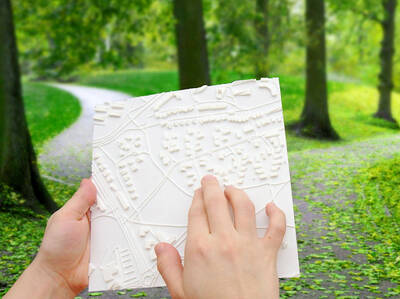
Have you ever wondered how people navigate the world when they can’t see a map? For individuals with visual impairments, conventional maps are nearly impossible to use. This is where tactile maps come in — essential tools that allow people to “see” the world through touch. A tactile map is specially designed with raised lines, textures, and symbols to represent geographical features such as roads, rivers, and buildings. Users explore it with their fingertips. However, these maps are not exclusively for people with visual disabilities. They serve as valuable multisensory learning tools that enhance spatial understanding for everyone, making

A growing green movement allows hotel guests to fund tree planting projects simply by opting out of daily room cleans. This approach turns an ordinary hotel stay into a direct contribution to nature. Founded in the Netherlands, the nonprofit “Hotels for Trees” operates on the principle that one skipped cleaning equals one new tree. It has planted more than 750,000 trees since 2021. Similarly, Sarnia Hotels in Guernsey donates £2 per refused clean. Since 2024, over 3,300 services have been cancelled, raising sufficient money to plant 1,100 native trees and hedgerows. Simplicity has been central to this success.

1. 他病了三天。 ˇ He has been sick for three days. χ He has been sick since three days. 註︰這裡現在完成時態 have / has been 表示從過去某一時日到現在的一段時間存在的行為或狀態,與它連用的時間副詞應為 「for +若干時」,如 for a year, for three hours 等,意思是歷時多少。 2. 他自從星期三以來都很忙。 ˇ He has been busy since Wednesday. χ He has been busy from Wednesday. 註︰「自從……以來」,該用 since。說從某一天(某一時刻)到某一天(某一時刻)才用 from,如 from Monday till Friday。 3. 房間角落裡散放著一些零星物件。 ˇ There were some odds and ends lying in the corner of the room. χ There were some odds and ends lying at the corner of the room. 註︰「在房間角落裡」該用介詞 in。例如: He stood in the corner. There is a lamp in the corner of the room. at the corner 指房子外部的拐角。例如: A little boy


 RSS
RSS