


The Slope of Overcoming Difficulty was built in the 1950s, since when it has been an important passage for getting in and out of Tamkang University. Alumni who studied at the school in the 1980s say that in the past many students who commuted to Tamsui by train had to walk along Yingjhuan Road and climb the Slope of Overcoming Difficulty to reach the campus. When standing on the first step and looking up, they could always see a stream of students climbing the slope.
“It was on Sept. 20, 1999, that I climbed the Slope of Overcoming Difficulty on my first day at university. I can recall it vividly because the 921 Earthquake happened the next day,” says alumnus Liao Jen-chieh. Climbing the slope was especially memorable for students who did not ride a scooter or bus to school because it was the quickest shortcut to get to the campus from the bottom of the mountain. Before joining the university, Liao knew nothing about the tradition of climbing the slope. Climbing the slope and chatting with other new students on the first day of school helped students adapt to the new environment.
“Some people walked the walk together and ended up as couples,” says Liao jokingly. In those days there was a girl who accompanied him up and down the slope countless times. Years later, that girl became his wife.
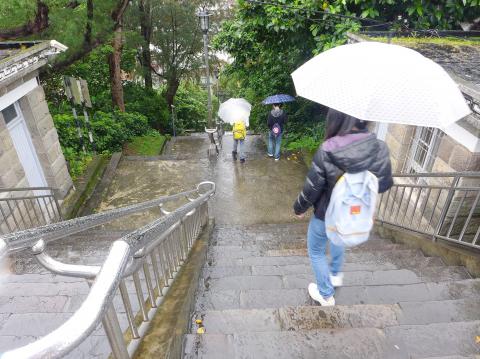
Photo: Li Ya-wen, Taipei Times
照片: 台北時報記者李雅雯攝
What if the Slope of Overcoming Difficulty were closed down? “It would be a pity, because many memories from my student days happened there,” says Liao. Current students would not like the slope to be closed either. “This is the path that I am used to walking to school. If it is closed, I will have to go a longer way around,” one student says.
(Liberty Times, translated by Ethan Zhan)
克難坡建於民國四十年代,是進入淡江校園的必經要道,民國七十年代的校友提及,當年許多坐火車到淡水上課的學生們,都必須走英專路爬上克難坡,從第一級石階往上看,總是看到成群學生。
「我是民國八十八年九月廿日當天入學去爬克難坡,記憶很清楚,因為隔天就是九二一大地震」,校友廖人傑說。沒有機車可騎或不搭公車的學生,對克難坡會特別有印象,因為那是從山下往坡上最快的捷徑。入學前完全不知道有爬克難坡的傳統,開學當天和新同學一邊爬坡一邊聊天,有助於融入新環境。
「有些人走一走就終成眷屬了耶!」廖人傑打趣地說,當年陪著走克難坡上上下下不知多少次的女孩,多年後就成了他的太太。
假設克難坡封起來了呢?「很可惜,因為學生時代的記憶都在那兒」,廖人傑說。現在的在學生也不期待看到封路,「這是我到學校習慣走的路,若是封了,就得繞遠路了」。
〔記者李雅雯/新北報導〕
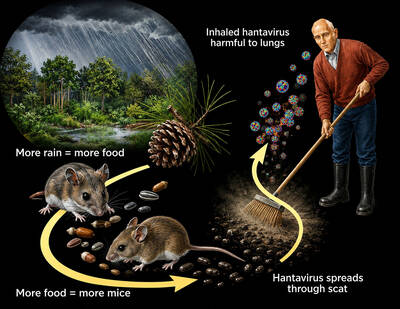
An outbreak aboard a cruise ship of a rare rodent-borne illness called hantavirus has left three passengers dead and sickened others, but global health officials say the risk to the general public remains low because the germ does not easily spread between people. “This is not the next COVID, but it is a serious infectious disease,” said Maria Van Kerkhove, director of epidemic and pandemic preparedness at the World Health Organization (WHO). “Most people will never be exposed to this.” The virus usually spreads when people inhale contaminated residue of rodent droppings. Hantaviruses have been around for centuries and are thought to

Have you ever wondered how people navigate the world when they can’t see a map? For individuals with visual impairments, conventional maps are nearly impossible to use. This is where tactile maps come in — essential tools that allow people to “see” the world through touch. A tactile map is specially designed with raised lines, textures, and symbols to represent geographical features such as roads, rivers, and buildings. Users explore it with their fingertips. However, these maps are not exclusively for people with visual disabilities. They serve as valuable multisensory learning tools that enhance spatial understanding for everyone, making

A growing green movement allows hotel guests to fund tree planting projects simply by opting out of daily room cleans. This approach turns an ordinary hotel stay into a direct contribution to nature. Founded in the Netherlands, the nonprofit “Hotels for Trees” operates on the principle that one skipped cleaning equals one new tree. It has planted more than 750,000 trees since 2021. Similarly, Sarnia Hotels in Guernsey donates £2 per refused clean. Since 2024, over 3,300 services have been cancelled, raising sufficient money to plant 1,100 native trees and hedgerows. Simplicity has been central to this success.

1. 他病了三天。 ˇ He has been sick for three days. χ He has been sick since three days. 註︰這裡現在完成時態 have / has been 表示從過去某一時日到現在的一段時間存在的行為或狀態,與它連用的時間副詞應為 「for +若干時」,如 for a year, for three hours 等,意思是歷時多少。 2. 他自從星期三以來都很忙。 ˇ He has been busy since Wednesday. χ He has been busy from Wednesday. 註︰「自從……以來」,該用 since。說從某一天(某一時刻)到某一天(某一時刻)才用 from,如 from Monday till Friday。 3. 房間角落裡散放著一些零星物件。 ˇ There were some odds and ends lying in the corner of the room. χ There were some odds and ends lying at the corner of the room. 註︰「在房間角落裡」該用介詞 in。例如: He stood in the corner. There is a lamp in the corner of the room. at the corner 指房子外部的拐角。例如: A little boy


 RSS
RSS