


In Taiwan’s various religious customs and rituals, women are traditionally not allowed to touch or get close to the sedan chairs that are used to carry gods. But in the ritual ceremony for welcoming the Wang Yeh gods, also known as the plague gods, at Wufang Village in Pingtung County’s Hsinyuan Township they have broken the gender taboo by allowing women to carry sedan chairs and religious items. Hsu Jung-huang, director of Hsinyuan’s Chengying Temple, says that the times and society are changing. Women can serve in the army, so of course they can be sedan carriers for the gods, he says.
Looking back at the month-long ceremonies for welcoming the Wang Yeh gods that recently ended in Pingtung’s Donggang, Liouciou and Nanjhou townships, only men were seen carrying the Wang Yeh sedan chairs and religious items, and every temple scrupulously reminded women about the traditional taboo of touching or getting close to sedan chairs or religious items.
But the group of sedan carriers for the recent Wang Yeh welcoming ceremony at Chengying Temple consisted almost entirely of elderly women and mothers.
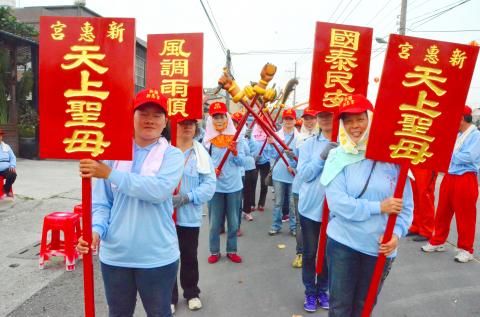
Photo: Yeh Yung-chien, Liberty Times
照片:自由時報記者葉永騫
Hsu says that with a population of only 2,000 people, practically the entire village is mobilized to help out with the ceremony, so almost all of the young men in the village take part in the large Songjiang battle formation troupe and help conduct traffic. Women, on the other hand, are usually responsible for serving as sedan carriers — a division of labor among the sexes that allows them to work together in welcoming the gods.
The temple worships mainly the Wang Yeh gods surnamed Chu, Chih, Yen and Tang as well as Kuo Hung-fu. Having women serve as sedan carriers initially caused some controversy and some people said it was entirely inappropriate, but Hsu believes that it is not a problem as long as a woman does not participate in the ceremony when she is menstruating, which has allowed the temple to overcome the sexist tradition. Everyone has gradually accepted this new way of thinking and the women sedan carriers have become a unique feature of Wufang Village’s ceremony.
(Liberty Times, Translated by Kyle Jeffcoat)
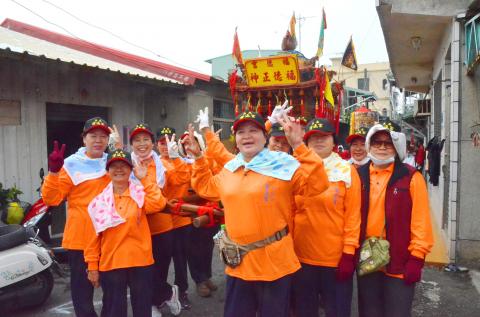
Photo: Yeh Yung-chien, Liberty Times
照片:自由時報記者葉永騫
台灣各類宗教民俗,女子不得靠近神轎,但屏東縣新園鄉打破傳統禁忌,五房村糖府千歲的祈安遶境活動,神明的轎班人員就多由女性出任,神明法器也有部份由女子手持;澄瀛宮總幹事許榮煌說,時代在變,社會也在變,女性都能當兵,當然也能勝任神明轎班。
反觀為期一個多月的東港、琉球、南州迎王平安祭典剛剛結束,盛大遶境隊伍,轎班清一色男性,王爺的神轎及用品,廟方三令五申交代女子不得觸摸、靠近,這是傳統民間禁忌。
但新園鄉五房村澄瀛宮糖府千歲日前祈安遶境活動,卻是娘子軍出動,七頂神明轎班多由婆婆媽媽組成。
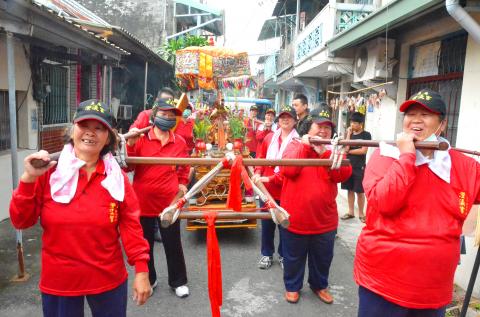
Photo: Yeh Yung-chien, Liberty Times
照片:自由時報記者葉永騫
總幹事許榮煌說,五房村僅有兩千多人,這次祭祀全村總動員,年輕男子幾乎都加入宋江陣,其餘男性投入交通指揮、村內婦女就加入轎班,男女分擔工作,合力為平安遶境奉獻。
澄瀛宮主祀朱、池、鹽、糖府千歲及廣澤尊王,這回轎班多是娘子軍曾引發議論,有人說不妥,但許榮煌認為,只須月事來時主動迴避即可,廟方突破傳統思維,讓大家慢慢接受新觀念,娘子軍也成了五房村神轎一大特色。六十三歲陳連女就說,為神明抬轎覺得很光榮。
(自由時報記者葉永騫)
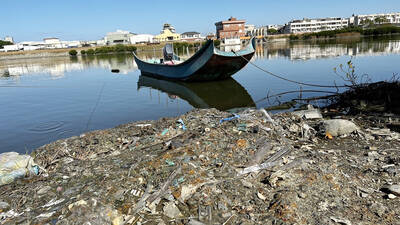
Many consumers are guilty of filling drawers or closets with old laptops, cellphones, fitness trackers and other electronic devices once they are no longer needed. It’s hard to know where to recycle such items, or it seems costly and inconvenient to do so. The world generates millions of tons of electronic waste — also called e-waste — each year. According to the UN’s most recent estimate, people worldwide produced 62 million metric tons of e-waste in 2022, and only about 22 percent of it was properly recycled. The US’ Environmental Protection Agency estimates that less than a quarter of e-waste is
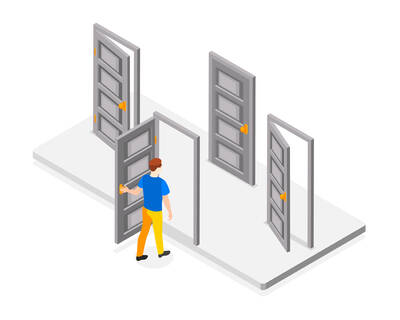
You’re sitting in class when a classmate asks to borrow a pencil. It seems like a small favor, so you agree without hesitation. The following week, the same classmate asks to share your notes. Later, they request help with a group project. You agree each time — after all, you helped out the first time — but before you know it, it has become automatic. This scenario demonstrates the “foot-in-the-door technique,” a psychological concept that shows how agreeing to small, acceptable demands makes it easier to accept larger ones later on. The name for this strategy comes from door-to-door
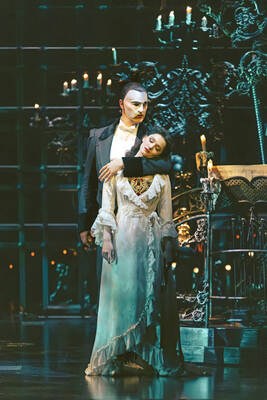
A: The four-day Tomb Sweeping Day long weekend begins Friday and will run until Monday. Are you going to sweep your ancestors’ tombs? B: I did in advance last weekend, so I can go to Kaohsiung to see the musical “The Phantom of the Opera.” A: Wow, is “Phantom” touring Taiwan again? It debuted in 1986, so this year marks the 40th anniversary of the show. B: And it’s not just touring Kaohsiung starting March 31, but also Taipei starting April 21 and Taichung starting May 26. A: “Phantom” is one of the world’s Four Major Musicals. I’ve seen all of them, except “Les

Dos & Don’ts — 想想看,這句話英語該怎麼說? 1. 我們很早到達電影院。 ˇ We arrived at the theater very early. χ We arrived the theater very early. 註︰arrive 為不及物動詞,後面如果有受詞要用 at 或 in。例如:They arrived in Taipei yesterday.。一般大地方,如國家、省、大城市等前面用 in,凡小地方城鎮、學校等則用 at。 2. 開車半小時以後,我們到達了海灘。 ˇ After half an hour’s drive, we got to the beach. χ After half an hour’s drive, we got the beach. 註︰come, go, get(來、去、到達)某地時,在表示地點的名詞前面應該用 to,如 go to school, go to Taipei, come to Shanghai 等。如果這些動詞後面所跟的是 here, there, home 等副詞,則不用 to。 3. 明天我會回辦公室。 ˇ I will be back in the office tomorrow. χ I will be back to office tomorrow. 註︰to be back 一語裡的 back 是副詞,不是介詞,所以後面要用 at (the market) 或 in (the office)。 假如假期結束,要回學校上課了則可說: ? Kids will be back


 RSS
RSS