


With the Zhongyuan Festival ending yesterday, we are halfway through Ghost Month, the time in which the gates of the underworld are said to open. What comes next? The Hsinchu Hakka Yimin Festival. It is an annual event in which Hakka honor and commemorate the valor and the sacrifice of hundreds of Hakka martyrs, or Yimin, who fought against invaders in two civil uprisings in Taiwan to protect their people and their land during the Qing Dynasty.
Today marks the opening of the Hsinchu Hakka Yimin Festival. It will begin with performers in Yimin costumes re-enacting battles between the Yimin and invaders and a Hakka carnival featuring creative ways of suspending meals on bamboo sticks at Hsinchu County’s Sinpu-Fangliao Yimin Temple this morning. “The event tomorrow morning will also feature the ritual of welcoming returning Yimin pennants from subsidiary Yimin temples from across Taiwan to the main temple,” Sinpu-Fangliao Yimin Temple Abbot Lin Pang-hsiung told the Taipei Times yesterday. This will be followed by a concert titled “A World of Hakka, an Evening of Yimin,” featuring Taiwanese band Mayday, held at the Hsinchu County Stadium this evening. Mayday will join the public to celebrate Hakka culture and pay homage to the Yimin. The Yimin pennants will, of course, be transferred to the stadium prior to the concert.
Although there are 41 subsidiary Yimin temples in Taiwan, there will only be 25 temples participating in the returning ritual today due to the inconvenience of traveling to the temple, a temple worker surnamed Chiu said yesterday. Aside from returning during the last weekend before the Yimin Festival, each temple also has its own annual returning date, said Lin.
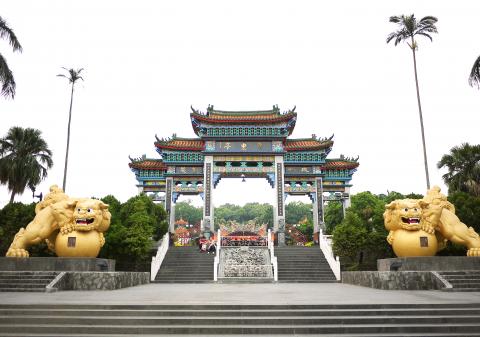
Photo: Lin Ya-ti, Taipei Times
照片:台北時報林亞蒂
The Yimin Festival is one of 12 major Hakka festivals designated by the Hakka Affairs Council and is also the most sacred religious and cultural event for Hakka people throughout Taiwan, attracting a total of 600,000 worshipers annually. Besides the opening events today, the flagship event of the one-month-long festival will be the three-day Yimin Festival ceremonies from the day after tomorrow (on the 18th day of the seventh month of the lunar calendar) until next Wednesday.
The ceremonies will incorporate the traditional pudu ritual for transmigrating the souls of the dead and will be carried out according to traditional practices. First, bamboo sticks holding lanterns and flags will be raised, symbolizing the beginning of the pudu ritual, which will be followed by a series of events, including the consecration of objects, placing lanterns on water, water-lantern parades, traditional Yimin deity inspection tours with performances by folk art troupes in the 15 Hakka communities, worshiping the Jade Emperor, and a giant sacrificial pigs contest.
Built in 1788, the Sinpu-Fangliao Yimin Temple (aka the Baojhong Temple) is the oldest and largest of all Yimin temples in Taiwan. It is also the center for Hakka worship in Hsinchu County. The Yimin Mound and the Auxiliary Yimin Mound, where the Yimin martyrs were buried, are located behind the temple.
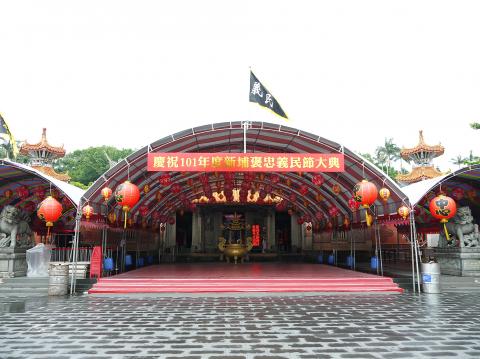
Photo: Lin Ya-ti, Taipei Times
照片:台北時報林亞蒂
There are 15 Hakka communities across Taiwan, and they all take turns making the annual pilgrimage to the Yimin temple. This year, it is the Hukou Hakka community’s turn. Hukou community chief Chang Fu-pu said it covers a wide area and has more than 60,000 members, which makes it the third largest of the 15 Hakka communities. On Aug. 5, Yimin pennants were transferred from the Sinpu-Fangliao Yimin Temple to the five representative temples of the Hukou community — namely the Siansheng Temple in Hukou, the three Sanyuan temples in Hukou’s ancient district, Hukou’s Polowen area, and Yangmei’s Sanhu borough respectively, and the Fude Temple in Hukou’s Jhongsing area.
Therefore, for one month following Aug. 5, when the Yimin deities are transferred to Hukou from Sinpu, each borough and neighborhood in Hukou will take turns preparing sumptuous breakfasts, lunches and dinners for their “ancestors,” and members of the public are also allowed to present food in the fengfan ceremony, and this will go on until the Yimin deities have returned to the Sinpu-Fangliao Yimin Temple.
Council for Hakka Affairs Minister Huang Yu-chen said recently that, “Taiwan and the world would not be complete without the Hakka.” A series of big festival activities will help pass down the cultural traditions and promote the loyal and righteous spirit of Yimin deities.
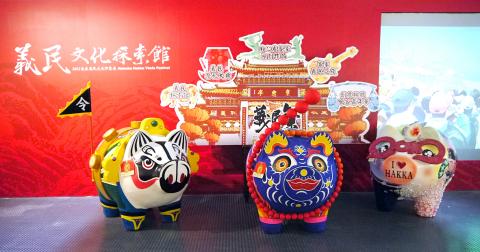
Photo: Lin Ya-ti, Taipei Times
照片:台北時報林亞蒂
(Lin Ya-ti, Taipei Times)
中元節昨天落幕,鬼月鬼門已開半個月,接下來還有什麼祭祀活動呢?答案是:「新竹縣義民文化祭」。它是全台客家鄉親的年度祭祀盛會,祭弔數百位「義民爺」,他們是在清朝兩次在台灣的起義事件,護國衛民的英勇烈士。
今天正值義民文化祭的開幕式,首先登場的是今天上午在新竹縣新埔枋寮義民廟的「義民打頭陣與創意挑擔哈客嘉年華」活動。新埔枋寮義民廟住持林邦雄昨天向《台北時報》表示:「明天上午將有各地分香廟的『香旗回娘家』活動。」接下來是今晚新竹縣體育場的「客家義民之夜」晚會,請到「五月天」樂團,與民眾一同哈客、祭義民。當然,也會在演出前,迎神護駕義民爺令旗到新竹縣體育場。
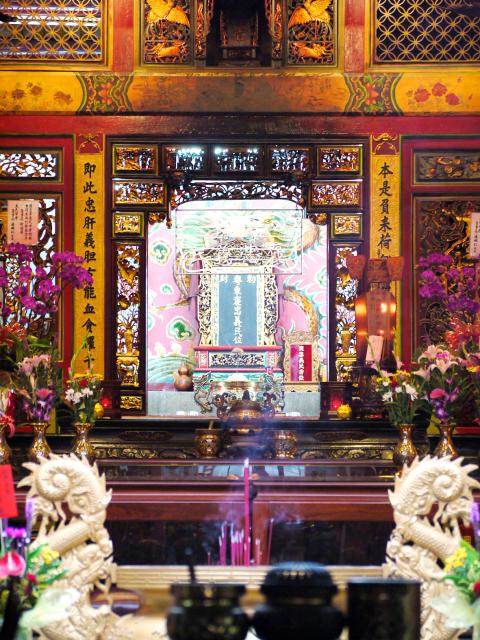
Photo: Lin Ya-ti, Taipei Times
照片:台北時報林亞蒂
全台雖有四十一間義民廟,但邱姓廟方人員昨天表示,因考量到路途的因素,今天將有二十五間分香廟「回娘家」。而林邦雄也表示,各分香廟除了義民節前的假日「回娘家」外,各自也有每年回本廟的日子。
義民節是行政院客家委員會的客庄十二大節慶之一,也是全台客家鄉親最虔誠的宗教文化祭典,每年祭祀總人口數高達六十萬人。除了開幕活動外,為期一個月的義民祭活動重頭戲,就落在後天(農曆七月十八日)起至下週三,為期三天的義民節祭典。
祭典將融合普渡儀式,遵循祭祀古禮。首先有立燈篙,象徵祭典的開始;接著有開光、放水燈、遊水燈排、陣頭齊聚的十五聯庄義民爺繞境、拜天公、以及神豬比賽等。
興建於西元一七八八年的新埔枋寮義民廟,又稱「褒忠亭」,是台灣首屈一指的義民廟,也是竹塹地區客家人的信仰中心。廟宇後方有「義民塚」與「義民附塚」,即是義民先烈的安葬之處。
一年一度的祭典,由涵蓋新竹桃園十五聯庄輪值籌辦義民節,而今年的輪值區為湖口聯庄。湖口總爐主張福普表示,湖口聯庄涵蓋範圍廣,人數多達六萬多人,是十五聯庄中第三大祭典區。湖口聯庄已於八月五日,從新埔枋寮義民廟恭請義民爺「香旗」到湖口輪值祭典區,祭廟代表包括湖口顯聖宮、老湖口三元宮、波羅汶三元宮、楊梅三湖里三元宮、湖口鄉中興社區福德宮等五個廟。
對客家子弟來說,義民爺就像是自己的祖先,因此從八月五日恭迎義民爺從新埔回湖口的一個月期間,湖口聯庄各鄰里每日輪流為「祖先」準備早、中、晚的豐盛佳餚,也開放信徒「奉飯」,直到恭送義民爺回義民廟為止。
客家委員會主任委員黃玉振表示:「沒有客家,台灣就不完整;沒有客家,世界就不完全!」客家人透過民俗節慶活動,讓信仰文化傳承,並發揚義民爺的忠義精神。
(台北時報記者林亞蒂)

Cameras are everywhere — in our pockets, on our walls and even in space. They capture emotions, preserve history and reflect culture. Through these devices, photography is now essential to modern life, influencing how we perceive ourselves and the world. To understand the root of their power, let’s explore the camera’s remarkable journey. The story begins with the camera obscura, a dark room with a tiny hole. Light passing through the opening projected an inverted image on the opposite wall. Renaissance artists used this principle to paint accurate scenes. However, these images couldn’t be preserved as photographs. That changed

A: This year’s two most anticipated films have finally hit theaters in Taiwan. “Michael” premiered last Wednesday, while “The Devil Wears Prada 2” premiered this Wednesday ahead of its global release. B: Isn’t “Michael” the biopic about the late King of Pop Michael Jackson? A: Yup, it tells the story of Michael’s legendary life, from child star to global icon. And the role is in fact played by his nephew, Jaafar Jackson. B: Michael caused a sensation when touring Taiwan twice in 1993 and 1996. His classic hits, dance moves and music videos reshaped global pop culture at that time. A: I’m gonna

A: In addition to the biopic “Michael,” comedy “The Devil Wears Prada 2” is finally in theaters. I can’t believe it’s been 20 years since the 2006 debut of the original film. B: Does the sequel still revolve around the fashion industry? A: This time, “Miranda,” the fashion magazine editor-in-chief played by Meryl Streep, will team up with her former assistant “Andy,” played by Anne Hathaway, to fight against Emily, her other ex-assistant played by Emily Blunt. B: Isn’t the role of “Miranda” based on then US “Vogue” editor-in-chief Anna Wintour? A: Yup, it established Anna’s fashion status, influenced pop culture
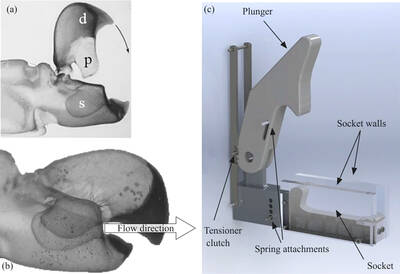
Few sea creatures of their size have as much destructive power as pistol shrimp. These small animals, usually measuring around four centimeters long, produce shock waves that can stun or even kill their prey. The attack begins when the shrimp opens its specialized claw, allowing water to fill a chamber inside. Then the claw closes rapidly. A bump on the claw strikes the chamber, forcing the trapped water out through a narrow opening at a high speed of about 25 meters per second. The rapid movement forms a bubble in the water that collapses almost instantly under the pressure of the


 RSS
RSS