


Composer Teng Yu-hsien’s works, such as Su Kui Hong (Red Four Seasons), Bang Chhun Hong (Awaiting the Spring Breeze), and other popular Taiwanese folk songs, are still performed in Taiwan today. Organized by Teng’s grandson Teng Tai-chao, a series of events titled “Centennial, Encounter, Teng Yu-hsien” are taking place at the Bopiliao Historical Block in Taipei’s Wanhua District and will run through Dec. 18. The events commemorate Teng Yu-hsien’s legendary life and will include a phonograph record which was thought to be lost for more than seven decades. They promise to take audiences back to the 1930s, when Taiwanese popular music thrived.
Music collector Lin Tai-wei opened a press conference on Monday by playing the only surviving phonograph record in Taiwan of the then budding composer Teng Yu-hsien’s earliest work, March of the Daitotei. Hearing the music, considered lost for over seven decades, once more echoing around the Bopiliao Historical Block with the rustling sound of old phonograph records, was evocative of a bygone era.
Among the exhibits, publicly exhibited for the first time in their entirety, are Teng Yu-hsien’s valuable original scores, including the Sigh of Wild Flowers, composed for eight instruments, which is the most complete known set of scores of his work. There are 10 more original phonograph records, including Goat Ia Chhiu (Moon Night Melancholy), U Ia Hoe (Flowers in the Rainy Night), and A Red Egg.
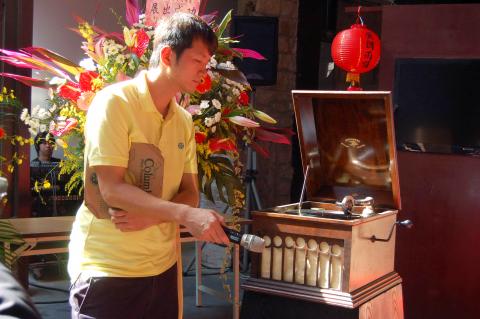
Photo: Chiu Shao-wen, Taipei Times
照片:自由時報記者邱紹雯
Teng Tai-chao said that although Teng Yu-hsien was Hakka, he studied Hoklo during his time at Laosong Public School, and most of his works are Taiwanese folk songs with Hakka elements. Tai-chao hopes to keep his grandfather’s legacy alive through the exhibitions and to allow these beautiful melodies, which belong to all Taiwanese, to last forever.
For more information about Teng Yu-hsien and old records, there are to be two seminars on 78rpm phonograph records today and next Saturday at Bopiliao with many collectors sharing their stories about these old 78s. Also, there will be an open-air concert of Teng Yu-hsien’s classic songs performed by singer Emily Guan, composer and cellist Fan Tsung-pei, and others on Dec. 17.
(LIBERTY TIMES, TRANSLATED BY LIN YA-TI)
作曲家鄧雨賢所創作的《四季紅》、《望春風》等一首首膾炙人口的台語經典老歌傳唱至今。鄧雨賢之孫鄧泰超策劃「百年.遇見.鄧雨賢」系列活動,即日起至十二月十八日在台北市萬華區的剝皮寮歷史街區展出,回顧鄧雨賢傳奇的一生,並重現失傳超過七十年的蟲膠原音唱片。該活動將帶領聽眾重新回味三○年代台灣流行音樂盛況。
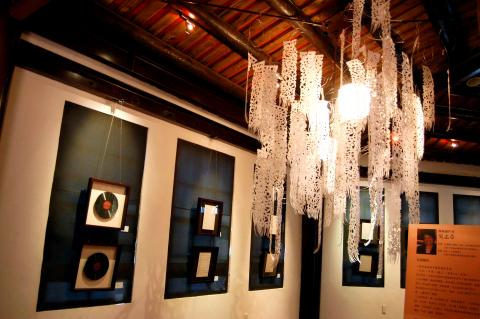
Photo: Chiu Shao-wen, Taipei Times
照片:自由時報記者邱紹雯
收藏家林太崴在週一的開幕記者會上,透過鄧雨賢嶄露頭角之作《大稻埕行進曲》僅存的蟲膠唱片,播放該曲揭開序曲。失傳超過七十年的樂音,重新迴盪在剝皮寮歷史街區,古早的「沙沙」樂音今日聽起來另有一番滋味。
展覽中也首度完整公開鄧雨賢珍貴的樂譜創作手稿,包括以八種樂器創作譜曲的《閒花嘆》,也是目前所留下最完整的手稿系列。另有《月夜愁》、《雨夜花》、《一顆紅蛋》等十張原版蟲膠唱片。
鄧泰超說,雖然鄧雨賢為客家人,但在老松公學校時期學習台語,創作歌曲多為台語歌,也融入客家元素,希望展覽能替祖父紀錄生命,讓屬於台灣人的優美旋律永遠流傳。
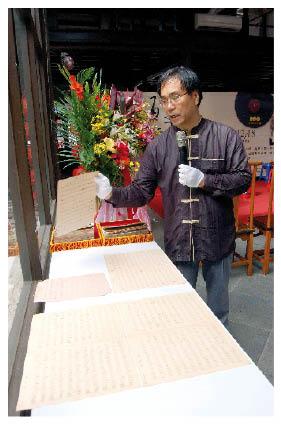
Photo: Chiu Shao-wen,Taipei Times
照片:自由時報記者邱紹雯
想更進一步認識鄧雨賢及老唱片,今天和下週六協會在剝皮寮舉辦兩場「七十八轉老唱片座談會」,由多位收藏家分享蟲膠唱片的故事;十二月十七日另有露天音樂會,由女歌手官靈芝和作曲家兼大提琴家范宗沛等人帶來多首鄧雨賢的經典歌曲。
(自由時報記者邱紹雯)

The debate surrounding Taipower’s recent corporate identity reboot has gone well beyond the design community. The controversy began after Taipower replaced the familiar “Taiwan Power Company” wording — widely regarded as the calligraphy of Yu You-ren (1879-1964), former Control Yuan president and master calligrapher — with a modern logotype by designer Aaron Nieh’s team, Aaron Nieh Workshop. Taipower said the change was not a wholesale replacement of old signage, but an “optimization of its identity system,” aimed at meeting the needs of digital media, electronic bills, apps, social media graphics and various small-format applications. Existing physical markings, such as building

Since 2005, the third Monday in January has come to be known as “Blue Monday.” In other words, that day is believed to be the most depressing day of the year. This concept seems logical at first. After all, Monday marks the start of the school or workweek after two days of rest and fun. Also, blue is a color that is often associated with sadness. Furthermore, in many parts of the world, January is a time when the weather is cold, rainy, and gloomy. But is there any scientific proof that this January day is truly sadder than any of

Continued from yesterday(延續自昨日) https://www.taipeitimes.com/News/lang For the most part, the idea of “Blue Monday” has been rejected as a myth. Some mental health experts also say there is a danger in labeling a certain day as the most depressing time of the entire year. Some argue that if people expect to feel sadder on the third Monday in January, this belief alone may increase their anxiety. One group that is worried about the negative effect of believing in Blue Monday is Samaritans. A mental health charity based in the UK, Samaritans is working to turn Blue Monday into “Brew Monday.” In this

A: In early May, there were concerts by Icyball, Chyi Yu, Korea’s EXO and Japan’s Anisama, but I missed them all. What a shame. B: That’s OK. There are shows coming up by various artists, including Power Station, Accusefive, Japanese singer Mika Nakashima, Chinese-Icelandic jazzer Laufey, and even Singaporean diva Stefanie Sun. A: After a 12-year hiatus, Stefanie is finally returning to Taipei again. B: In late May, there will be more shows by Crowd Lu, WeiBird, Korea’s Donghae, 2AM, EXID, and Thailand’s BUS. A: The Thai boyband is so popular. It looks like “T-pop” is catching up with J-pop


 RSS
RSS