


A 90-something-year-old woman living in Hsinchu County withdrew NT$1,000,000 two years ago and then forgot that she hid the thick pile of NT$1,000 banknotes in the kitchen cupboard. A family member recently discovered the money while cleaning up the kitchen. The banknotes are still intact, but are damaged and moldy. They were forced to seek help from the Investigation Bureau’s Hsinchu County Field Station since all the banks they went to refused to exchange the money for new bills.
The elderly woman refused to be interviewed, but her son-in-law, surnamed Huang, said she is financially independent, and because of her old age and illiteracy and unwillingness to bother the younger generation to go to the bank with her, she periodically withdrew money so that she would have some cash readily available. It was her habit to hide money in various places around the house without letting her family know.
When family members were recently cleaning up the kitchen, they found an ordinary plastic bag in one corner of the cupboard where plates and food were stacked. Peeking inside the bag, they were surprised to discover a pile of NT$1,000 banknotes 18cm high, with the Standard Chartered Bank seal still intact. They assumed that she must have forgotten the pile of money was inside the cupboard. They did not break the seals because they were afraid of causing further damage to the banknotes. It was only after checking her bankbook they conjectured that the total sum might be around NT$1,000,000.
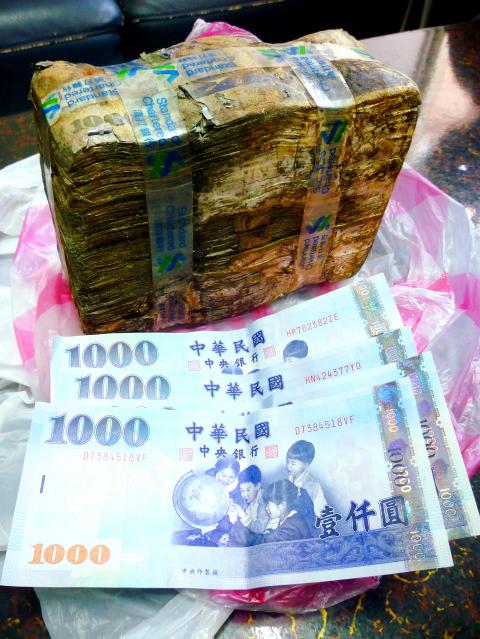
Photo: Liao Hsue-ju, Taipei Times
照片:自由時報記者廖雪茹
Huang said they took the banknotes to E.Sun Bank to exchange them for new ones, but that the banknotes were too damaged and moldy, not to mention stuck together. The clerk refused to exchange them, so they took the pile of money to the Bank of Taiwan, where they were advised to take the money to an Investigation Bureau field office to authenticate the money in order to replace it with new banknotes according to the Central Bank’s standard procedure for dealing with damaged banknotes.
Huang applied to have the money authenticated at the Investigation Bureau’s Hsinchu County Field Station where it was determined that humidity in the kitchen had damaged the bills, that only a small amount had been damaged, that moths had not eaten any of them, and that most of the banknotes were intact.
(LIBERTY TIMES, TRANSLATED BY TAIJING WU)
新竹一位九十多歲老太太,二年前提款新台幣一百萬元回家,厚厚整捆千元鈔藏在「菜櫥仔」竟忘了,家人最近整理廚房意外發現;紙鈔大致完整,但外觀污損、發霉,銀行不敢收,家人因此求助新竹縣調查站鑑定。
老太太不願受訪,但她的女婿黃先生說,岳母經濟獨立自主,但因年老、不識字,又不想麻煩晚輩陪她跑銀行,常一次領一筆回家,以便隨時取用,而她習慣東擺一點、西藏一些,也沒讓家人知道。
日前家人清掃廚房,在堆放碗盤、乾糧的「菜櫥仔」角落,翻到一只普通塑膠袋,一看竟是整捆千元鈔,厚達十八公分,有渣打銀行的完整封條,猜想必是阿嬤放到忘記,因怕損及鈔票,不敢拆封,只核對存摺,研判是新台幣一百萬元。
黃先生說,家人拿去玉山銀行換新鈔,但紙鈔有點污損、發霉,且每張都黏在一起,行員不敢收兌;家人去台灣銀行,行員建議送調查站鑑定,確認為可辨識真鈔,才能依中央銀行處理破損紙幣的標準兌換新鈔。
於是黃先生將鈔票送新竹縣調查站申請鑑定,縣調站研判,可能是廚房潮濕,造成鈔票外觀污損,僅一小疊有破損,沒被蛀蟲啃食,大致完整。
(自由時報記者廖雪茹)

The US-Israeli war with Iran, which began on Feb. 28, has killed thousands of people, destabilized the Middle East and rocked global energy markets by effectively closing the strait. WHAT IS THE STRAIT OF HORMUZ? Lying between Oman and Iran and linking the Gulf north of it with the Gulf of Oman to the south and the Arabian Sea beyond, the strait is 33km wide at its narrowest point, with a shipping lane just 3km wide in either direction. Perhaps the world’s most important energy shipping channel, the waterway is about 167km long. Following through on an old threat, Tehran effectively closed the strait
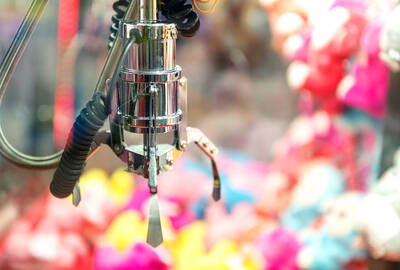
Have you ever found yourself desperately feeding coins into a claw machine just because you’ve already spent so much trying to win that stuffed animal? Or maybe you’ve continued watching a boring movie simply because you already paid for the ticket? If so, you’ve experienced the “sunk cost fallacy.” A sunk cost refers to time, money or effort that has already been spent and cannot be recovered. This psychological trap is surprisingly common. You might keep playing a video game you no longer enjoy because you’ve invested countless hours in building your character, or maintain a toxic friendship because you’ve known

A: Which TV drama series have been global hits so far this year? B: The US drama “Stranger Things 5,” South Korean drama “Can This Love Be Translated?” and Chinese megahit “Pursuit of Jade” are all popular lately. A: Isn’t “Pursuit of Jade” the costume idol drama about the romance between a charming marquis and a pig-slaughterer? Actor Zhang Linghe and actress Tian Xiwei are both so attractive. B: Plus, Netflix’s Korean-Japanese gay romance drama “Soul Mate” — starring Korea’s Ok Taec-yeon and Japan’s Hayato Isomura — is set to premiere in May. A: These hit international dramas

1. 他甚至還自認為是個了不起的領導人。 ˇ He even went so far as to think himself a great leader. ˇ He even went so far as to think of himself as a great leader. χ He even went so far as to think himself as a great leader. 註:認為某人或某事為何等樣人或何等樣事,可用 think+受詞+受詞補語,或 think of ... as ...,正句第一句比第二句普遍些。用了 of,後面用 as;沒有 of,就不可以用 as。又如: I thought him quite a joke. I thought of him as quite a joke. 2. 你不應該打擾他休息。 ˇ You should not intrude upon him during his time off. χ You should not intrude him during his time off. 註:intrude 作「闖進」、「打擾」、「侵入」解時,是不及物動詞,後面跟 upon。 3. 男孩正在玩陀螺。 ˇ The boy is playing with his top. χ


 RSS
RSS