


Whenever the subject is usually broached, most people say they would rather not do their compulsory military service. However, Vincent Chao, a 23-year-old Canadian citizen born in Taiwan but growing up abroad, still chose to do his military service after returning to Taiwan to work for two years. He says, “I am Taiwanese, so of course I want to serve.” Chao has even decided to renounce his Canadian citizenship after completing his military service.
Chao was born in Taipei’s Neihu District. He moved to Japan at the age of four with his family, and then immigrated to Canada in 1997. Since he wanted to understand life in Taiwan, he traveled back to his homeland to attend junior high school for a year and a half, temporarily living with relatives in Kaohsiung. Chao eventually went back to Canada to finish high school and major in political science at a Canadian university.
Chao said he never learned Mandarin Chinese growing up, even though his parents and younger brother spoke the language. He never even learned how to write his name in Chinese, and it was this desire to learn the language that made him ask his parents if he could return to Taiwan. During his university studies in Canada, he decided that he would return to Taiwan to build his career and do his military service upon graduation.

Photo: Luo Hsin-chen, Taipei Times
照片:自由時報記者羅欣貞
Upon returning to Taiwan, Chao started working for the Taipei Times (a sister paper of the Chinese-language Liberty Times) as a political reporter. Despite his passion for the job, he decided to do his civic duty and complete his compulsory military service. He said the difficulties one faces serving in the military are bearable, and just like when you are a reporter, every day offers a new experience. “There are very few opportunities in life where your country willingly provides you with a fitness coach to train you, and if I wasn’t serving as a soldier, I wouldn’t have the slightest clue where to go for target practice.”
(LIBERTY TIMES, TRANSLATED BY TAIJING WU)
聽到要當兵大部分人都不願意,但是二十三歲,擁有加拿大國籍的趙怡翔在台灣出生,自幼旅居海外,卻在回台工作兩年後,決定穿上軍服當兵去。他說「我是台灣人,當然要當兵。」他決定服完兵役放棄加拿大國籍。
趙怡翔出生於台北內湖,四歲時隨家人移居日本,一九九七年舉家移民加拿大。為了了解台灣的生活,他在國中時獨自回國,寄住高雄親戚家,還到國中唸了一年半,回加拿大才完成高中及大學學業主修政治。
他說長大時未曾學過中文,即便父母親和他弟弟都說華語,連自己的名字都不會寫。也就為了學中文,所以才要求父母讓他回台灣學中文。上大學時便決定畢業回台灣發展,且想在台灣服兵役。
趙怡翔回台曾在自由時報報系「Taipei Times」工作,擔任政治線記者。雖然對這份工作相當喜愛,但還是決定穿上軍服完成國民應盡的義務。他說軍中的辛苦是可以忍受的,就像當記者一樣,每天都是新體驗。他表示,「人生應該很少機會有國家提供健身教練幫你鍛鍊身體,且若不是服兵役,他還不知道去哪裡學打靶。」
(自由時報記者羅欣貞)

As bee populations around the world continue to decline at an alarming rate, scientists are developing an innovative solution: robotic bees. Recent advances at research institutions like Massachusetts Institute of Technology (MIT) in the US have produced tiny flying robots capable of performing pollination tasks similar to those of real bees. These tiny machines represent an impressive technological achievement. MIT’s latest models can hover in the air for over 1,000 seconds and perform complex movements, demonstrating the agility needed for successful pollination. The robots are designed to mimic the flight patterns of natural bees, offering potential support to agriculture

A: Taiwan legalized same-sex marriage on May 24, 2019, so this week marks the seventh anniversary of that milestone. By the end of 2024, a total of 32,126 LGBT couples had tied the knot. B: How many of them got married to foreign partners? A: In 2024, there were 504 cross-border same-sex marriages. By the end of that year, there were 130 cross-strait same-sex marriages between Taiwanese and Chinese — accounting for only about 0.4 percent of the total. B: I’ve heard that a seven-year marriage brings the “seven-year itch.” I bet some couples regret their decisions now. A:

A: While Taiwan is celebrating the 7th anniversary of legalizing same-sex marriage, a poll shows that the support rate for same-sex marriage rose sharply from 37.4 percent seven years ago to 69.9 percent last year. B: Actually, I’m a bit curious about the size of Taiwan’s LGBT population. A: I’m not sure. But if we take a Gallup poll in the US as an example, 9.3 percent of American adults identified as LGBT in 2024. B: Wow, is it because the Americans are relatively open? In many other countries, the figures hover around 5 percent. A: Based on this,
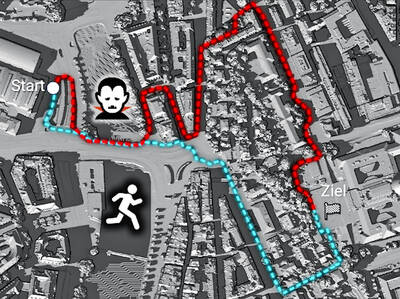
As climate change and urbanization push city temperatures higher, walking outdoors is becoming increasingly uncomfortable in many parts of the world, especially when prolonged time spent in sunlight is involved. As a result, outdoor lovers are now seeking cooler, shaded walking routes. However, most mainstream map apps still do not __1__ shaded footpaths. Enter routing.osm.ch — a Swiss web-based route planner that introduces a novel solution to this problem. Its “Vampire mode,” named after the legendary creatures’ fear of being __2__ natural light, was developed by a Swiss research team led by Professor Stefan Keller. The platform combines open data from


 RSS
RSS