


The world, it seems, was its salad bar.
Scientists are amazed at the chomping ability of a newly described duck-billed dinosaur. They say its strong jaw meant that no leaf, branch or bush would have been safe.
"It really is like the Arnold Schwarzenegger of dinosaurs - it's all pumped up," said Scott Sampson, who works at the Utah Museum of Natural History.
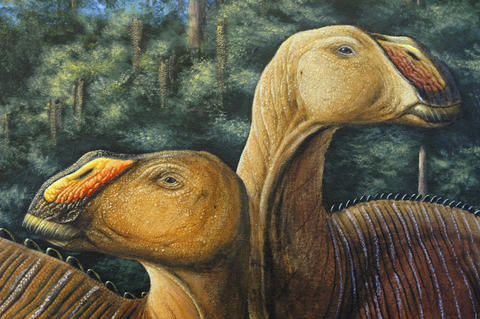
PHOTO: AP
Duck-billed dinosaurs were pretty scary plant eaters. They had hundreds of teeth and a body that could knock down trees.
This new kind of duck-billed dinosaur was discovered in the western US in 2002. Scientists say it was at least 9m long and 3m tall.
Scientists are now trying to learn if this new kind of dinosaur lived alone or traveled in packs. They also want to know why different species of duck-billed dinosaurs developed.
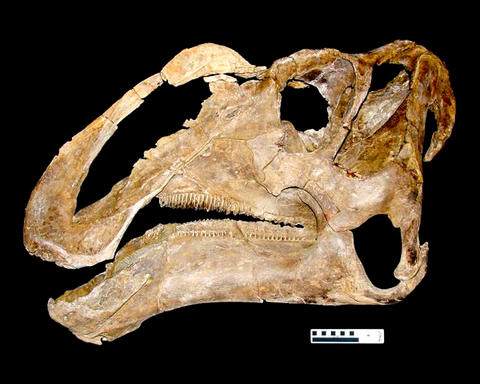
PHOTO: AP
(Staff Writer, with AP)
整個世界似乎就是牠的沙拉吧。
一種新種鴨嘴恐龍的囓咬能力讓科學家們驚嘆不已。他們說牠的強壯下顎意味著幾乎沒有任何樹葉、樹枝或灌木能「倖免於難」。
美國猶他州自然歷史博物館館員史考特.山普森說:「牠就像是恐龍界的阿諾.史瓦辛格-可說是渾身上下都很強壯。」
鴨嘴恐龍是非常可怕的食草動物。牠們擁有數百顆牙齒,身體可以撞倒大樹。
這種新種鴨嘴恐龍[的化石]是二○○二年在美國西部被發現的。科學家們指出牠至少有九公尺長、三公尺高。
科學家們正試圖了解這種新種恐龍是喜歡獨居還是群體活動。
(美聯社/翻譯:艾利斯)
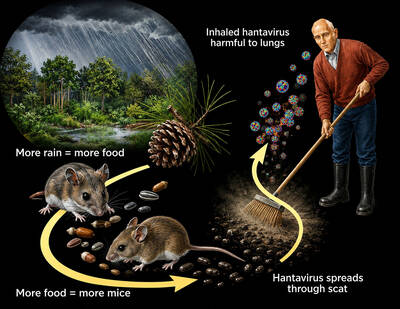
An outbreak aboard a cruise ship of a rare rodent-borne illness called hantavirus has left three passengers dead and sickened others, but global health officials say the risk to the general public remains low because the germ does not easily spread between people. “This is not the next COVID, but it is a serious infectious disease,” said Maria Van Kerkhove, director of epidemic and pandemic preparedness at the World Health Organization (WHO). “Most people will never be exposed to this.” The virus usually spreads when people inhale contaminated residue of rodent droppings. Hantaviruses have been around for centuries and are thought to
A: Apart from the Danjiang Bridge in New Taipei City, the MRT Sanying Line (Light Blue Line) will open in June. B: Is that the new line leading to Yingge District, the ceramic town? A: Yup, the line will connect the Yingge Ceramics Museum and the Old Streets in Sanxia and Yingge Districts. B: The eastward extension of the Tamsui-Xinyi Line (Red Line) that goes through Taipei’s Xinyi District will also open in June. A: Plus, Taoyuan’s Aerotropolis Line (Green Line) will partially open by the end of the year. In the future, it will connect the

1. 他病了三天。 ˇ He has been sick for three days. χ He has been sick since three days. 註︰這裡現在完成時態 have / has been 表示從過去某一時日到現在的一段時間存在的行為或狀態,與它連用的時間副詞應為 「for +若干時」,如 for a year, for three hours 等,意思是歷時多少。 2. 他自從星期三以來都很忙。 ˇ He has been busy since Wednesday. χ He has been busy from Wednesday. 註︰「自從……以來」,該用 since。說從某一天(某一時刻)到某一天(某一時刻)才用 from,如 from Monday till Friday。 3. 房間角落裡散放著一些零星物件。 ˇ There were some odds and ends lying in the corner of the room. χ There were some odds and ends lying at the corner of the room. 註︰「在房間角落裡」該用介詞 in。例如: He stood in the corner. There is a lamp in the corner of the room. at the corner 指房子外部的拐角。例如: A little boy
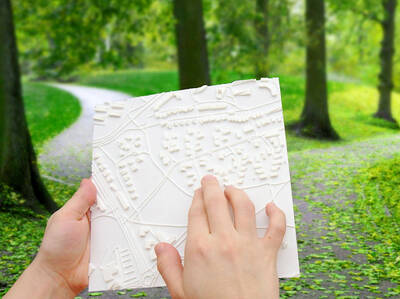
Have you ever wondered how people navigate the world when they can’t see a map? For individuals with visual impairments, conventional maps are nearly impossible to use. This is where tactile maps come in — essential tools that allow people to “see” the world through touch. A tactile map is specially designed with raised lines, textures, and symbols to represent geographical features such as roads, rivers, and buildings. Users explore it with their fingertips. However, these maps are not exclusively for people with visual disabilities. They serve as valuable multisensory learning tools that enhance spatial understanding for everyone, making


 RSS
RSS