


Have you ever been to Yangmingshan National Park? Did you know that many of the mountains there are volcanos?
A volcano is made where a gap in the earth lets out very, very hot melted rock called magma.
When the magma comes out onto the earth it is called lava. Lava can be very thick and run slowly, like honey, or it can be very thin and run quickly, like soda.
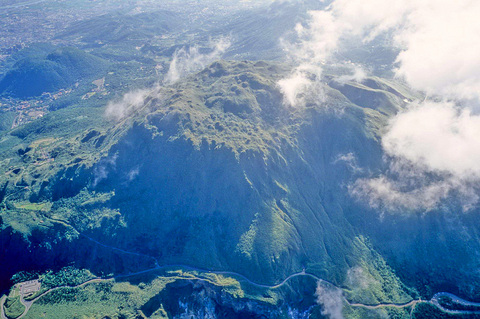
PHOTO COURTESY OF YAMINGSHAN NATIONAL PARK HEADQUARTERS
There are volcanos all over the world. Not all volcanos look like mountains, but a lot of them do. There are also volcanos under the sea.
It's been 100,000 years since the volcanos in Yangminshan (the Datan Mountains) last let out lava. When this happens it is called an eruption.
The mountains may look peaceful now but there is still a lot happening far underground. Scientists said last week that there is still a lot of magma under the mountains.
Don't worry too much though. The scientists can warn us if an eruption is going to happen. They will know about it because the plants and animals nearby will get sick.
(Catherine Thomas, staff writer)
你去過陽明山國家公園嗎?你知道那裡的山有許多是火山嗎?
火山是由地底裂縫所噴發的炙熱岩漿所組成。
當岩漿從地底噴發出來時,就稱為熔岩。熔岩可能像蜂蜜一樣濃稠、流動緩慢;也可能像汽水一樣稀淡、快速流動。
世界各地都有火山。並非所有火山看起來都像山脈一樣,但有很多都是如此。也有海底火山。
陽明山(大屯火山群)距上次噴發熔岩已有十萬年之久。當這種事發生時,稱為「火山爆發」。
這些山脈現在也許看起來平和,但深遠的地底下仍有許多變動。科學家上週指出,陽明山底下仍然有許多岩漿。
不過別太擔心。假如火山快爆發了,科學家會警告我們。當附近的動植物枯萎生病時,科學家就得知警訊了。(翻譯:賴美君)
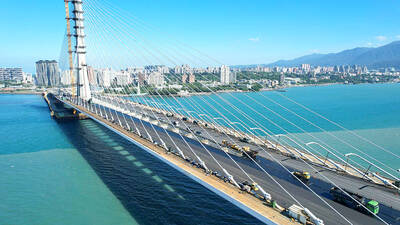
A: The Danjiang Bridge in New Taipei City is to open on May 12, and the MRT Sanying Line (Light Blue Line) will also open in June. Isn’t that great? B: Is that the bridge connecting the city’s Tamsui and Bali Districts? What’s so special about this new landmark spanning the Tamsui River? A: The Danjiang Bridge will become the world’s longest-span single-mast asymmetric cable-stayed bridge — with a total river-crossing section of 920 meters and main span of 450 meters. B: The news says there are sidewalks and bike lanes on both sides. Watching the sunset from the
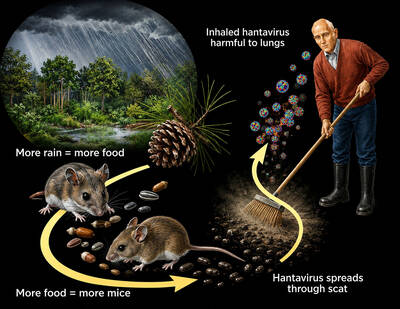
An outbreak aboard a cruise ship of a rare rodent-borne illness called hantavirus has left three passengers dead and sickened others, but global health officials say the risk to the general public remains low because the germ does not easily spread between people. “This is not the next COVID, but it is a serious infectious disease,” said Maria Van Kerkhove, director of epidemic and pandemic preparedness at the World Health Organization (WHO). “Most people will never be exposed to this.” The virus usually spreads when people inhale contaminated residue of rodent droppings. Hantaviruses have been around for centuries and are thought to
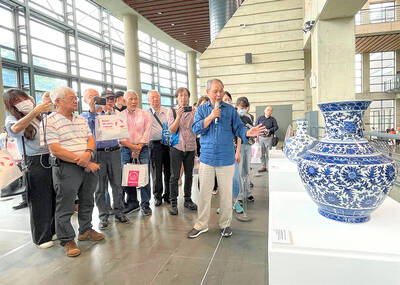
A: Apart from the Danjiang Bridge in New Taipei City, the MRT Sanying Line (Light Blue Line) will open in June. B: Is that the new line leading to Yingge District, the ceramic town? A: Yup, the line will connect the Yingge Ceramics Museum and the Old Streets in Sanxia and Yingge Districts. B: The eastward extension of the Tamsui-Xinyi Line (Red Line) that goes through Taipei’s Xinyi District will also open in June. A: Plus, Taoyuan’s Aerotropolis Line (Green Line) will partially open by the end of the year. In the future, it will connect the

1. 他病了三天。 ˇ He has been sick for three days. χ He has been sick since three days. 註︰這裡現在完成時態 have / has been 表示從過去某一時日到現在的一段時間存在的行為或狀態,與它連用的時間副詞應為 「for +若干時」,如 for a year, for three hours 等,意思是歷時多少。 2. 他自從星期三以來都很忙。 ˇ He has been busy since Wednesday. χ He has been busy from Wednesday. 註︰「自從……以來」,該用 since。說從某一天(某一時刻)到某一天(某一時刻)才用 from,如 from Monday till Friday。 3. 房間角落裡散放著一些零星物件。 ˇ There were some odds and ends lying in the corner of the room. χ There were some odds and ends lying at the corner of the room. 註︰「在房間角落裡」該用介詞 in。例如: He stood in the corner. There is a lamp in the corner of the room. at the corner 指房子外部的拐角。例如: A little boy


 RSS
RSS