


The timing of the presentation of the presidential candidates' various China policies has affected their contents. The influence of relative poll performance was also particularly evident.
Support for James Soong (
Soong's advisors, however, had already written the draft proposal on his China policy before the scandal broke. In contrast, the teams working for his former colleague Lien only began working on their candidates' policy when he was playing catch-up.
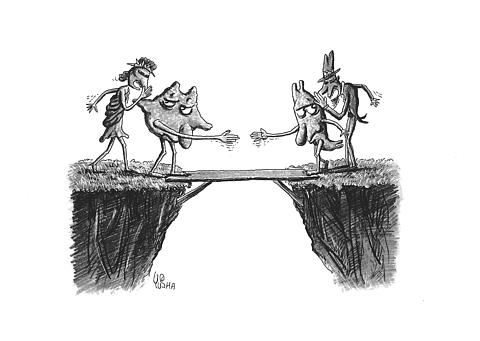
Illustration: Yu Sha
For Soong, the feeling of security that his lead gave him allowed his advisors the luxury of thinking seriously about a China policy. Preparing for his likely inauguration, Soong wanted to address both domestic and Chinese audiences while his opponents, busy catching up, could only focus on the domestic scene.
This simple fact explains why Soong's proposal is potentially the most negotiable one from Beijing's perspective.
The rationale behind Soong's policy is to establish some credit with Beijing so he won't be labeled a "troublemaker" like President Lee Teng-hui (
With his original margin of at least 10 points in the polls, Soong only needed to be careful that his China policy would not hurt him domestically. This meant that he could not openly agree with the notorious "one China" formula -- but to score with China, Soong and his advisors cleverly revived the term "relative sovereignty" (
This term was first used casually by National Taiwan University Professor Hu Fu (
By "relative," Professor Hu and his unexpected contemporary frontman mean that China's sovereignty is not unilaterally held by either side of the Taiwan Strait. While each has complete control over their own affairs, neither can unilaterally determine the fate of the whole of "China," which presumably includes both China and Taiwan.
Therefore Beijing has no right to unilaterally determine if Taiwan, or the mainland, is or is not part of "China," nor does Taipei. Concerning the status of "China," both sides must concur in order for any future arrangement to take place. This scheme certainly puts Taipei and Beijing on an equal footing.
In this policy, the "one China" principle is not stated, but it is implied. Beijing will pick up this implication eventually, if not immediately. Soong is unable to say this openly in Taiwan, for this would be tantamount to committing political suicide.
It is this situation which prompted Soong and his running mate Chang Chao-hsiung (
The Earth and the Moon are separate, yet they belong to a single system. They both circle the Sun although the satellite circles the Sun by circling the Earth, which itself circles the Sun. There are centripetal as well as centrifugal forces between them. The Earth cannot absorb the Moon, nor can it leave the Moon. The same constraint exists for the Moon.
Chang did not say what this system is called. For Beijing, it may well be called "China," while politicians on Taiwan prefer not to label it at all.
The relationship between the Earth and the Moon is not all that different from that between the Earth and the Sun, which is an obvious analogy for the international system. Henceforth, Soong argues in his platform that international norms among states are applicable to the Beijing-Taipei relationship.
Lien, by contrast, must not step outside the framework of "special state-to-state" relations put forth by President Lee. The foremost task for Lien is to attract votes rather than settle down with Beijing on any future cross-strait relationship. Catching up gradually from behind, he needs every single vote he can gather by any means possible. He must consider his China policy in this light, in order to make his campaign meaningfully competitive.
The first person Lien cannot afford to alienate is Lee . Since Lee is adamant in his "special state-to-state" prescription, Lien has no choice but to work in a discourse which is not incompatible with it. On the other hand, Lien needs to demonstrate that he has his own opinions to break away from his image as Lee's puppet. To be different and to be compliant are the two conflicting criteria that his advisors had in mind in drafting Lien's China policy.
Another difficulty is Lien's shaky popularity. He needs to satisfy as many voters as possible and this is difficult on the cross-strait issue. One critical group for Lien to win over is the post-1949 immigrants and their families, who are inclined to support Soong because they think the KMT is anti-China.
Lien needs to appear more moderate than Lee for him to become a viable alternative for this group, amounting to over 10 percent of the total vote. Unfortunately for Lien, he cannot afford to alienate the majority of native Taiwanese and most of them are not pro-unification.
To attract both groups, Lien's China policy must remain vague. This goes against the strategy of having him appear independent and strong, standing outside Lee's shadow. To be both vague and clear is another set of criteria Lien's China policy should meet.
To test the wind, Lien's advisors leaked to the media that he was thinking of proposing a "confederation" as the main conceptual framework to regulate cross-strait relations. Indeed, like visitors to Fantasy Island, different audiences can each get what they want from his notion of confederation.
It is a proposal that seems to meets the contradictory criteria that Lien must achieve.
In a confederation, each member has full sovereignty. This is good news to independence-minded people and Lee. To the US and China, confederation sounds more moderate than "special state-to-state" because confederate partners have some social and economic links that do not exist between members and non-members. For those post-1949 families, confederation presents a concrete move toward a tighter relationship between China and Taiwan. In the news leak, all three dimensions were specifically touched on.
When we compare Soong's China policy with Lien's, we find that that they are not as similar as some commentators believe. To begin with, the motivations are different: Soong's is for China's consumption, while Lien's is a little bit for everybody. Although Soong may want to say different things now that his popularity rating has dropped, the current situation suggests that Soong's "Earth-Moon" model still has the upper hand.
Lien has encountered resistance to his "fantasy island" from within his own camp. He cancelled the scheduled announcement of his confederation theme and may have to drop the term totally.
Lee and his advisors certainly want something that can uncover the "one China" message implied in the idea of relative sovereignty. Lee thus enjoys neither the Moon, nor the fantasy island. He wants a clear-cut announcement of Taiwan sovereignty pursued outside of China. This determination may hinder Lien from winning the votes of the post-1949 families. On this particular account, the moon stands over fantasy island, for the time being at least.
Shih Chih-yu (石之瑜) is professor in the department of political science at National Taiwan University.

‘NO SECURITY RISK’: The Railway Bureau reassured the public that the technicians’ activities were limited to technical guidance and did not involve sensitive systems The Railway Bureau yesterday said it had invited eight Chinese technicians to assist with an airport MRT construction project. The bureau issued the confirmation after an Internet user said Chinese nationals had entered the construction zone of Taiwan Taoyuan International Airport’s Terminal 3 project. They asked why “individuals from an enemy state” were allowed access to such a major national infrastructure project, which raised serious concerns over Taiwan’s industrial safety, sensitive systems and information security. The bureau’s Northern Region Engineering Branch Office said subcontractor Taiwan Handle Industrial Co (台灣手把工業) of the Taoyuan airport MRT’s “Contract No. CU05 Project A14 Station Civil, MEP &

A US uncrewed surface vessel (USV) encountered multiple Chinese warships during an autonomous transit of the Taiwan Strait, US defense company Seasats said in a statement on Wednesday. Seasats announced that a Lightfish USV had completed the first autonomous transit of the Taiwan Strait. Over five days, the USV traversed the entire length of the Strait while constantly monitoring surface vessel traffic, the company said. The Lightfish encountered multiple Chinese warships, one of which was a Chinese People’s Liberation Army Navy (PLAN) Type 056 corvette, it said. The Chinese vessels were operating “well within Taiwan’s exclusive economic zone without transmitting their identity via the
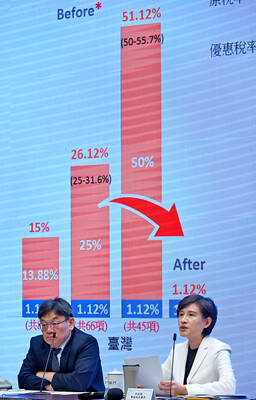
GREATER REACH? Auto parts and wood products would face tariffs of up to 15%, matching those targeting the EU, Japan and South Korea, Vice Premier said The US has announced that preferential tariff treatment for Taiwan’s non-semiconductor Section 232 goods would take effect retroactively from May 1, the Executive Yuan said yesterday. The US government yesterday posted a notice on the Federal Register’s public inspection Web site previewing tariff concessions for Taiwan under a memorandum of understanding (MOU) on Taiwan-US investment after two months of negotiations. The MOU signed on Jan. 15 stipulated three major preferential tariff arrangements: a 15 percent “reciprocal” tariff rate for Taiwan without stacking most-favored nation (MFN) rates; preferential Section 232 treatment for semiconductors and related products; and preferential Section 232 treatment for non-semiconductor

The National Chungshan Institute of Science and Technology yesterday showcased its locally developed variants of the Vision 60 robotic patrol dog, which it plans to deploy on the nation’s outlying territories in the South China Sea. The variants were produced under the Joint Lab project — created by the institute and domestic companies — and assembled with domestically produced motors, lenses and artificial intelligence (AI) systems alongside licensed tech from the US, Missile and Rocket Systems Research Division deputy director Jen Kuo-kang (任國光) told the media event at a military base in Taipei’s Dazhi (大直) area. Taiwan has built up its strengths


 RSS
RSS