

The Executive Yuan’s request for a supplementary budget of NT$607.6 billion (US$18.55 billion), including funding for social welfare programs and to strengthen national defense, advanced to committee review yesterday after Premier Cho Jung-tai (卓榮泰) briefed the legislature on the plan.
The general budget for this year finally passed its third reading on Aug. 14 after repeated delays by the opposition-controlled Legislative Yuan. The Executive Yuan in September proposed a supplementary budget to address additional funding requirements, including measures to ensure public livelihood stability in response to the conflict in the Middle East, adjustments to social welfare allowances and procurement of weaponry to enhance defense capabilities.
Cho urged lawmakers from all parties to give their full support to ensure that the budget is passed as quickly as possible to maintain the government’s operational capacity.
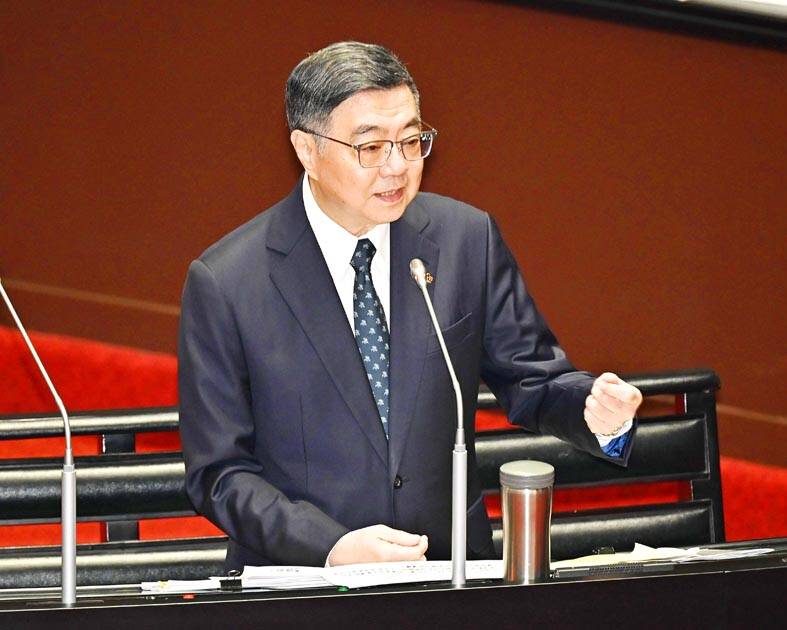
Photo: Tu Chien-jung, Taipei Times
The plan includes NT$145.7 billion in defense spending that was previously rejected by opposition lawmakers, to procure uncrewed systems and a new surface-to-air defense system. Of that amount, NT$55.9 billion would be allocated for three types of uncrewed systems that the Ministry of National Defense has sought to procure to bolster Taiwan’s defenses: coastal attack drones, coastal reconnaissance drones and small one-way uncrewed surface vessels.
The plan would also allocate NT$64.5 billion in classified funding for two projects, which are believed to involve financing that opposition lawmakers had removed, for Taiwan-US codevelopment programs.
Cho said NT$21.5 billion has been earmarked for welfare programs, including the monthly allowance for elderly farmers, which would be increased from NT$8,110 to NT$10,000, while benefits under the national pension and six major social welfare programs would be increased by 23.5 percent, and any benefit currently below NT$5,000 would be adjusted to that minimum.
He added that NT$10.7 billion would be used to support NT$2,000 across-the-board increases for professional stipends and supervisory allowances for military, public service and educational personnel.
Another NT$300 million would be used to fund subsidies for families with children to the tune of NT$5,000 per person per month, he said.
State-run oil supplier CPC Corp, Taiwan (台灣中油) is set to receive the largest share of the supplementary budget, NT$233.8 billion, to support its operations.
The company has accumulated deficits since 2020, due in part to government policies aimed at stabilizing petroleum and natural gas prices.
Separately, eight major business and industrial associations yesterday issued a joint statement calling on lawmakers to support the Cabinet’s proposal to subsidize Taiwan Power Co (台電) and CPC to rein in inflation.
Most of the two state utilities’ losses comes from government measures to rein in inflation by keeping electricity and gas prices low to stabilize commodity prices and ensure reliable power supply, the groups said.
The groups urged lawmakers to support government measures to help these firms to prevent any adverse impact on industrial operations or the cost of living for the general public.
However, they also emphasized the need to clearly distinguish between costs stemming from government policy and those resulting from operational management, and establishing a transparent review and supervision system.
They recommended that Taipower and CPC develop medium to long-term financial improvement plans and to periodically disclose their progress.
Funding for research and development into alternative energy sources and the transition to a net zero economy should be preserved, they added.
The government should balance the needs of the general public, industrial competitiveness and energy supply security by creating a fair, transparent and predictable energy pricing adjustment mechanism, and any significant adjustments should be preceded by thorough consultation with the industrial sector, they said.
The eight groups are the Chinese National Federation of Industries; the General Chamber of Commerce; the Chinese National Association of Industry and Commerce, Taiwan; the National Association of Small and Medium Enterprises; the Taiwan Federation of Industries; the Manufacturers United General Association; the Taiwan Electrical and Electronic Manufacturers’ Association; and the Taiwan Chamber of Commerce and Industry.
Additional reporting by Liao Chia-ning
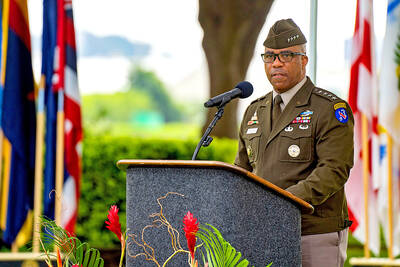
EYE ON 2027: The US military has placed equipment, materiel and personnel on the islands near China, a US officer said while warning about the threat from China The US Army Pacific (USARPAC) is deploying forces and equipment across the region based on the assumption that Beijing could possess the military capability and the intent to invade Taiwan by next year, a top US commander said on Tuesday. Speaking at the TechNet Indo-Pacific conference in Honolulu, US General Ronald Clark said that the threat posed by the so-called “Davidson window” is “still valid,” US military newspaper Stars and Stripes reported on Wednesday. The term stems from a 2021 warning by Admiral Philip Davidson, then-head of the US Indo-Pacific Command, that the threat of Chinese military action against Taiwan could materialize

‘ONE CHINA’ DECISION: A Cabinet spokesperson said that Pakistan had pandered to Beijing, and disregarded international rules and reality with the overflight ban The first Taiwanese commercial aircraft since restrictions were lifted flew over Pakistan yesterday morning following an abrupt U-turn by authorities to approve permits that were briefly revoked due to Islamabad’s “one China” policy. EVA Airways (長榮航空) Flight 65 from Taipei to Vienna entered Pakistani airspace at about 3:30am local time, Flightradar24 tracking data showed. All other Europe-bound EVA Air and China Airlines (華航) flights that departed late on Wednesday night into early yesterday morning opted to use Russian airspace, or go via India. The airlines had been forced to detour, including flying over Russia, since Sunday, after Pakistan shut its airspace to Taiwanese
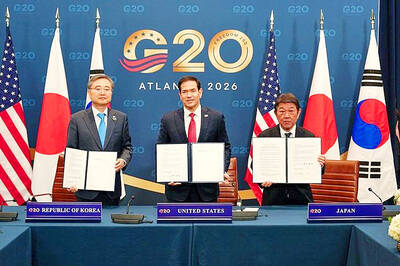
Taiwan yesterday welcomed and expressed appreciation for foreign ministers from the US, Japan and South Korea for emphasizing the importance of maintaining peace and stability across the Taiwan Strait at a trilateral meeting on the sidelines of the G20 in Atlanta, Georgia, on Friday. US Secretary of State Marco Rubio met with Japanese Minister of Foreign Affairs Motegi Toshimitsu and South Korean Minister of Foreign Affairs Cho Hyun to review the progress of a trilateral partnership that aims to advance security and prosperity in a free and open Indo-Pacific region, the US Department of State said in a statement. They emphasized
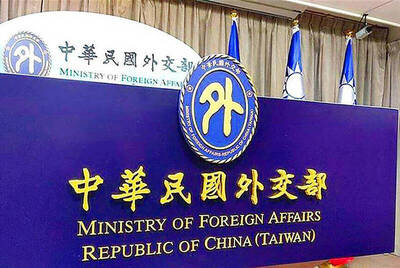
VARYING TREATMENT: During Chen Shui-bian’s presidency, China had rejected Taiwan’s APEC envoy, but had personally handed an invitation to the MAC head under the KMT Taiwan has lodged a protest over China’s discriminatory handling of its invitation to the upcoming APEC summit in Shenzhen, China, the Ministry of Foreign Affairs said yesterday. China, the host of the meeting on Nov. 18 and 19, sent Taiwan a letter, but it was not a formal invitation, an official familiar with the matter said on condition of anonymity. China did not address Taiwan as “Chinese Taipei,” the nation’s official APEC designation, in the invitation, deviating from established protocol and downgrading the nation’s status, the official said. The government immediately lodged a strong protest against actions by China that undermine Taiwan’s status,


 RSS