

Taiwan has lodged a protest over China’s discriminatory handling of its invitation to the upcoming APEC summit in Shenzhen, China, the Ministry of Foreign Affairs said yesterday.
China, the host of the meeting on Nov. 18 and 19, sent Taiwan a letter, but it was not a formal invitation, an official familiar with the matter said on condition of anonymity.
China did not address Taiwan as “Chinese Taipei,” the nation’s official APEC designation, in the invitation, deviating from established protocol and downgrading the nation’s status, the official said.
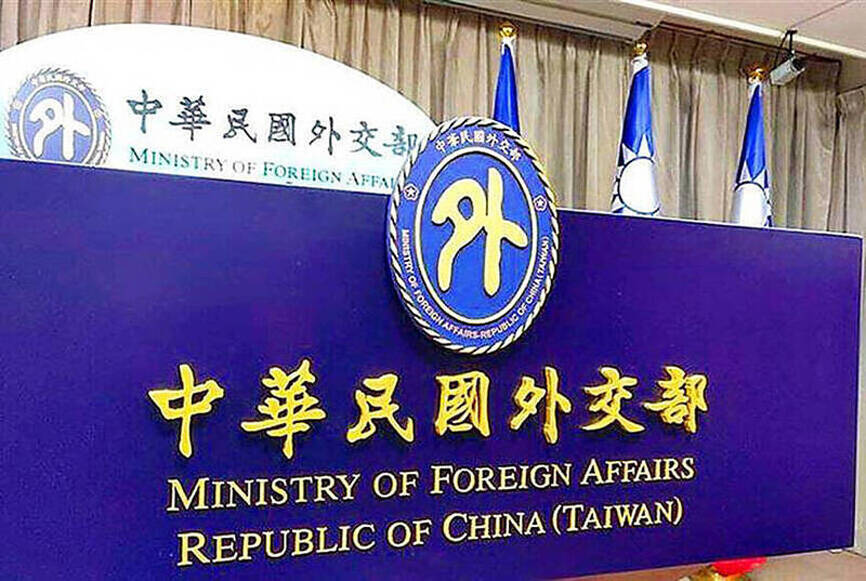
Photo: CNA
The government immediately lodged a strong protest against actions by China that undermine Taiwan’s status, to protect the nation’s rights as a full and equal member of APEC, the ministry said.
APEC is an important regional economic cooperation organization, and preparations for Taiwan’s participation are ongoing in accordance with past practice, it said, adding that updates would be provided to the public in due course.
Taiwan takes part in APEC under the name “Chinese Taipei,” which it also uses for the Olympics, and has traditionally sent a representative appointed by the president to the leaders’ meeting.
As an APEC member, Taiwan should be invited with established procedures and conventions, with this year’s arrangements following the same protocol as last year’s meeting in South Korea, they said.
Taiwan’s representative for this year’s summit has already been selected, and the choice had been communicated to Beijing and would be announced by the Presidential Office, they added.
China has hosted the APEC summit twice.
In 2001, under the Democratic Progressive Party (DPP) administration of then-president Chen Shui-bian (陳水扁), Beijing sent an unsigned fax notification and rejected Taiwan’s envoy, former vice president Li Yuan-tsu (李元簇), prompting Taipei to boycott the summit.
In 2014, during the Chinese Nationalist Party (KMT) administration of then-president Ma Ying-jeou (馬英九), Beijing dispatched then-Taiwan Affairs Office deputy director Gong Qinggai (龔清概) to personally hand the invitation to then-Mainland Affairs Council minister Wang Yu-chi (王郁琦) at the Taipei Guest House.
Taiwan was being treated differently again this year, the official said, adding that China only does so with Taiwan, which downgrades and harms the nation’s status.
The government is assessing whether it could accept the arrangements, they said.
When cross-strait relations are bad, China would certainly use the summit to suppress Taiwan, they added.
Even when the KMT was in power in 2014, Beijing had sought to marginalize Taiwan at the summit, they said, adding that the Ma administration had been reluctant to speak publicly about the matter.
Since the DPP has been in power, China has shown no goodwill toward Taiwan and is bound to seek to suppress or belittle the nation at the summit, the official said.
Although previous APEC ministerial meetings had followed established conventions, that does not mean Beijing would refrain from pressuring Taiwan, they said.
China has already chosen to target Taiwan’s representative to the leaders’ meeting by using a discriminatory form of address in its invitation, they said, adding that the government had argued with the Chinese side over the matter.
The key issue this time is whether China’s differential treatment would damage Taiwan’s status, the official said.
Failing to protest against the latest move could allow Beijing to apply the same approach in the future, they added.

Taiwanese gymnast Tang Chia-hung (唐嘉鴻) on Sunday won gold in the men’s horizontal bar final at the Artistic Gymnastics World Championships in Rotterdam, the Netherlands. Tang scored 14.966 in the final. He had advanced to the final in second place with a score of 14.566 points in qualifying, with a difficulty score of 6.000 and an execution score of 8.566. In the final, he raised his difficulty score to 6.600, the highest among the eight finalists. Although he did not fully steady himself on landing, his score was still enough to claim the gold medal. Taiwan had previously won two silver medals and

EYE ON 2027: The US military has placed equipment, materiel and personnel on the islands near China, a US officer said while warning about the threat from China The US Army Pacific (USARPAC) is deploying forces and equipment across the region based on the assumption that Beijing could possess the military capability and the intent to invade Taiwan by next year, a top US commander said on Tuesday. Speaking at the TechNet Indo-Pacific conference in Honolulu, US General Ronald Clark said that the threat posed by the so-called “Davidson window” is “still valid,” US military newspaper Stars and Stripes reported on Wednesday. The term stems from a 2021 warning by Admiral Philip Davidson, then-head of the US Indo-Pacific Command, that the threat of Chinese military action against Taiwan could materialize

‘ONE CHINA’ DECISION: A Cabinet spokesperson said that Pakistan had pandered to Beijing, and disregarded international rules and reality with the overflight ban The first Taiwanese commercial aircraft since restrictions were lifted flew over Pakistan yesterday morning following an abrupt U-turn by authorities to approve permits that were briefly revoked due to Islamabad’s “one China” policy. EVA Airways (長榮航空) Flight 65 from Taipei to Vienna entered Pakistani airspace at about 3:30am local time, Flightradar24 tracking data showed. All other Europe-bound EVA Air and China Airlines (華航) flights that departed late on Wednesday night into early yesterday morning opted to use Russian airspace, or go via India. The airlines had been forced to detour, including flying over Russia, since Sunday, after Pakistan shut its airspace to Taiwanese
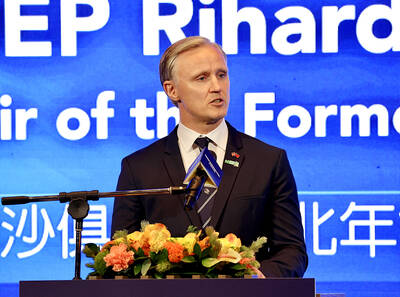
BUILDING LINKS: Taipei and Europe should cooperate ‘so that no single supplier and no single government can hold our shared future hostage,’ an official said Beijing has no say in Taiwan’s partnerships with European countries, Formosa Club acting chair Rihards Kols, a member of the European Parliament (MEP), told a forum in Taipei yesterday. The Formosa Club, an interparliamentary group of European lawmakers, and the Ministry of Foreign Affairs cohosted the Trusted Technology Forum for Democracies, focusing on artificial intelligence (AI) and drone technologies. In his opening speech, Kols said it is crucial that people meet and understand each other’s concerns, and work out how they can help. The club has brought European parliamentarians to the second annual forum to understand Taiwan better and seek


 RSS