

President William Lai (賴清德) yesterday touted Taiwan’s economic resilience, with the stock market ranking fourth globally and assets under management reaching NT$48.38 trillion (US$1.48 trillion), and pledged to further develop and internationalize the nation’s financial markets.
Speaking at the Taiwan Weeks, an annual international financial and capital markets event jointly organized by the Financial Supervisory Commission and Taiwan’s securities and futures industry associations, the president thanked investors and industry partners for their continued confidence in and support for Taiwan’s financial markets.
Taiwan has demonstrated remarkable resilience and maintained steady economic growth in the past few years, despite shifts in the global landscape and challenges posed by the artificial intelligence (AI) boom, he said.
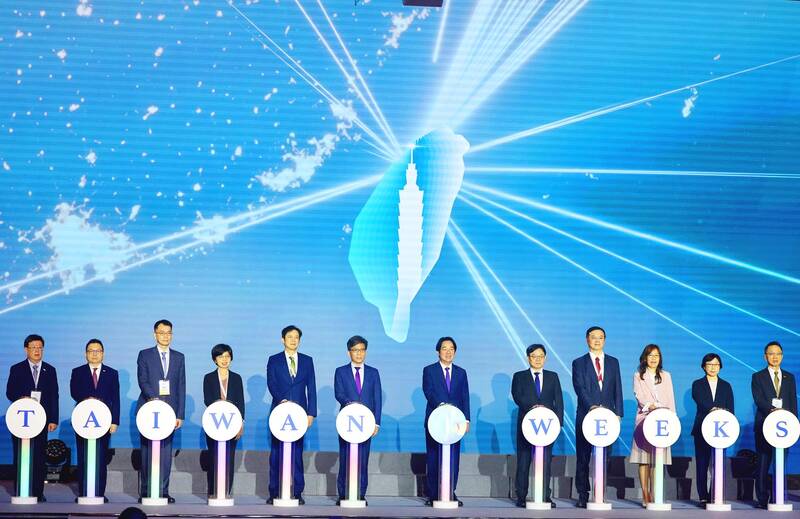
Photo: CNA
The economy grew 8.76 percent last year, and growth this year is projected to exceed 11 percent, he said.
Citing Bloomberg data, he said Taiwan had risen to become the world’s fourth-largest stock market this year, reflecting the continued expansion of its capital market.
These economic achievements were no coincidence, but were underpinned by Taiwan’s strong and irreplaceable industrial foundations, he said.
Taiwanese companies boast strong profitability, highly flexible supply chain networks and pivotal positions in global supply chains, enabling the country to remain resilient amid global uncertainties, he said.
He outlined three priorities for the government to build on the nation’s industrial strengths and strengthen its financial sector, making it more resilient to challenges and better positioned for sustainable growth.
The first is to further internationalize Taiwan’s financial markets by continuing to liberalize the financial sector, expand cross-border services and deepen cooperation with global markets, he said.
The government also aims to attract more global asset management firms and financial professionals, positioning Taiwan as a key platform for international capital seeking investment opportunities in Asia, he said.
Second is to make Taiwan’s capital market more innovative and dynamic by encouraging more high-quality international companies to list in Taiwan and strengthening ties between venture capital firms, financial institutions and capital markets, he said.
The goal is to establish Taiwan as an innovation financing hub in Asia, he added.
The third is to make Taiwan a more trusted long-term investment destination, he said.
To that end, the government will continue to strengthen corporate governance and sustainability disclosures, he said, adding that Taiwan has begun phasing in the IFRS Sustainability Disclosure Standards this year to improve corporate transparency and bring local reporting practices in line with international standards.
Speaking at the same event, a senior NASDAQ executive said that Taiwan stands at the center of AI development, with the highest AI exposure in the region at 71 percent, and has been a major beneficiary of efficient capital markets.
“AI needs capital, and capital needs markets that can direct it quickly and transparently,” NASDAQ executive vice chairman Edward Knight said, adding that “Taiwan sits at the center of this story.”
Equity markets can accelerate AI development by directing capital toward productive investments and help companies fund research, build facilities and hire workers, while lowering financing costs, Knight said, adding that the process was evident in Taiwan.
Knight expressed optimism about Taiwan’s future, recalling his first visit to Taipei in 1992, when he was struck by the industriousness of its people.
“I have found Taiwan to be a place where the future is not something that happens to you, but something you build,” he said.
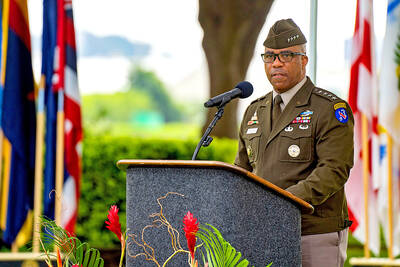
EYE ON 2027: The US military has placed equipment, materiel and personnel on the islands near China, a US officer said while warning about the threat from China The US Army Pacific (USARPAC) is deploying forces and equipment across the region based on the assumption that Beijing could possess the military capability and the intent to invade Taiwan by next year, a top US commander said on Tuesday. Speaking at the TechNet Indo-Pacific conference in Honolulu, US General Ronald Clark said that the threat posed by the so-called “Davidson window” is “still valid,” US military newspaper Stars and Stripes reported on Wednesday. The term stems from a 2021 warning by Admiral Philip Davidson, then-head of the US Indo-Pacific Command, that the threat of Chinese military action against Taiwan could materialize

‘ONE CHINA’ DECISION: A Cabinet spokesperson said that Pakistan had pandered to Beijing, and disregarded international rules and reality with the overflight ban The first Taiwanese commercial aircraft since restrictions were lifted flew over Pakistan yesterday morning following an abrupt U-turn by authorities to approve permits that were briefly revoked due to Islamabad’s “one China” policy. EVA Airways (長榮航空) Flight 65 from Taipei to Vienna entered Pakistani airspace at about 3:30am local time, Flightradar24 tracking data showed. All other Europe-bound EVA Air and China Airlines (華航) flights that departed late on Wednesday night into early yesterday morning opted to use Russian airspace, or go via India. The airlines had been forced to detour, including flying over Russia, since Sunday, after Pakistan shut its airspace to Taiwanese
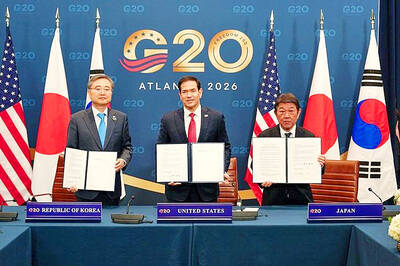
Taiwan yesterday welcomed and expressed appreciation for foreign ministers from the US, Japan and South Korea for emphasizing the importance of maintaining peace and stability across the Taiwan Strait at a trilateral meeting on the sidelines of the G20 in Atlanta, Georgia, on Friday. US Secretary of State Marco Rubio met with Japanese Minister of Foreign Affairs Motegi Toshimitsu and South Korean Minister of Foreign Affairs Cho Hyun to review the progress of a trilateral partnership that aims to advance security and prosperity in a free and open Indo-Pacific region, the US Department of State said in a statement. They emphasized
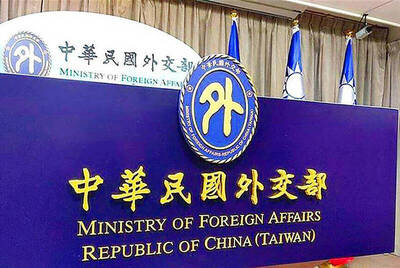
VARYING TREATMENT: During Chen Shui-bian’s presidency, China had rejected Taiwan’s APEC envoy, but had personally handed an invitation to the MAC head under the KMT Taiwan has lodged a protest over China’s discriminatory handling of its invitation to the upcoming APEC summit in Shenzhen, China, the Ministry of Foreign Affairs said yesterday. China, the host of the meeting on Nov. 18 and 19, sent Taiwan a letter, but it was not a formal invitation, an official familiar with the matter said on condition of anonymity. China did not address Taiwan as “Chinese Taipei,” the nation’s official APEC designation, in the invitation, deviating from established protocol and downgrading the nation’s status, the official said. The government immediately lodged a strong protest against actions by China that undermine Taiwan’s status,


 RSS