

Taiwan’s Ching Tien I (擎天) supersonic cruise missiles have completed their production run and entered service, the non-classified portion of the proposed military budget for next year shows, indirectly confirming the existence of a system that has long been the subject of speculation.
The Ministry of National Defense’s budget proposal submitted to the legislature this week included a curious item called “Fei Chi II (飛戟) weapons system and equipment maintenance program,” which is to be implemented from next year through 2031.
Chinese-language media have labeled the budget’s reference to the Fei Chi II system as an “official leak” connected to the Ching Tien II hypersonic missile, which implicitly acknowledged the existence and operational status of Ching Tien I missiles.
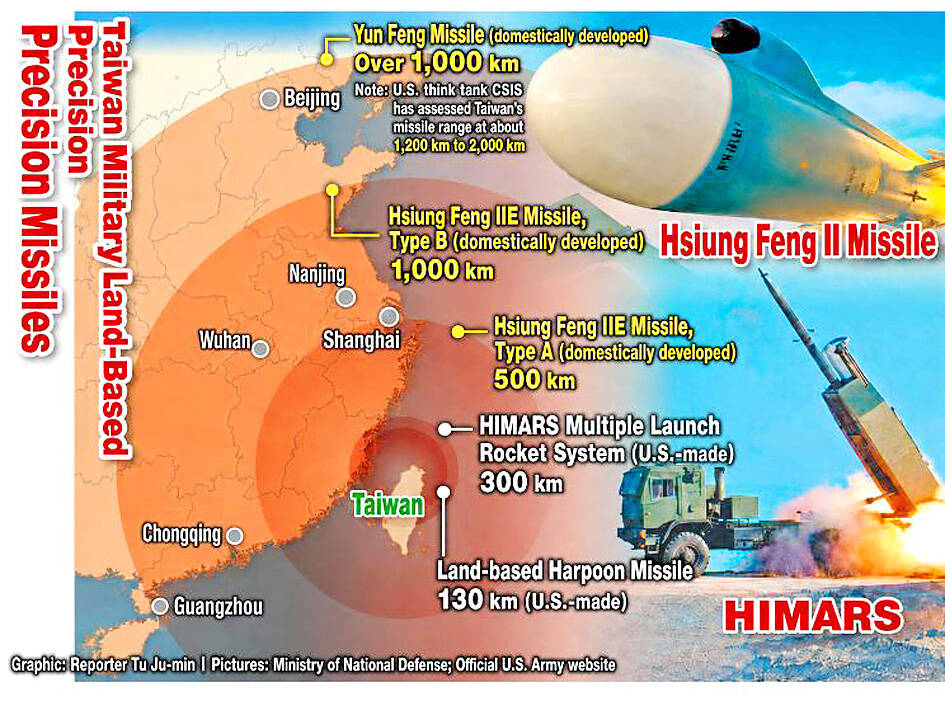
The declassification of the Ching Tien family of missiles signals that the military has moved to publicly acknowledging possessing a strike capability, a measure likely motivated by a desire to enhance deterrence.
Following the 1996 Taiwan Strait Crisis, Taiwan began to secretly work on the Yun Feng (雲峰) medium-range supersonic cruise missile, concealing budgets and test flights inside the Hsiung Feng III program, the Washington-based Center for Strategic and International Studies said.
The Chinese-language China Times reported that the Yun Feng program was cut short in 2014, resulting in a limited production run of 10 launch systems equipped with 15 to 20 missiles each, with a total production target of 500 missiles.
The design of the terminated missile served as the basis for Ching Tien I, a supersonic cruise missile whose existence has never been officially acknowledged, the broadsheet said.
The development of a successor to the Ching Tien I system was apparently conducted under the codename Fei Chi II, the spending item appearing in the defense ministry’s budget, it said.
The Ching Tien I reportedly uses a ramjet motor, with a top speed of Mach 3 (about 3,700kph) and an effective range of 1,200km to 1,500km, enough to hit the Chinese People’s Liberation Army’s (PLA) “second echelon” bases in eastern and central China.
Owing to design limitations and the rocket’s ponderous size, the Ching Tien I mostly relies on silos or mountain missile installations as launch facilities, whose visibility to satellite surveillance limits the system’s survivability.
The Ching Tien II, developed to improve upon its predecessor’s capabilities, is said to use a scramjet engine, with a top speed of Mach 5 and an effective range of more than 2,000km. These parameters suggest the missile can strike targets in China’s hinterland, including Beijing and Wuhan.
The Ching Tien II is designed to be launched from a mobile vehicle, and the ministry is currently considering a European-made 12x12 military utility truck to serve as the launch platform, a source said on condition of anonymity.
Truck-mounted Ching Tien II systems can use highways and heavy-duty forest roads to relocate after firing, allowing them to evade enemy detection and targeting, sources said.
A railroad-based launch platform is also being explored, they added.
The Ching Tien II’s deep-strike capability and mobility make them a highly valuable asymmetric warfare asset for deterring China from attacking Taiwan, they said.

The Hualien District Prosecutors’ Office yesterday launched an investigation following allegations by a former foreign correspondent in Taiwan of widespread vote-buying in Hualien County. In an interview with Formosa TV (FTV, 民視) aired on Saturday, former Financial Times Taiwan correspondent Kathrin Hille spoke about Taiwan’s democracy and said that she now lives in rural Hualien, where “all the votes are bought.” Neighbors would talk about who had come by and leave cash on the table showing “how much each vote was worth that year,” Hille said. The practice needs to be addressed, considering Taiwan has been a democracy for many
SAFETY RISKS: A Taiwanese man who was traveling to Shanghai for business was allegedly questioned for six hours due to his past work for Amnesty International The Mainland Affairs Council (MAC) urged Taiwanese to exercise caution when considering trips to China after a Taiwanese man was allegedly questioned for six hours in Shanghai over past work with Amnesty International. The council on Saturday said in a report that 426 Taiwanese have gone missing or been detained or had their freedom of movement restricted in China since Jan. 1, 2024. The figure is up by seven from the previous week. New Chinese entry and exit regulations are due to take effect on Sept. 15, the council said. Of the 426 cases, 160 people have gone missing, up
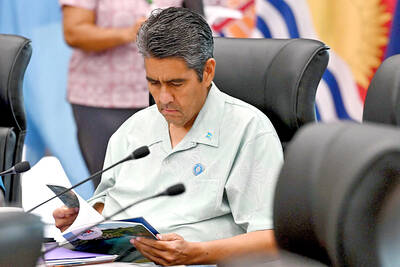
Palau’s president yesterday called for a “unified” Pacific response to a missile test by China in July, while Taiwan and its Pacific allies a day earlier at the Pacific Islands Forum (PIF) reaffirmed their commitment to peace, stability and prosperity. China gave only a handful of nations short notice before test-firing an intercontinental ballistic missile in July, sparking condemnation from several Pacific leaders. The 18-member PIF being held in Palau was expected to release a communique after press time last night, with a formal response to the test possibly included. Palau, which invited Taiwan to attend sideline events as an aid partner, urged
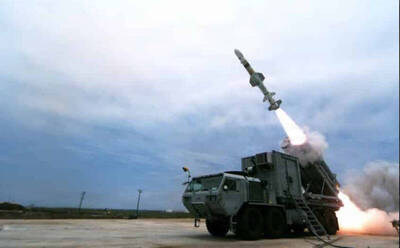
DEFENSE PROCUREMENT: The Pentagon has told a US congressional hearing that Taiwan has ‘top priority worldwide’ in the delivery of Harpoon missile systems The US Navy and Boeing Co have conducted a series of tests for land-based Harpoon anti-ship missile system being supplied to Taiwan and released footage showing the system striking a target vessel at sea. The weapons system and support equipment tested were reportedly tailored for Taiwan, while the first launch vehicles and other components have already begun arriving in Taiwan, with the full delivery of 100 systems scheduled to be completed by the end of 2028. Pentagon officials have previously told a US congressional hearing that Taiwan has “top priority worldwide” in the delivery of Harpoon missile systems, with production


 RSS
RSS