

The US Navy and Boeing Co have conducted a series of tests for land-based Harpoon anti-ship missile system being supplied to Taiwan and released footage showing the system striking a target vessel at sea.
The weapons system and support equipment tested were reportedly tailored for Taiwan, while the first launch vehicles and other components have already begun arriving in Taiwan, with the full delivery of 100 systems scheduled to be completed by the end of 2028.
Pentagon officials have previously told a US congressional hearing that Taiwan has “top priority worldwide” in the delivery of Harpoon missile systems, with production lines operating at full capacity to address threats in the Taiwan Strait.
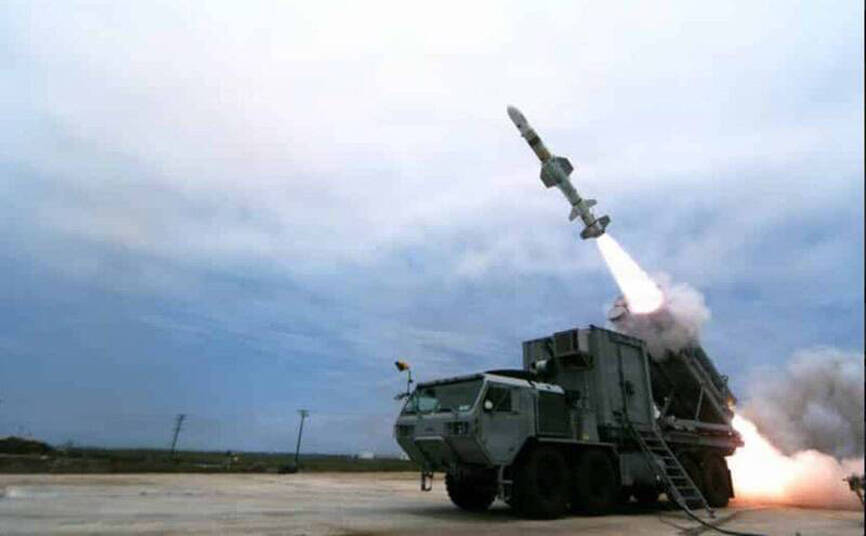
Photo: Screen grab from US Navy’s Web site
The navy has budgeted more than NT$90.2 billion (US$2.85 billion) for the procurement of the systems, as part of a program running from 2021 to 2030 to establish a dense network of land-based anti-ship missile defenses.
Taiwan has purchased 100 land-based Harpoon Coastal Defense Systems from the US, which included 400 missiles, four training missiles, 100 missile launch vehicles and 25 radar vehicles. Several launch vehicles, command-and-control vehicles and radar vehicles have arrived in Taiwan, and the navy’s Littoral Combat Command is conducting equipment acceptance and simulated strike training.
The procurement is scheduled to be completed by the end of 2028.
The missiles being acquired by Taiwan are the latest upgraded RGM-84L-4 Harpoon Block II (U) land-based anti-ship missiles. They are equipped with enhanced resistance to electronic countermeasures, which would allow them to identify and engage enemy vessels in heavy-jamming environments, as well as GPS guidance and active radar guidance systems.
The missiles can be used against amphibious landing forces and carrier strike groups, while also possessing a land-attack capability against military installations along the coast. Their range exceeds the about 100km range of earlier ship-launched versions, significantly expanding the area they can cover across the Taiwan Strait.
A key feature of the latest tests was the use of Oshkosh-made Heavy Expanded Mobility Tactical Trucks (HEMTTs), which are among the US military’s newest heavy-duty tactical vehicles, military news Web site Naval News reported.
Unlike the older trailer-mounted launchers supplied by Boeing to other countries, Taiwan is receiving a highly mobile configuration in which the launch system and vehicle are integrated.
Each eight-wheel-drive HEMTT launch vehicle is equipped with an armored cab and carries four Harpoon missile canisters. The vehicles are designed for rapid movement and concealed deployment over unpaved terrain, providing greater battlefield mobility and survivability than conventional commercial truck-based trailers.
Taiwan Association for Security and Development chairman Chi Tung-yun (紀東昀) said his organization obtained four photographs of the land-based Harpoon system in southern Taiwan last year.
The equipment shown in the photographs almost completely matches footage released by the US military, Chi said.
The photographs show Harpoon missile launch vehicles that differ from those used by Denmark and South Korea, but they use the same Oshkosh HEMTT 8x8 heavy tactical truck chassis as Patriot missile systems, while carrying a new type of missile, he said.
The photographs’ backgrounds were altered using artificial intelligence to obscure identifying details, while text on the transport trailers was removed, he said.
Researchers at the Institute for National Defense and Security Research have previously said that once the US-made Harpoon systems are fully deployed, they would be integrated with Taiwan-made Hsiung Feng II (Brave Wind II, 雄風二型) and Hsiung Feng III anti-ship missiles.
The systems are expected to be linked to the navy’s Littoral Combat Command, creating a layered coastal defense network designed to deter and disrupt an amphibious assault.
The deployment is part of Taiwan’s broader effort to develop a highly mobile, distributed anti-ship capability aimed at countering Chinese military operations across the Taiwan Strait.
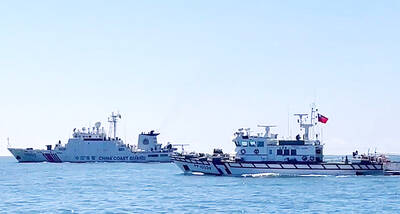
China deployed a record number of coast guard, scientific research and other ships near Taiwan’s waters last month, the Coast Guard Administration (CGA) said, as Beijing dials up pressure on Taipei. The coast guard warned of an increasingly severe situation, as analysts say the increased activity is part of China’s bid to map the region for submarine warfare. The number of Chinese ships detected around Taiwan proper soared to a record 244 last month — an average of nearly eight every day, official data showed. That compares with 55 ships detected in June and 30 in May, and 58 in July last year. In
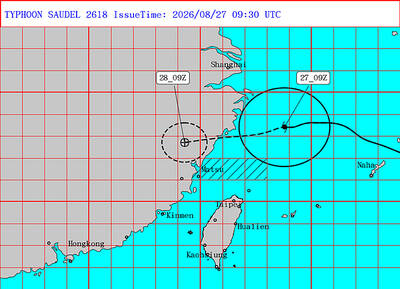
Taiwan is bracing for heavy rain in the south and rough seas around outlying Lienchiang County (Matsu), as Typhoon Saudel passes north toward eastern China, with forecasters yesterday warning of localized flooding over the next two days. Saudel is expected to pass closest to Taiwan today, when its outer rain bands are forecast to brush past Matsu, before making landfall at about noon in China’s Zhejiang Province and weakening significantly, the Central Weather Administration said. The storm’s outer bands, combined with strengthening southwesterly winds, are expected to bring heavy rain to southern and southeastern Taiwan today, it said. As the storm approaches Matsu,

LIMITED: The bill’s NT$40bn annual spending cap would prevent Taiwan from effectively building up its drone combat capabilities, National Defense Minister Wellington Koo said The legislature yesterday rejected the Executive Yuan’s NT$210 billion (US$6.62 billion) special budget proposal to buy military drones and instead passed its own plan, which earmarks NT$40 billion per year over six consecutive years. The Executive Yuan said its plan to buy about 210,000 drones by 2031 could not wait, as the wars in Ukraine and Iran showed the importance of uncrewed systems in modern warfare amid a rising threat from China. However, the Chinese Nationalist Party (KMT) and Taiwan People’s Party (TPP) used their opposition majority to pass a bill providing NT$240 billion through annual budgets over six years, with annual

INCREASING IMBALANCE: The percentage of working-age people is expected to shrink to 42.3% of the population, while older people would comprise 52.9%, the agency said Taiwan’s population is projected to shrink by almost half over the next five decades, intensifying labor shortages and placing a growing drag on economic growth as the technology-intensive economy confronts a rapidly aging workforce. The population is expected to fall to 12.15 million by 2075, a 48 percent decline from this year, National Development Council projections released yesterday showed. The decline would fundamentally alter Taiwan’s workforce. From 2037, more than half of the working-age population is projected to be aged between 45 and 64, signaling the end of an era when the economy could rely on a relatively large labor force. The shift


 RSS
RSS