

Washington and Canberra on Wednesday agreed to boost the US military presence in Australia and speed up cooperation, both countries said.
Wary of China’s unprecedented military build-up, US ally Australia has reshaped its defense force to focus on its missile strike capability and deterring would-be foes from its northern approaches.
US Secretary of Defense Pete Hegseth said Canberra understood “the gravity of maintaining a favorable balance of power in the region” as he met with Australian Minister for Defence Richard Marles in Washington.
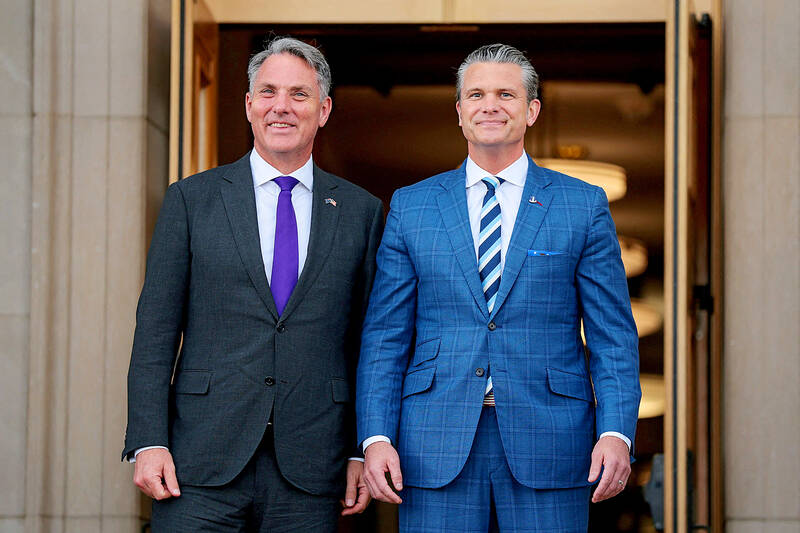
Photo: Reuters
The two “agreed to accelerate force posture initiatives at Australian bases, bolster cooperation in combined logistics and build greater interoperability through joint exercises,” a joint statement said.
Australia does not permit foreign military bases on its soil, but hosts US Marines for exercises for six months of the year in the northern city of Darwin. A rotating force of US-commanded submarines is scheduled to arrive in Western Australia next year.
Pressed on what the expanding force posture would entail, Marles told journalists that cooperation was also taking place in “logistics, cooperation, in respect of our air forces, cyber and space.”
The expanding cooperation was a response to “the biggest conventional military build-up by any country in the world since the Second World War in the form of China,” he said. “We need to be ensuring that we build deterrence, that we build balance, so that we can provide for the peace and stability of the region in which we live.”
“Collaboration through the alliance with the United States is fundamentally important to that,” he added.
Australia has also embarked on its largest-ever military spending project to build nuclear-powered submarines next decade under the AUKUS agreement with the US and the UK.
Critics have said the deal does not guarantee that Australia would receive the submarines.

The Hualien District Prosecutors’ Office yesterday launched an investigation following allegations by a former foreign correspondent in Taiwan of widespread vote-buying in Hualien County. In an interview with Formosa TV (FTV, 民視) aired on Saturday, former Financial Times Taiwan correspondent Kathrin Hille spoke about Taiwan’s democracy and said that she now lives in rural Hualien, where “all the votes are bought.” Neighbors would talk about who had come by and leave cash on the table showing “how much each vote was worth that year,” Hille said. The practice needs to be addressed, considering Taiwan has been a democracy for many

INCREASING IMBALANCE: The percentage of working-age people is expected to shrink to 42.3% of the population, while older people would comprise 52.9%, the agency said Taiwan’s population is projected to shrink by almost half over the next five decades, intensifying labor shortages and placing a growing drag on economic growth as the technology-intensive economy confronts a rapidly aging workforce. The population is expected to fall to 12.15 million by 2075, a 48 percent decline from this year, National Development Council projections released yesterday showed. The decline would fundamentally alter Taiwan’s workforce. From 2037, more than half of the working-age population is projected to be aged between 45 and 64, signaling the end of an era when the economy could rely on a relatively large labor force. The shift
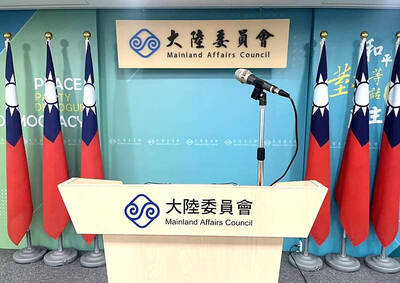
SAFETY RISKS: A Taiwanese man who was traveling to Shanghai for business was allegedly questioned for six hours due to his past work for Amnesty International The Mainland Affairs Council (MAC) urged Taiwanese to exercise caution when considering trips to China after a Taiwanese man was allegedly questioned for six hours in Shanghai over past work with Amnesty International. The council on Saturday said in a report that 426 Taiwanese have gone missing or been detained or had their freedom of movement restricted in China since Jan. 1, 2024. The figure is up by seven from the previous week. New Chinese entry and exit regulations are due to take effect on Sept. 15, the council said. Of the 426 cases, 160 people have gone missing, up
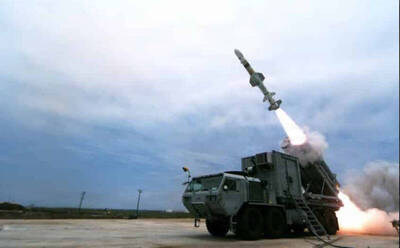
DEFENSE PROCUREMENT: The Pentagon has told a US congressional hearing that Taiwan has ‘top priority worldwide’ in the delivery of Harpoon missile systems The US Navy and Boeing Co have conducted a series of tests for land-based Harpoon anti-ship missile system being supplied to Taiwan and released footage showing the system striking a target vessel at sea. The weapons system and support equipment tested were reportedly tailored for Taiwan, while the first launch vehicles and other components have already begun arriving in Taiwan, with the full delivery of 100 systems scheduled to be completed by the end of 2028. Pentagon officials have previously told a US congressional hearing that Taiwan has “top priority worldwide” in the delivery of Harpoon missile systems, with production


 RSS
RSS