


New attacks in the Middle East on Friday threatened to unravel an already fragile US-Iran ceasefire, even as US officials confirmed that Iranian soccer players had received visas for the FIFA World Cup.
Weeks of complex talks marked by threats and flare-ups of violence have failed to secure a deal to end the war and reopen the Strait of Hormuz, a key conduit for global energy flows.
A ceasefire in the Middle East war, triggered about 100 days ago by US and Israeli strikes that wiped out Iran’s top leadership, has been in place since April 8.
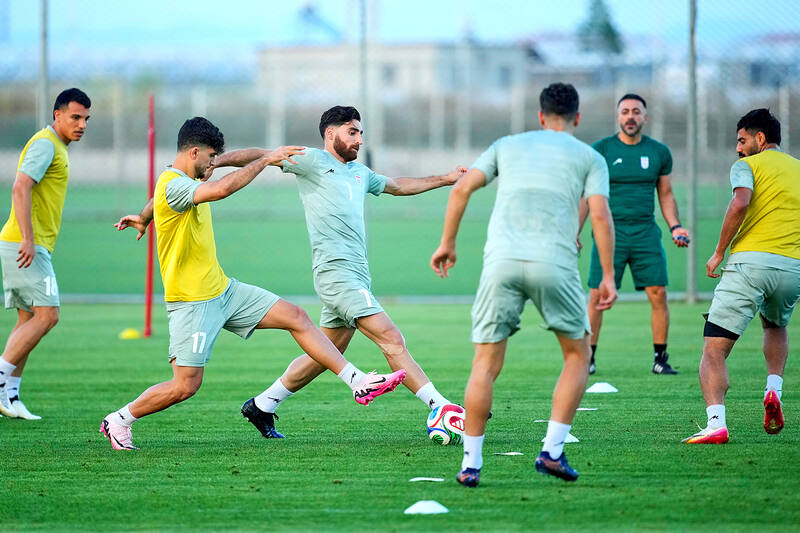
Photo: AP
However, tensions surged again on Friday when the US military said it struck radar sites in Iran after downing drones headed toward the strait.
Shortly after, air raid sirens sounded in neighboring Gulf nations Kuwait and Bahrain — both US allies.
Iran’s Revolutionary Guards said yesterday that they had targeted “enemy bases in the area” with missiles in response to a US “invasion” of the country’s Sirik and Qeshm islands.
US Central Command (CENTCOM) said Iran launched seven ballistic missiles toward Kuwait and Bahrain.
CENTCOM said six of the missiles were downed, while the seventh “did not reach its intended target.”
“There are currently no reports of harm to US personnel, and Iranian claims of damaging US 5th fleet headquarters in Bahrain are false,” the command said in a statement.
The latest flare-up came despite the US moving ahead with allowing Iran’s national team to travel to the World Cup it is cohosting with Canada and Mexico.
US Ambassador to Turkey Tom Barrack confirmed the visa issuances, saying that “sports transcends borders, and we look forward to welcoming competitors and fans from around the world.”
However, Iran’s Fars news agency reported that visas had yet to be issued for some members of the team’s “technical and executive staff.”
An unnamed US administration official said in a statement: “We will not allow the Iranian team to abuse this system to sneak terrorists into the United States under false pretenses.”
The team was to fly from Turkey to Spain yesterday before traveling on to their base camp in Mexico, where they are expected to arrive today.
Earlier on Friday, CENTCOM said its forces also downed four Iranian drones headed toward the Strait of Hormuz before striking Iranian coastal radar installations in Goruk and on Qeshm Island.
“The attack drones posed an immediate threat to regional maritime traffic,” while the strikes on radar installations “defend against further attacks,” CENTCOM said in a statement.
Iranian state television IRIB reported yesterday that “several explosions were heard” in Sirik in southern Iran at about 2:30am.
“Following the invasion of the child-killing and terrorist US army into Sirik and Qeshm Island, enemy bases in the region were hit by aerial missiles,” IRIB reported, quoting the Guards after the US strikes on Iran.
Kuwait’s military yesterday said that it was responding to “hostile” missile and drone attacks, days after a strike on the country’s international airport killed one and wounded dozens.
“Kuwaiti air defenses are currently responding to hostile missile and drone attacks,” the military said on X, without specifying their origin.
US President Donald Trump told NBC News on Friday that Iran still retained roughly “21, 22 percent” of its missile stockpile despite repeated claims from US officials that Tehran’s military capacity had been crippled.
That figure was higher than the 18 percent Trump gave last month.
Efforts to turn the truce into a lasting settlement have repeatedly stalled, while the conflict has rattled global markets and increased political pressure on Trump at home ahead of midterm elections.

The National Chungshan Institute of Science and Technology yesterday showcased its locally developed variants of the Vision 60 robotic patrol dog, which it plans to deploy on the nation’s outlying territories in the South China Sea. The variants were produced under the Joint Lab project — created by the institute and domestic companies — and assembled with domestically produced motors, lenses and artificial intelligence (AI) systems alongside licensed tech from the US, Missile and Rocket Systems Research Division deputy director Jen Kuo-kang (任國光) told the media event at a military base in Taipei’s Dazhi (大直) area. Taiwan has built up its strengths

RIGHT DIRECTION: Taiwan’s efforts to prevent forced labor include a proposal to ‘fully prohibit’ employers from withholding workers’ documents, an official said Taiwan is to establish a mechanism to restrict imports of goods linked to forced labor, the Executive Yuan said yesterday, after the US proposed imposing additional tariffs on Taiwanese goods over labor concerns. “The Ministry of Labor and the Ministry of Economic Affairs are to establish an interministerial review procedure,” Executive Yuan spokesperson Michelle Lee (李慧芝) said at a news briefing in Taipei. “The government is to use the Foreign Trade Act [貿易法] as the legal basis to restrict imports of goods produced with forced labor” and bring its supply chain governance more in line with international standards on human rights, resilience

NOT IMMEDIATE: Taiwan has a chance to appeal the proposed 10 percent tariff before it starts, while other countries face a 12.5 percent tariff from the trade office Taiwan is among 60 economies determined by the US to have failed to impose or enforce a ban on the importation of goods produced with forced labor, according to a notice released on Tuesday by the Office of the US Trade Representative (USTR), which proposed imposing an additional 10 percent or more tariff on them. The USTR in a statement said that following an investigation, it had determined under Section 301 of the Trade Act of 1974 that the failure of the 60 economies to impose and effectively enforce a prohibition on the importation of goods produced with forced labor is
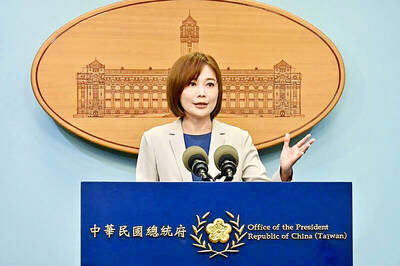
TIT-FOR-TAT: The US allegedly revoked the visa of a Chinese national working at Xinhua News Agency in the US in response to Beijing’s expulsion of Vivian Wang The Presidential Office yesterday condemned China for expelling a New York Times correspondent from Beijing following the newspaper’s interview with President William Lai (賴清德), saying the move highlighted Beijing’s suppression of press freedom and its threat to international news media. Taiwan has noted a series of recent incidents in which Beijing used similar tactics to “threaten and pressure international media outlets and journalists,” Presidential Office spokeswoman Karen Kuo (郭雅慧) said in a statement. “This concerns not only press freedom and freedom of expression, but also the safety of journalists, and Taiwan and relevant partners are paying close attention to the situation,” she


 RSS
RSS