


Taiwan’s markets are braced for a pressure test tomorrow after the Philadelphia Semiconductor Index plunged more than 10 percent on Friday, triggering a spillover effect that sent Taiwan index futures in after-hours trading down 3,006 points by the close, marking the largest point decline on record.
TAIEX futures plunged more than 3,000 points in after-hours trading. Losses on a standard futures contract reached about NT$600,000, while mini-contracts saw losses of about NT$150,000.
With the decline exceeding margin requirements, retail investors who maintained positions with only the minimum initial margin could have their positions forcibly liquidated by the system overnight if their intraday risk ratio fell below the 25 percent liquidation threshold.
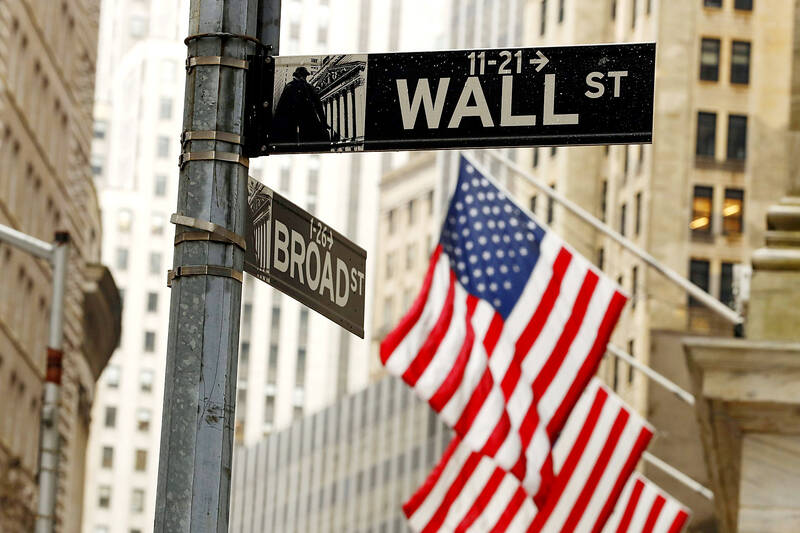
Photo: Reuters
A futures brokerage executive yesterday said that long positions whose equity falls below the maintenance margin of about NT$443,000 for a standard contract, but that have not yet hit the 25 percent liquidation threshold, would face pressure to “top up their initial margin” during tomorrow’s morning session.
If the required funds are not added by noon, the brokerage would trigger a second round of forced liquidations, they said.
The true extent of the damage from the overnight trading turmoil would become clearer the following day, when futures brokers report settlement defaults and the Taiwan Futures Exchange publishes the total value of defaults and the number of affected investors, they added.
The cash market is also facing a stress test, they said.
The TAIEX closed down 1.33% at 45,070.94 points on Friday, and if tomorrow’s trading mirrors the futures plunge, high-leverage margin accounts would be hit first, they said.
Accounts with maintenance margin ratios that had previously hovered around a 140 to 150 percent could fall close to the 130 percent margin call threshold after tomorrow’s session, raising the risk of a “margin call cascade.”
However, a senior executive at a major brokerage said that many brokers have recently tightened margin lending due to risk controls and full credit limits.
As a result, the overall maintenance margin is actually above 170 percent, and even leveraged exchange-traded funds are being strictly managed, they said.
Most margin accounts were opened when the market was above 30,000 points, so even in extreme scenarios, the potential “damage” is not expected to be severe, they said.
Panic sell-off on Wall Street was sparked by stronger-than-expected US jobs data for last month, fueling fears that the US Federal Reserve would hold off on cutting rates.

The National Chungshan Institute of Science and Technology yesterday showcased its locally developed variants of the Vision 60 robotic patrol dog, which it plans to deploy on the nation’s outlying territories in the South China Sea. The variants were produced under the Joint Lab project — created by the institute and domestic companies — and assembled with domestically produced motors, lenses and artificial intelligence (AI) systems alongside licensed tech from the US, Missile and Rocket Systems Research Division deputy director Jen Kuo-kang (任國光) told the media event at a military base in Taipei’s Dazhi (大直) area. Taiwan has built up its strengths

RIGHT DIRECTION: Taiwan’s efforts to prevent forced labor include a proposal to ‘fully prohibit’ employers from withholding workers’ documents, an official said Taiwan is to establish a mechanism to restrict imports of goods linked to forced labor, the Executive Yuan said yesterday, after the US proposed imposing additional tariffs on Taiwanese goods over labor concerns. “The Ministry of Labor and the Ministry of Economic Affairs are to establish an interministerial review procedure,” Executive Yuan spokesperson Michelle Lee (李慧芝) said at a news briefing in Taipei. “The government is to use the Foreign Trade Act [貿易法] as the legal basis to restrict imports of goods produced with forced labor” and bring its supply chain governance more in line with international standards on human rights, resilience

NOT IMMEDIATE: Taiwan has a chance to appeal the proposed 10 percent tariff before it starts, while other countries face a 12.5 percent tariff from the trade office Taiwan is among 60 economies determined by the US to have failed to impose or enforce a ban on the importation of goods produced with forced labor, according to a notice released on Tuesday by the Office of the US Trade Representative (USTR), which proposed imposing an additional 10 percent or more tariff on them. The USTR in a statement said that following an investigation, it had determined under Section 301 of the Trade Act of 1974 that the failure of the 60 economies to impose and effectively enforce a prohibition on the importation of goods produced with forced labor is

TIT-FOR-TAT: The US allegedly revoked the visa of a Chinese national working at Xinhua News Agency in the US in response to Beijing’s expulsion of Vivian Wang The Presidential Office yesterday condemned China for expelling a New York Times correspondent from Beijing following the newspaper’s interview with President William Lai (賴清德), saying the move highlighted Beijing’s suppression of press freedom and its threat to international news media. Taiwan has noted a series of recent incidents in which Beijing used similar tactics to “threaten and pressure international media outlets and journalists,” Presidential Office spokeswoman Karen Kuo (郭雅慧) said in a statement. “This concerns not only press freedom and freedom of expression, but also the safety of journalists, and Taiwan and relevant partners are paying close attention to the situation,” she


 RSS
RSS