


Israeli strikes yesterday killed at least four people in Lebanon, local authorities said, and a UN peacekeeper was killed in the crossfire, despite the announcement of another ceasefire agreement.
The fighting in Lebanon threatens efforts to end the Iran war and reopen the Strait of Hormuz, as Tehran has demanded that any lasting truce extend to Lebanon.
Israeli Prime Minister Benjamin Netanyahu, who faces elections later this year, wants to press ahead with Israel’s offensive until Hezbollah no longer poses a threat. Israeli troops have seized about one-fifth of Lebanon since Hezbollah began launching rocket and drone attacks in solidarity with Iran days into the wider war.
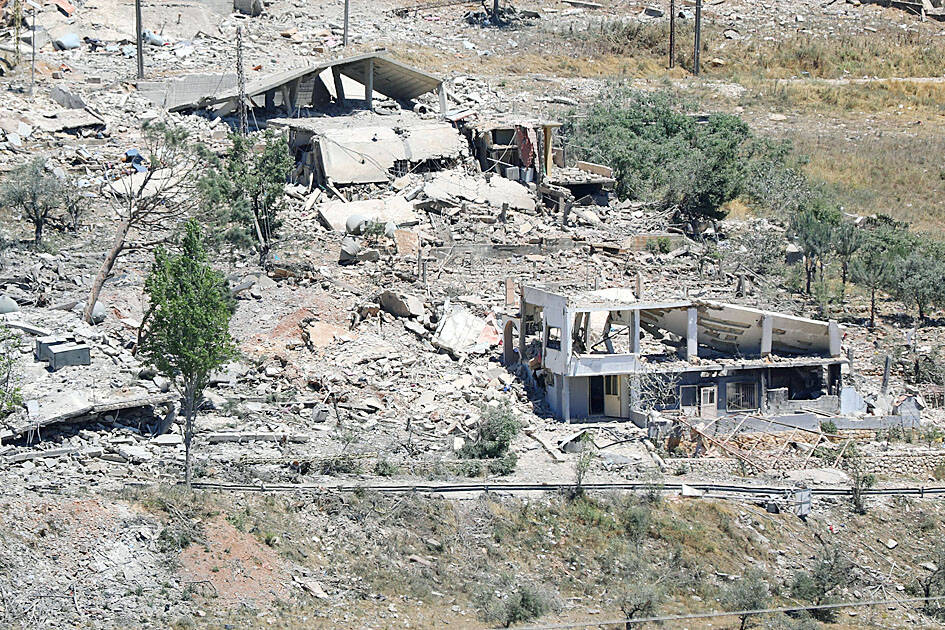
Photo: Reuters
US President Donald Trump, who faced a rare rebuke from the US Congress on Wednesday, has sought to downplay the diplomatic deadlock and the failure of declared ceasefires to end the fighting, telling reporters that in the Middle East, “a ceasefire is when you’re shooting in a more moderate manner.”
A Serbian peacekeeper was killed and two other peacekeepers were wounded when a mortar struck their location near Marjayoun, a Christian-majority town that has seen intense fighting, UN Interim Force in Lebanon and Serbia’s Ministry of Defense said.
Neither said whether the mortar fire came from Israel or Hezbollah.
Lebanon’s state-run National News Agency said a drone strike killed a motorcyclist and wounded four people in the village of Maaroub, while airstrikes on the village of Sohmor in the Bekaa Valley killed three people and wounded others.
It also reported airstrikes in other areas of the south.
The latest declared ceasefire came about through US brokered talks between Israel and Lebanon’s government.
Lebanese President Joseph Aoun called the new agreement “the last chance to enter a final and comprehensive ceasefire.”
Lebanon was ready to implement Wednesday’s deal once he receives responses from relevant factions in Lebanon, including Hezbollah, he said.
The US would determine how and when the deal is implemented, he added.
The agreement states that Hezbollah “is not just an enemy of Israel and an enemy of America, but that it is an enemy of Lebanon” and calls for dismantling it.
The government has promised to do so in the past, but does not have the capabilities to disarm Hezbollah by force.
In the southern city of Sidon, Lebanon, many residents reacted to the ceasefire announcement with skepticism, saying previous agreements had failed to stop the violence.
“Every few days a ceasefire is announced, but people keep getting killed,” Mayada Hijazi said.
“It’s all talk and no action,” Salah Nassab said. “We keep going back to our homes and then we get displaced again, back and forth. We’re very tired.”

‘NO SECURITY RISK’: The Railway Bureau reassured the public that the technicians’ activities were limited to technical guidance and did not involve sensitive systems The Railway Bureau yesterday said it had invited eight Chinese technicians to assist with an airport MRT construction project. The bureau issued the confirmation after an Internet user said Chinese nationals had entered the construction zone of Taiwan Taoyuan International Airport’s Terminal 3 project. They asked why “individuals from an enemy state” were allowed access to such a major national infrastructure project, which raised serious concerns over Taiwan’s industrial safety, sensitive systems and information security. The bureau’s Northern Region Engineering Branch Office said subcontractor Taiwan Handle Industrial Co (台灣手把工業) of the Taoyuan airport MRT’s “Contract No. CU05 Project A14 Station Civil, MEP &

The National Chungshan Institute of Science and Technology yesterday showcased its locally developed variants of the Vision 60 robotic patrol dog, which it plans to deploy on the nation’s outlying territories in the South China Sea. The variants were produced under the Joint Lab project — created by the institute and domestic companies — and assembled with domestically produced motors, lenses and artificial intelligence (AI) systems alongside licensed tech from the US, Missile and Rocket Systems Research Division deputy director Jen Kuo-kang (任國光) told the media event at a military base in Taipei’s Dazhi (大直) area. Taiwan has built up its strengths

TIT-FOR-TAT: The US allegedly revoked the visa of a Chinese national working at Xinhua News Agency in the US in response to Beijing’s expulsion of Vivian Wang The Presidential Office yesterday condemned China for expelling a New York Times correspondent from Beijing following the newspaper’s interview with President William Lai (賴清德), saying the move highlighted Beijing’s suppression of press freedom and its threat to international news media. Taiwan has noted a series of recent incidents in which Beijing used similar tactics to “threaten and pressure international media outlets and journalists,” Presidential Office spokeswoman Karen Kuo (郭雅慧) said in a statement. “This concerns not only press freedom and freedom of expression, but also the safety of journalists, and Taiwan and relevant partners are paying close attention to the situation,” she
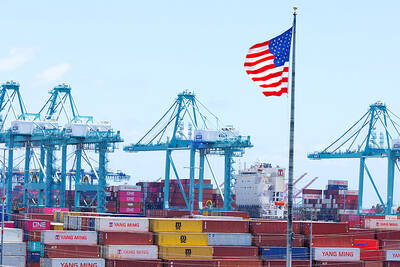
NOT IMMEDIATE: Taiwan has a chance to appeal the proposed 10 percent tariff before it starts, while other countries face a 12.5 percent tariff from the trade office Taiwan is among 60 economies determined by the US to have failed to impose or enforce a ban on the importation of goods produced with forced labor, according to a notice released on Tuesday by the Office of the US Trade Representative (USTR), which proposed imposing an additional 10 percent or more tariff on them. The USTR in a statement said that following an investigation, it had determined under Section 301 of the Trade Act of 1974 that the failure of the 60 economies to impose and effectively enforce a prohibition on the importation of goods produced with forced labor is


 RSS
RSS