


President William Lai (賴清德) on the 37th anniversary of the Tiananmen Square Massacre yesterday wrote on social media that he hoped China could face the incident, acknowledge the truth and work to heal the wounds it left behind.
A country’s might is not decided by its size or its military strength, but determined by whether its people are free, respected and can strive toward a better life, he said.
Within 37 years, a newborn would have grown into an adult, established a career, built a family and moved toward a bright future, but 37 years ago, thousands of young people, filled with hope and ideas, were killed on the streets of Beijing, Lai said.
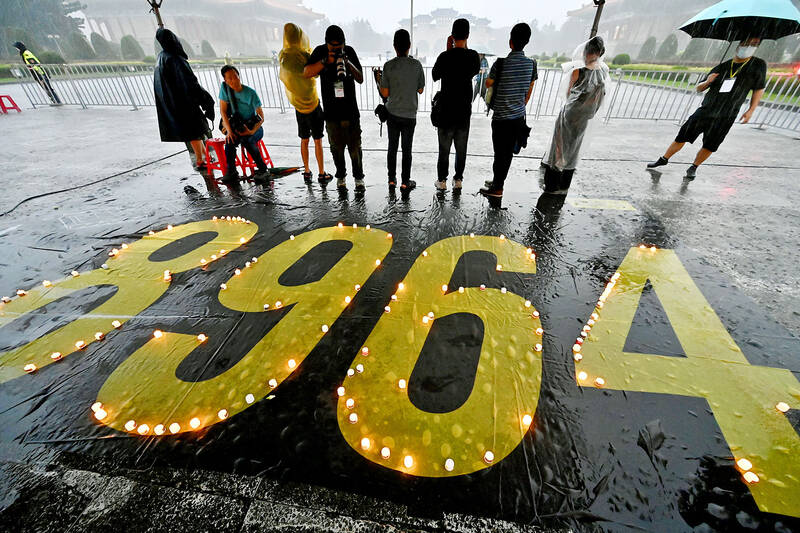
Photo: George Tsorng, Taipei Times
They were ruthlessly shot and crushed by tanks, as the army moved to suppress and kill young protesters in Tiananmen Square, he said.
What was lost that day was not just the lives of young activists protesting for democracy, but an entire generation’s hope for freedom and democracy in China, Lai said.
A great and powerful country should not focus on aggressive military action, but instead listen to the voices of its citizens and allow them to pursue their dreams, while bravely facing the tragedies of the past, he said.
Lai said he hoped China could begin reconciliation and dialogue with the victims, allow its citizens to speak freely, and let the next generation, regardless of their political beliefs, participate in public discourse.
In particular, the voices of the Chinese youth need to be heard, as they are the future and strength that could drive the nation forward, he added.
The government and society should support the next generation in creating a life that is better than those of the people before them, and their opinions should not be silenced through violence or surveillance, Lai said.
Lai said he attended a discussion last week with high-school students, and their bright ideas and youthful energy made him hopeful for Taiwan’s future.
The government this week announced new policies to combat Taiwan’s aging population that would offer childrearing subsidies, improve childcare support, implement education initiatives and create a more family-friendly workplace, he said, adding that it was Taiwan’s way of investing in its young people and supporting the next generation.
Taiwan will stand shoulder-to-shoulder with anyone around the world seeking democracy, Lai said.
Only when we face the truth can we work to heal the wounds of the past and ensure that no one is killed for fighting for their freedom, he added.
Meanwhile, in Washingon, US Secretary of State Marco Rubio on Wednesday said that Beijing’s censorship would not erase memories of the military assault.
“Those who sacrificed to uphold their unalienable rights of free expression and peaceful assembly will be vindicated someday,” he said in a statement that followed past practice of the US’ top diplomat marking the anniversary.
That drew criticism from China, with Chinese Ministry of Foreign Affairs spokesperson Mao Ning (毛寧) saying that “China is strongly dissatisfied and firmly opposed to the US distorting historical facts, smearing China’s political system and development path.”
The Chinese government has long reached a “clear conclusion” about the “political turmoil that occurred in the late 1980s,” she said, accusing Washington of interfering with Beijing’s internal affairs on the pretext of democracy and human rights.”
China has never provided a full death toll for the Tiananmen Square Massacre, but rights groups and witnesses said the figure could run into thousands.
Beijing has blamed the protests on counterrevolutionaries seeking to overthrow the Chinese Communist Party.
Additional reporting by Reuters

‘NO SECURITY RISK’: The Railway Bureau reassured the public that the technicians’ activities were limited to technical guidance and did not involve sensitive systems The Railway Bureau yesterday said it had invited eight Chinese technicians to assist with an airport MRT construction project. The bureau issued the confirmation after an Internet user said Chinese nationals had entered the construction zone of Taiwan Taoyuan International Airport’s Terminal 3 project. They asked why “individuals from an enemy state” were allowed access to such a major national infrastructure project, which raised serious concerns over Taiwan’s industrial safety, sensitive systems and information security. The bureau’s Northern Region Engineering Branch Office said subcontractor Taiwan Handle Industrial Co (台灣手把工業) of the Taoyuan airport MRT’s “Contract No. CU05 Project A14 Station Civil, MEP &

The National Chungshan Institute of Science and Technology yesterday showcased its locally developed variants of the Vision 60 robotic patrol dog, which it plans to deploy on the nation’s outlying territories in the South China Sea. The variants were produced under the Joint Lab project — created by the institute and domestic companies — and assembled with domestically produced motors, lenses and artificial intelligence (AI) systems alongside licensed tech from the US, Missile and Rocket Systems Research Division deputy director Jen Kuo-kang (任國光) told the media event at a military base in Taipei’s Dazhi (大直) area. Taiwan has built up its strengths

TIT-FOR-TAT: The US allegedly revoked the visa of a Chinese national working at Xinhua News Agency in the US in response to Beijing’s expulsion of Vivian Wang The Presidential Office yesterday condemned China for expelling a New York Times correspondent from Beijing following the newspaper’s interview with President William Lai (賴清德), saying the move highlighted Beijing’s suppression of press freedom and its threat to international news media. Taiwan has noted a series of recent incidents in which Beijing used similar tactics to “threaten and pressure international media outlets and journalists,” Presidential Office spokeswoman Karen Kuo (郭雅慧) said in a statement. “This concerns not only press freedom and freedom of expression, but also the safety of journalists, and Taiwan and relevant partners are paying close attention to the situation,” she

NOT IMMEDIATE: Taiwan has a chance to appeal the proposed 10 percent tariff before it starts, while other countries face a 12.5 percent tariff from the trade office Taiwan is among 60 economies determined by the US to have failed to impose or enforce a ban on the importation of goods produced with forced labor, according to a notice released on Tuesday by the Office of the US Trade Representative (USTR), which proposed imposing an additional 10 percent or more tariff on them. The USTR in a statement said that following an investigation, it had determined under Section 301 of the Trade Act of 1974 that the failure of the 60 economies to impose and effectively enforce a prohibition on the importation of goods produced with forced labor is


 RSS
RSS