


Myanmar President Min Aung Hlaing yesterday embarked on an official visit to India, one of the country’s key regional partners, for high-level meetings aimed at bolstering bilateral ties.
It is the first time Min Aung Hlaing has traveled to the neighboring country since he was sworn into office as president last month following an election that critics said was orchestrated to maintain the military’s tight grip on power.
His last visit to India was in 2019 as military chief.
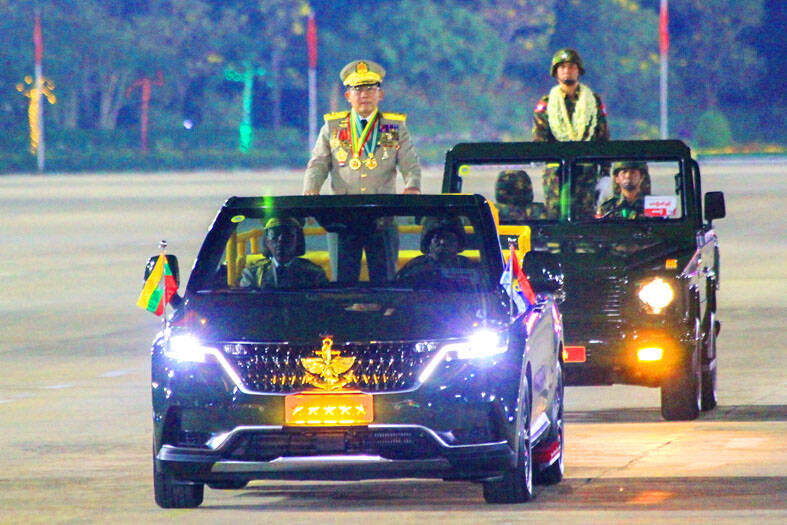
Photo: Reuters / Stringer
India has maintained ties with Myanmar’s military-backed administrations despite Western sanctions imposed after the military seized power from the elected government of former leader Aung San Suu Kyi in 2021, and launched a crackdown on opponents that evolved into a nationwide armed conflict and humanitarian crisis.
MRTV reported that Min Aung Hlaing flew from Naypyitaw yesterday morning and landed at Gaya International Airport in India.
The Myanmar president is to meet with Indian President Droupadi Murmu and Prime Minister Narendra Modi, as well as government officials and representatives from business organizations, to discuss ways to deepen ties, and foster cooperation in the economic, religious, cultural and social sectors, it said.
The president, who is accompanied by members of his Cabinet, would also visit prominent infrastructure facilities during the trip, MRTV said.
India shares a 1,643km border with Myanmar and a maritime boundary in the Bay of Bengal.
Myanmar is strategically important to India’s security interests. The two countries have cooperated on border security and intelligence sharing to combat insurgent groups operating out of the border region.
Critics have expressed concern that Min Aung Hlaing’s visit to India would do more to legitimize the military-backed government.
“We condemn India’s decision to host Min Aung Hlaing, who is a war criminal waging a campaign of terror against the Myanmar people,” Justice For Myanmar spokeswoman Yadanar Maung said.
“India must change course, stop awarding false legitimacy to the junta, stop profiting from the military’s campaign of terror against the people, and instead support the Myanmar people who are struggling and sacrificing daily for federal democracy,” she added.
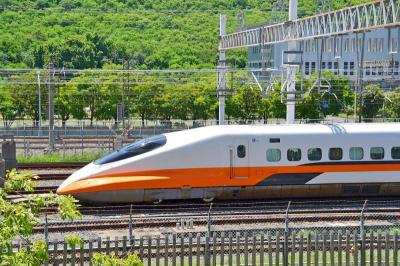
A signaling system malfunction disrupted high-speed rail (HSR) services beginning at 8am today, with trains temporarily reduced to three northbound and three southbound trains per hour as authorities conduct inspections. The malfunction occurred on a section of track in Miaoli County during pre-operation checks early this morning, forcing northbound and southbound trains to use a single track, the HSR operator said. The regular schedule has been replaced with three hourly trains offering only nonreserved seating in each direction, stopping at every station, it said, adding that business class cars would still have reserved seating. Departures from terminal stations are scheduled at the top
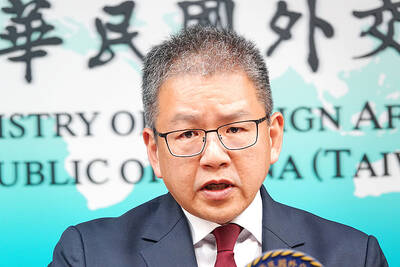
Taiwan is still in the process of assessing the possibility of recruiting workers from Eswatini, the Ministry of Foreign Affairs said yesterday, adding that its goal is to help Eswatini upgrade its vocational training centers. If there are plans to recruit workers from Eswatini, safeguarding national security, protecting public health and ensuring the employment rights of Taiwanese would be prerequisites, Department of West Asian and African Affairs Director-General Yen Chia-liang (顏嘉良) told a news conference. Key considerations would also include filling labor shortages in specific industries, and fostering bilateral professional and technical exchanges, he said. Yen was asked about the progress of labor

A US uncrewed surface vessel (USV) encountered multiple Chinese warships during an autonomous transit of the Taiwan Strait, US defense company Seasats said in a statement on Wednesday. Seasats announced that a Lightfish USV had completed the first autonomous transit of the Taiwan Strait. Over five days, the USV traversed the entire length of the Strait while constantly monitoring surface vessel traffic, the company said. The Lightfish encountered multiple Chinese warships, one of which was a Chinese People’s Liberation Army Navy (PLAN) Type 056 corvette, it said. The Chinese vessels were operating “well within Taiwan’s exclusive economic zone without transmitting their identity via the
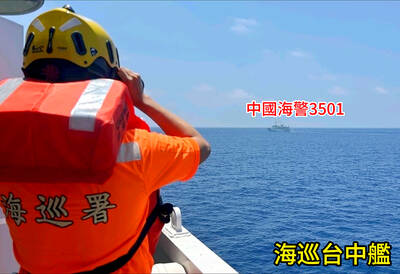
VERBOSE VESSELS: A CGA cutter and a China Coast Guard exchanged verbal barbs for more than a day in Taiwanese-controlled waters before the Chinese vessel left The Taiwanese and Chinese coast guards had a standoff near the strategically located Pratas Islands (Dongsha Islands, 東沙群島) in the north of the South China Sea, the Coast Guard Administration (CGA) said yesterday. The two sides engaged in intense radio exchanges over sovereignty claims during the 33-hour standoff. China Coast Guard vessel 3501 eventually left the restricted waters, 26.6 nautical miles (49.2km) west of the Pratas Islands, at 5pm yesterday, the CGA said. Lying approximately between southern Taiwan and Hong Kong, the Taiwan-controlled Pratas are seen by some security experts as vulnerable to Chinese attack due to their distance — more than


 RSS
RSS