


China’s rapid military modernization and assertiveness in the Indo-Pacific region and growing concerns over US priorities were the top issues on the table at Asia’s premier defense summit drawing leaders, top diplomats and security officials from around the world.
Vietnamese President To Lam opened the Shangri-La Dialogue yesterday with a keynote address, while US Secretary of Defense Pete Hegseth would start today’s session with remarks focused on Washington’s Indo-Pacific strategy.
With Hanoi performing a delicate balancing act with Washington and Beijing, Lam was expected to keep his address focused on using consensus to manage differences, and working jointly on regional stability and development.
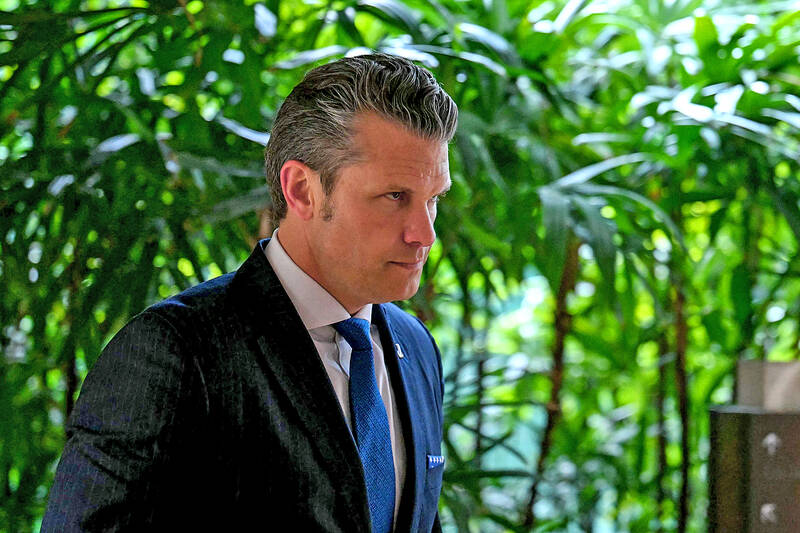
Photo: AFP
Lam was also expected to meet on the sidelines of the conference with Hegseth.
Last year in Singapore, Hegseth raised the ire of Beijing by saying “ the threat China poses is real, and it could be imminent,” and that its military was “rehearsing for the real deal.”
Washington would bolster its defenses to counter what the Pentagon sees as rapidly developing threats, particularly in China’s aggressive stance toward Taiwan, Hegseth had said.
However, this year’s speech comes only about two weeks after US President Donald Trump visited Chinese President Xi Jinping (習近平) in Beijing, where Xi warned that their two countries could clash over Taiwan if the issue was not handled properly.
Following the meetings, Trump called Xi a “great leader” and said that they were going to have a “fantastic future together.”
Trump also raised questions about Washington’s willingness to defend Taiwan, calling a new US$14 billion arms package that he has yet to greenlight “a very good negotiating chip for us” with China.
The US supplies Taiwan with modern aircraft, missiles and other weapons to help it defend itself, although it follows a policy of “strategic ambiguity” on whether it would intervene militarily if China were to attack the nation.
Trump has shown greater ambivalence toward Taiwan than his predecessors, fueling speculation about whether the president could be persuaded to dial back US support.
Hegseth’s speech would focus on the military’s “common-sense approach to safeguarding US vital national interests in the Indo-Pacific,” according to the Pentagon.
Coming so soon after the meeting of the two leaders in Beijing, it seems unlikely Hegseth would say anything to upstage Trump’s own remarks.
China is due to open tomorrow’s dialogue with its view, although Beijing was only sending a lower-level delegation this year, Chinese media reported.
It was not immediately clear who would be speaking.
While the annual conference tilts toward Asian security issues, there would be no avoiding Russia’s ongoing war against Ukraine and the Iran war, which has led to the shutdown of the Strait of Hormuz.
Qatar’s minister of defense is among the speakers this weekend, but Ukrainian President Volodymyr Zelenskiy is not expected at the dialogue this year.
Other speakers would include many top European defense officials, including from Lithuania and Poland.

A signaling system malfunction disrupted high-speed rail (HSR) services beginning at 8am today, with trains temporarily reduced to three northbound and three southbound trains per hour as authorities conduct inspections. The malfunction occurred on a section of track in Miaoli County during pre-operation checks early this morning, forcing northbound and southbound trains to use a single track, the HSR operator said. The regular schedule has been replaced with three hourly trains offering only nonreserved seating in each direction, stopping at every station, it said, adding that business class cars would still have reserved seating. Departures from terminal stations are scheduled at the top

Taiwan is still in the process of assessing the possibility of recruiting workers from Eswatini, the Ministry of Foreign Affairs said yesterday, adding that its goal is to help Eswatini upgrade its vocational training centers. If there are plans to recruit workers from Eswatini, safeguarding national security, protecting public health and ensuring the employment rights of Taiwanese would be prerequisites, Department of West Asian and African Affairs Director-General Yen Chia-liang (顏嘉良) told a news conference. Key considerations would also include filling labor shortages in specific industries, and fostering bilateral professional and technical exchanges, he said. Yen was asked about the progress of labor

VERBOSE VESSELS: A CGA cutter and a China Coast Guard exchanged verbal barbs for more than a day in Taiwanese-controlled waters before the Chinese vessel left The Taiwanese and Chinese coast guards had a standoff near the strategically located Pratas Islands (Dongsha Islands, 東沙群島) in the north of the South China Sea, the Coast Guard Administration (CGA) said yesterday. The two sides engaged in intense radio exchanges over sovereignty claims during the 33-hour standoff. China Coast Guard vessel 3501 eventually left the restricted waters, 26.6 nautical miles (49.2km) west of the Pratas Islands, at 5pm yesterday, the CGA said. Lying approximately between southern Taiwan and Hong Kong, the Taiwan-controlled Pratas are seen by some security experts as vulnerable to Chinese attack due to their distance — more than

A US uncrewed surface vessel (USV) encountered multiple Chinese warships during an autonomous transit of the Taiwan Strait, US defense company Seasats said in a statement on Wednesday. Seasats announced that a Lightfish USV had completed the first autonomous transit of the Taiwan Strait. Over five days, the USV traversed the entire length of the Strait while constantly monitoring surface vessel traffic, the company said. The Lightfish encountered multiple Chinese warships, one of which was a Chinese People’s Liberation Army Navy (PLAN) Type 056 corvette, it said. The Chinese vessels were operating “well within Taiwan’s exclusive economic zone without transmitting their identity via the


 RSS
RSS