


Solomon Islands yesterday elected as its new prime minister Matthew Wale, who has been a critic of the South Pacific nation’s closeness to China and pledged to bring change.
The Solomons has been seen as one of Beijing’s closest Pacific islands partners in the past few years, and any change of leaders in the strategically located archipelago is closely watched by Western diplomats.
Wale — who leads the Solomon Islands Democratic Party — won 26 votes to the government candidate’s 22 in a secret ballot of lawmakers.
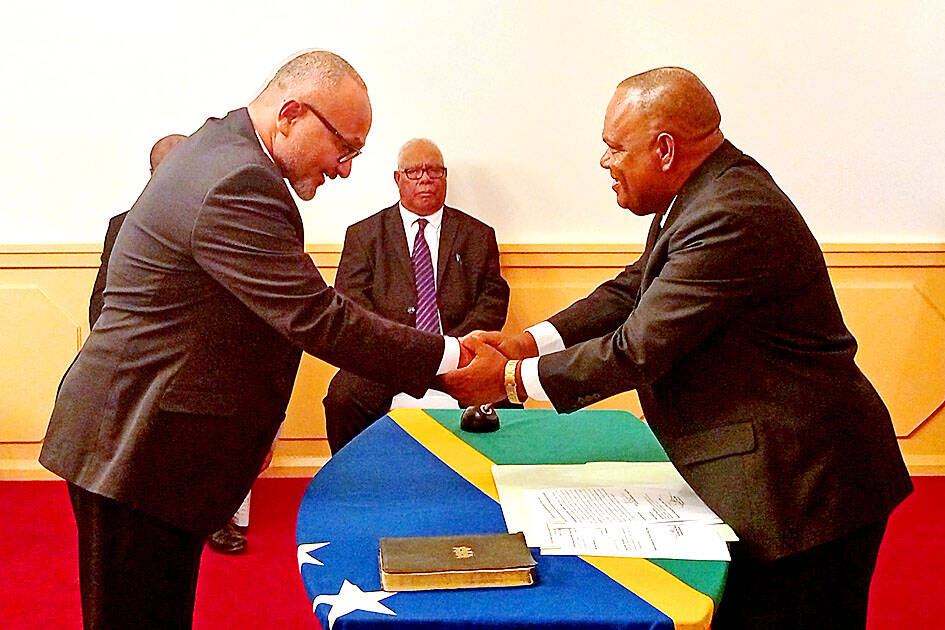
Photo: Solomon Islands Government / AFP
Former prime minister Jeremiah Manele was ousted last week in a no-confidence motion in parliament after a dozen ministers quit the government in March.
“Change is coming. These changes are necessary and may be painful,” Wale, 57, told reporters outside parliament.
“We are not immune from these geopolitical events,” he said, urging young Solomon Islanders to “be ambitious.”
As opposition leader since 2019 — when the Solomons switched ties from Taiwan to China — Wale has campaigned for greater government transparency in dealings with foreign mining and logging businesses.
Despite a population of just 700,000, the Solomon Islands occupies a strategic position 1,600km northeast of Australia, a major aid donor that is critical of China’s police presence in Honiara.
Wale, a former accountant, hails from Malaita, the most populous province whose local government boycotted Chinese companies until 2023.
Wale criticized then-Solomon Islands prime minister Manasseh Sogavare, who struck a secret security deal with China, for saying he was “back home” upon arriving in Beijing on a visit in 2023.
Wale previously called for the security pact to be made public.
Yesterday, he told the Australian Broadcasting Corp he wanted to first look at the deal before deciding what to do.
Anouk Ride, associate professor at the Australian National University, said Wale’s election was “a seismic shift” in Solomons’ politics.
He was likely to be “more moderate” on China ties and focused on the national interest, education, policing and health, she said.
The Chinese Ministry of Foreign Affairs congratulated Wale, saying it would be open to working with his government.
“China is willing to work with the new Solomon Islands government to expand practical cooperation between the two countries in various fields” and deepen their strategic partnership, ministry spokesman Guo Jiakun (郭嘉昆) told a news briefing.
Ordinary Solomon Islanders are struggling because of a surge in fuel prices brought on by the war in the Middle East, and there has been little improvement to health and education in rural villages since a conflict destroyed many services 20 years ago.
“You can see this very visibly in the rural areas and also Honiara town, where people are living without electricity and water supply,” Ride said.
While the “geopolitical switch” to China brought large, visible developments — including a national stadium and provincial airports — she said “those big-ticket projects haven’t impacted the lives of people.”
Former Australian diplomat to the Solomon Islands James Batley said Wale was “pragmatic when it comes to international relations” and likely to continue to balance ties with China and Australia.
Australian National University Pacific affairs expert Graeme Smith said while Wale has been outspoken against China, “it will be a tricky balancing act for him” as several of his new coalition partners are close to Beijing.
University of Queensland professor Clive Moore, who has known Wale for 20 years, said his father was a Canadian anthropologist with an American university who undertook research in the Solomons, and his mother a Malaitan.
Wale was a civil society leader with a Christian group as the nation emerged from a period of ethnic violence in 2003, entering parliament in 2008, he added.
The election of Wale would “calm things down” after a period of political upheaval where lawmakers were offered large sums of money from foreign business figures to back the previous government, Moore said.

‘NO SECURITY RISK’: The Railway Bureau reassured the public that the technicians’ activities were limited to technical guidance and did not involve sensitive systems The Railway Bureau yesterday said it had invited eight Chinese technicians to assist with an airport MRT construction project. The bureau issued the confirmation after an Internet user said Chinese nationals had entered the construction zone of Taiwan Taoyuan International Airport’s Terminal 3 project. They asked why “individuals from an enemy state” were allowed access to such a major national infrastructure project, which raised serious concerns over Taiwan’s industrial safety, sensitive systems and information security. The bureau’s Northern Region Engineering Branch Office said subcontractor Taiwan Handle Industrial Co (台灣手把工業) of the Taoyuan airport MRT’s “Contract No. CU05 Project A14 Station Civil, MEP &

The National Chungshan Institute of Science and Technology yesterday showcased its locally developed variants of the Vision 60 robotic patrol dog, which it plans to deploy on the nation’s outlying territories in the South China Sea. The variants were produced under the Joint Lab project — created by the institute and domestic companies — and assembled with domestically produced motors, lenses and artificial intelligence (AI) systems alongside licensed tech from the US, Missile and Rocket Systems Research Division deputy director Jen Kuo-kang (任國光) told the media event at a military base in Taipei’s Dazhi (大直) area. Taiwan has built up its strengths

TIT-FOR-TAT: The US allegedly revoked the visa of a Chinese national working at Xinhua News Agency in the US in response to Beijing’s expulsion of Vivian Wang The Presidential Office yesterday condemned China for expelling a New York Times correspondent from Beijing following the newspaper’s interview with President William Lai (賴清德), saying the move highlighted Beijing’s suppression of press freedom and its threat to international news media. Taiwan has noted a series of recent incidents in which Beijing used similar tactics to “threaten and pressure international media outlets and journalists,” Presidential Office spokeswoman Karen Kuo (郭雅慧) said in a statement. “This concerns not only press freedom and freedom of expression, but also the safety of journalists, and Taiwan and relevant partners are paying close attention to the situation,” she

NOT IMMEDIATE: Taiwan has a chance to appeal the proposed 10 percent tariff before it starts, while other countries face a 12.5 percent tariff from the trade office Taiwan is among 60 economies determined by the US to have failed to impose or enforce a ban on the importation of goods produced with forced labor, according to a notice released on Tuesday by the Office of the US Trade Representative (USTR), which proposed imposing an additional 10 percent or more tariff on them. The USTR in a statement said that following an investigation, it had determined under Section 301 of the Trade Act of 1974 that the failure of the 60 economies to impose and effectively enforce a prohibition on the importation of goods produced with forced labor is


 RSS
RSS