


The legislative caucuses yesterday agreed to invite Premier Cho Jung-tai (卓榮泰) to present a special report on Tuesday on preparations for the first tranche of procurement authorized by a special defense budget act, Deputy Legislative Speaker Johnny Chiang (江啟臣) said yesterday.
The legislature on May 8 passed the Special Act for Procurement Projects to Safeguard National Security and Enhance Asymmetric Warfare Capabilities (保衛國家安全及強化不對稱戰力計畫) to fund the purchase of US military equipment, with the spending capped at NT$780 billion (US$24.7 billion).
The bill, which fell short of the NT$1.25 trillion requested by the Cabinet, requires the Executive Yuan to report to the Legislative Yuan within a month of the law’s passage, military spending over the past five years, detailing costs, effectiveness, deliveries and how the purchases boost joint operations.
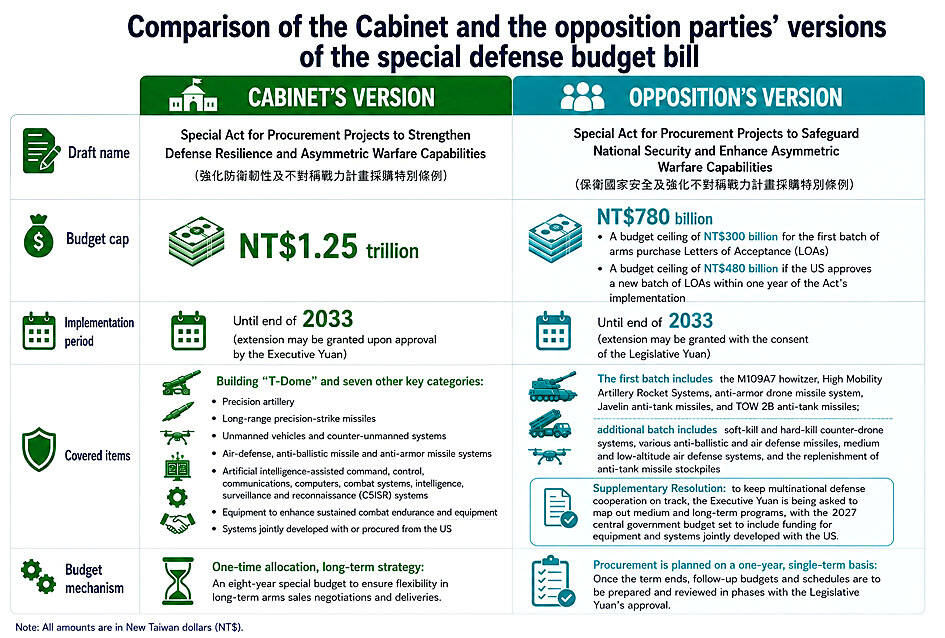
Sources: Executive Yuan and Legislative Yuan
Only with the legislature’s approval can the budget move forward, and the first batch of special budget proposals must be submitted for review within two months, the bill says.
The Chinese Nationalist Party (KMT) and Democratic Progressive Party (DPP) caucuses would each designate three representatives while the Taiwan People’s Party (TPP) caucus would designate one to question the premier or Cabinet members, Chiang said after the cross-caucus negotiations.
If the plans are approved by the Legislative Yuan, the Executive Yuan would submit the proposal to the legislature by noon the following day, he said.
The legislature would then hold a plenary session that afternoon, during which Cho would return to report on the drafting process and answer questions, he said, adding that once questioning concludes, the proposal would immediately be sent for review, and that all caucuses have agreed not to file reconsideration motions.
In other developments, the opposition-controlled legislature passed a motion to extend the current legislative session, originally scheduled to end on May 31, to the end of August, to allow for more time to review this year’s general budget and other items.
The Legislative Yuan holds two regular sessions each year — from February through May and from September through December.
In a proposal submitted on April 10, the TPP caucus argued that President William Lai (賴清德) and Cho had failed to submit a new list of nominees for the Constitutional Court and the National Communications Commission.
The opposition-controlled Legislative Yuan last year rejected the president’s nominees for the court and the commission.
The TPP added the Taiwan-US Agreement on Reciprocal Trade and a memorandum of understanding on Taiwan-US investment had not been to be sent to the legislature for review.
To give lawmakers sufficient time to deliberate these items, it proposed extending the current session through July 31.
During cross-party negotiations on April 20, the KMT and TPP supported the proposal over the DPP’s opposition, and an amended version of the motion to extend the current session through Aug. 31 was later placed on yesterday’s agenda for a vote, and was passed with 53 votes in favor and 39 against.
A DPP motion to reconsider the extension was blocked by the KMT.
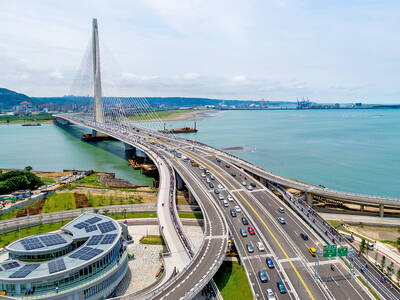
The Ministry of Transportation and Communications yesterday inaugurated the Danjiang Bridge across the Tamsui River in New Taipei City, saying that the structure would be an architectural icon and traffic artery for Taiwan. Feted as a major engineering achievement, the Danjiang Bridge is 920m long, 211m tall at the top of its pylon, and is the longest single-pylon asymmetric cable-stayed bridge in the world, the government’s Web site for the structure said. It was designed by late Iraqi-British architect Zaha Hadid. The structure, with a maximum deck of 70m, accommodates road and light rail traffic, and affords a 200m navigation channel for boats,
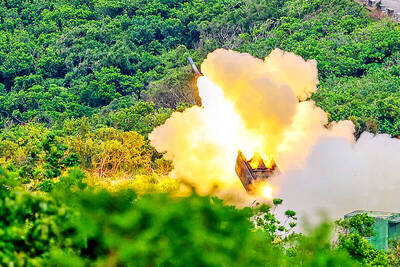
PRECISION STRIKES: The most significant reason to deploy HIMARS to outlying islands is to establish a ‘dead zone’ that the PLA would not dare enter, a source said A High Mobility Artillery Rocket System (HIMARS) would be deployed to Penghu County and Dongyin Island (東引) in Lienchiang County (Matsu) to force the Chinese military to retreat at least 100km from the coastline, a military source said yesterday. Taiwan has been procuring HIMARS and Army Tactical Missile Systems (ATACMS) from the US in batches. Once all batches have been delivered, Taiwan would possess 111 HIMARS units and 504 ATACMS, which have a range of 300km. Considering that “offense is the best defense,” the military plans to forward-deploy the systems to outlying islands such as Penghu and Dongyin so that
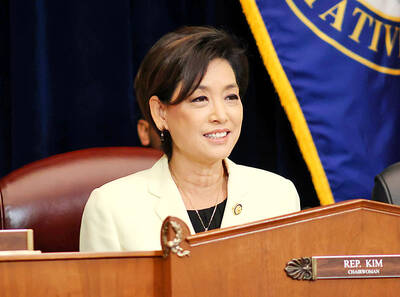
‘CLEAR MESSAGE’: The bill would set up an interagency ‘tiger team’ to review sanctions tools and other economic options to help deter any Chinese aggression toward Taiwan US Representative Young Kim has introduced a bill to deter Chinese aggression against Taiwan, calling for an interagency “tiger team” to preplan coordinated sanctions and economic measures in response to possible Chinese military or political action against Taiwan. “[Chinese President] Xi Jinping [習近平] has directed the People’s Liberation Army to be ready to invade Taiwan by 2027. China has a plan. America should have one too,” Kim said in a news release on Thursday last week. She introduced the “Deter PRC [People’s Republic of China] aggression against Taiwan act” to “ensure the US has a coordinated sanctions strategy ready should

TAIWAN ISSUE: US treasury secretary Scott Bessent said on the first day of meetings that ‘it wouldn’t be a US-China summit without the Taiwan issue coming up’ There were no surprises on the first day of the summit between US President Donald Trump and Chinese President Xi Jinping (習近平), the Mainland Affairs Council (MAC) said yesterday, as the government reiterated that cross-strait stability is crucial to the Asia-Pacific region, as well as the world. As the two presidents met for a highly anticipated summit yesterday, Chinese state media reported that Xi warned Trump that missteps regarding Taiwan could push their two countries into “conflict.” Trump arrived in China with accolades for his host, calling Xi a “great leader” and “friend,” and extending an invitation to visit the White House


 RSS
RSS