


US President Donald Trump said he had made “fantastic trade deals” and settled “a lot of different problems” in his meetings with Chinese President Xi Jinping (習近平) this week, but hours after the summit ended yesterday, details on exact agreements remained scarce.
Trump had arrived in Beijing seeking to seal accords in sectors including agriculture, aviation and artificial intelligence (AI), as well as to contain differences between the two sides in a number of tense geostrategic areas.
After the first day wrapped, Trump said Xi had agreed to help open the Strait of Hormuz, as well as buy Boeing jets and more US oil and soybeans.
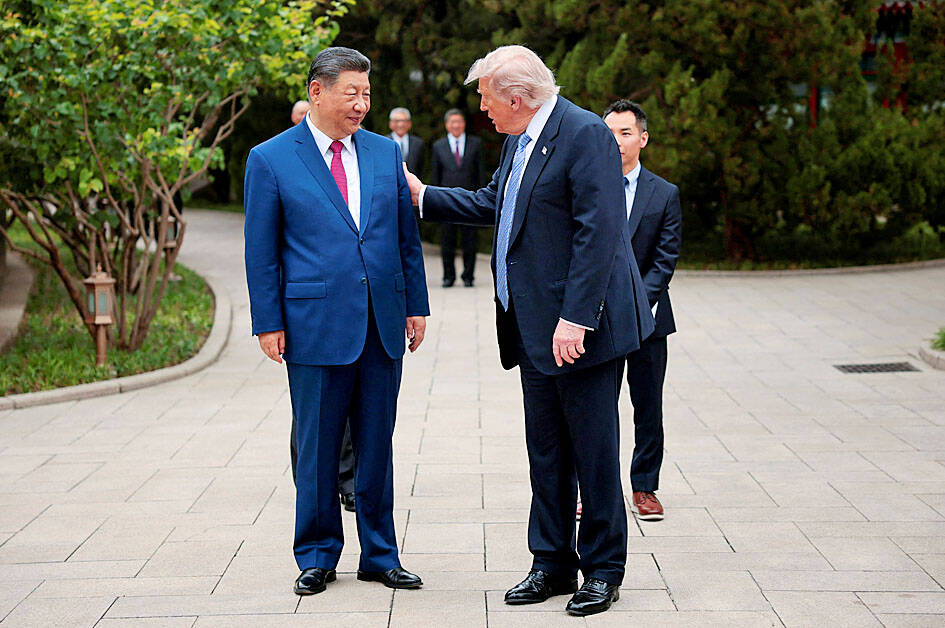
Photo: Reuters
However, there have been no formal announcements, and the Chinese Ministry of Foreign Affairs would not confirm or deny Trump’s statements when asked yesterday afternoon. The reserve on the Chinese side echoes the tone of the summit as a whole, where Trump’s overtures to Xi — whom he described as a “great leader” and “friend” — were met with more muted tones by Beijing.
However, the US leader yesterday said “a lot of good” had come out of the visit.
“We’ve made some fantastic trade deals, great for both countries,” he said after a walk with Xi among the rosebushes in the gardens of Zhongnanhai, a central leadership compound next to Beijing’s Forbidden City.
“We’ve settled a lot of different problems that other people wouldn’t have been able to solve,” Trump added, without providing specifics.
Xi, who promised to send Trump seeds for the White House Rose Garden, said it was a “milestone visit.”
He said the two sides had to date established “a new bilateral relationship, which is a relationship of constructive strategic stability.”
In an interview with Fox News after the summit’s first day, Trump said Xi had agreed to several US wishlist points. On the topic of the war in Iran, he said Xi had effectively assured his counterpart that China was not preparing to militarily aid Tehran, which has essentially closed the Strait of Hormuz.
“He’d like to see the Hormuz Strait open, and said ‘if I can be of any help whatsoever, I would like to help,’” Trump said.
The Chinese Ministry of Foreign Affairs yesterday released a statement on Iran calling for “a comprehensive and lasting ceasefire.”
“Shipping lanes should be reopened as soon as possible,” it added.
In the Fox interview, Trump said one big business deal struck involved Xi agreeing to purchase “200 big” Boeing jets.
En route home on Air Force One, he added that the deal included “a promise of 750 planes, which will be by far the largest order ever, if they do a good job with the 200.”
He said that Beijing had “agreed it wanted to buy” US oil, and expressed interest in buying US soybeans.
China, which is the key foreign customer of Iranian oil, bought small amounts of US oil before Trump imposed tariffs last year. It has sharply slowed down purchases of US soybeans, turning instead to Brazil.
China’s foreign ministry again did not confirm or deny the details mentioned by Trump.
No announcements were made regarding the advanced Nvidia chips used in AI, even though CEO Jensen Huang (黃仁勳) was among business leaders in Trump’s business delegation.
Chinese tech firms are barred from purchasing Nvidia’s most cutting-edge chips, under US export rules that Washington says are to protect national security.
Xi and Trump had lunch together before the latter left for the airport.
As the US president went to board Air Force One, he pumped his fist in the air twice.
“In terms of substance, I do not think there have been major surprises,” The Economist Intelligence Unit’s Yue Su said.
The new description of bilateral ties outlined by Xi “should be seen as a positive sign” in terms of reducing risk in the relationship, she said.
However, “this is likely to be a fragile stability that does not eliminate underlying frictions,” Su said.

‘NO SECURITY RISK’: The Railway Bureau reassured the public that the technicians’ activities were limited to technical guidance and did not involve sensitive systems The Railway Bureau yesterday said it had invited eight Chinese technicians to assist with an airport MRT construction project. The bureau issued the confirmation after an Internet user said Chinese nationals had entered the construction zone of Taiwan Taoyuan International Airport’s Terminal 3 project. They asked why “individuals from an enemy state” were allowed access to such a major national infrastructure project, which raised serious concerns over Taiwan’s industrial safety, sensitive systems and information security. The bureau’s Northern Region Engineering Branch Office said subcontractor Taiwan Handle Industrial Co (台灣手把工業) of the Taoyuan airport MRT’s “Contract No. CU05 Project A14 Station Civil, MEP &

The National Chungshan Institute of Science and Technology yesterday showcased its locally developed variants of the Vision 60 robotic patrol dog, which it plans to deploy on the nation’s outlying territories in the South China Sea. The variants were produced under the Joint Lab project — created by the institute and domestic companies — and assembled with domestically produced motors, lenses and artificial intelligence (AI) systems alongside licensed tech from the US, Missile and Rocket Systems Research Division deputy director Jen Kuo-kang (任國光) told the media event at a military base in Taipei’s Dazhi (大直) area. Taiwan has built up its strengths

TIT-FOR-TAT: The US allegedly revoked the visa of a Chinese national working at Xinhua News Agency in the US in response to Beijing’s expulsion of Vivian Wang The Presidential Office yesterday condemned China for expelling a New York Times correspondent from Beijing following the newspaper’s interview with President William Lai (賴清德), saying the move highlighted Beijing’s suppression of press freedom and its threat to international news media. Taiwan has noted a series of recent incidents in which Beijing used similar tactics to “threaten and pressure international media outlets and journalists,” Presidential Office spokeswoman Karen Kuo (郭雅慧) said in a statement. “This concerns not only press freedom and freedom of expression, but also the safety of journalists, and Taiwan and relevant partners are paying close attention to the situation,” she

NOT IMMEDIATE: Taiwan has a chance to appeal the proposed 10 percent tariff before it starts, while other countries face a 12.5 percent tariff from the trade office Taiwan is among 60 economies determined by the US to have failed to impose or enforce a ban on the importation of goods produced with forced labor, according to a notice released on Tuesday by the Office of the US Trade Representative (USTR), which proposed imposing an additional 10 percent or more tariff on them. The USTR in a statement said that following an investigation, it had determined under Section 301 of the Trade Act of 1974 that the failure of the 60 economies to impose and effectively enforce a prohibition on the importation of goods produced with forced labor is


 RSS
RSS