


The Drone Diplomacy Task Force on Tuesday signed a letter of intent (LOI) with the Arlington, Virginia-based Association for Uncrewed Vehicle Systems International (AUVSI) to promote talent exchanges and international certification.
The LOI was signed at XPONENTIAL, an autonomy and robotics exhibition in Detroit, Michigan, which began on Monday and runs through today.
The Ministry of Foreign Affairs-arranged task force also participated in Tuesday afternoon’s US-Taiwan Autonomous Systems Cooperation Forum.
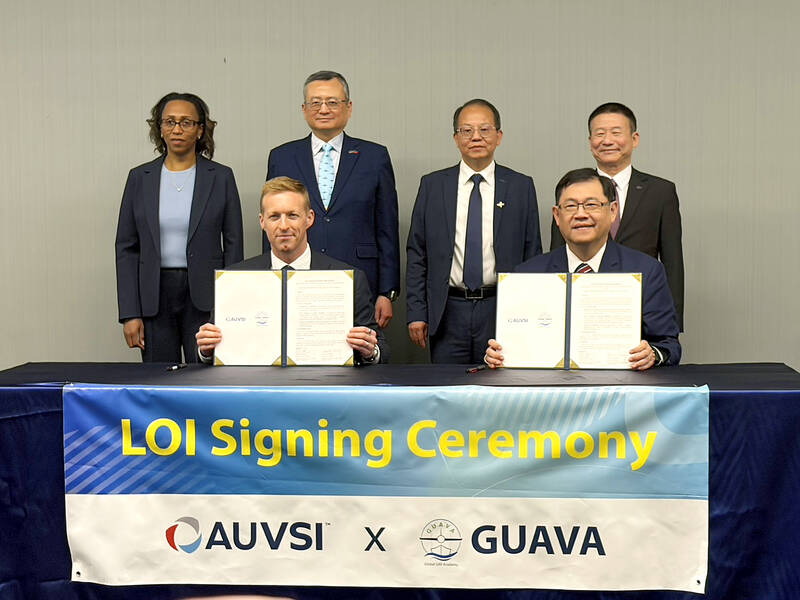
Photo courtesy of the Taipei Economic and Cultural Office in Chicago
AUVSI chief executive officer Michael Robbins said that Taiwan is the association’s first choice for expanding its Green Unmanned Aircraft Systems certification due to its “non-red” supply chain, and outstanding resilience, speed, scale and leadership in the uncrewed autonomous vehicle (UAV) sector.
Under the increasing threat of authoritarian states, democratic nations need to work together, Robbins said, adding that Taiwan is not only home to strong manufacturing, and research and development capabilities, but also serves as a key front line in maintaining regional peace and stability in the Asia-Pacific region.
AUVSI is the world’s largest trade association for uncrewed systems, robotics and autonomous technologies.
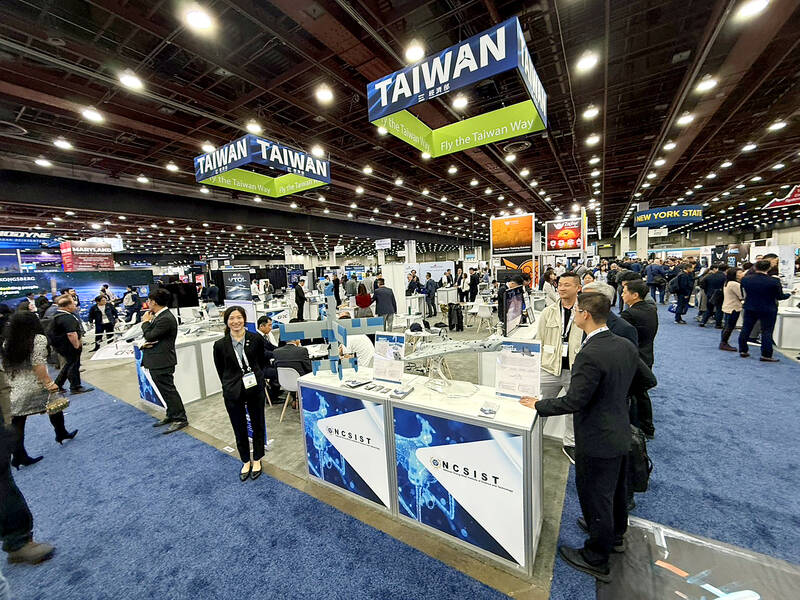
Photo courtesy of the National Chung-Shan Institute of Science and Technology
The task force last week attended the SelectUSA Investment Summit, hosted by the US Department of Commerce in Maryland.
It was established after President William Lai (賴清德) in October last year pledged to develop Taiwan’s “five trusted industry sectors,” said Department of NGO International Affairs Director Chiang Zhen-wei (江振瑋), who is heading the task force.
The five industries are: semiconductors, artificial intelligence, military defense, security and surveillance, and next-generation communications.
The task force was established by Minister of Foreign Affairs Lin Chia-lung (林佳龍) to boost international cooperation in the UAV sector, similar to the work being done for semiconductor diplomacy, Chiang said.
Taiwan’s drone industry is primarily small and medium-sized firms with limited international visibility, Chiang said, adding that he hopes more support from the task force would enable the sector to achieve greater scale.
Meanwhile, the Taiwan Excellence Drone International Business Opportunities Alliance signed a memorandum of understanding with the Michigan Drone Association and the North Dakota Trade Office at Tuesday’s forum.
The alliance was established in September 2024 by the Ministry of Economic Affairs and is led by fighter jet developer Aerospace Industrial Development Corp (漢翔航空工業).
The Russia-Ukraine war has redefined warfare, demonstrating the broad and practical applications of drones, alliance chairman Tsao Chin-pin (曹進平) said.
The industry previously focused on mass production and rapid deployment, but is now pivoting toward using limited budgets to produce highly effective UAVs that are cheaper, faster, more durable and more reliable, Tsao said.
Reliable, non-red supply chains are now absolutely essential to UAV production, he said.
Taipei Economic and Cultural Office Chicago Director-General Dennis Lei (類延峰) said that Taiwan’s UAV industry is not only critical to national defense, but is a key part of Taiwan-US cooperation and the development of democratic supply chains, promoting national values and reliable technology.
At the XPONENTIAL trade show in Detroit, Taiwan is represented by more than 20 firms that are showcasing the latest drone technologies and seeking orders as part of non-red supply chains.
Thunder Tiger Corp (雷虎科技) chief strategy officer Chang Feng-ning (張峰寧) said the push comes at a time of constant change in the nature of drones and other uncrewed systems.
“The industry is advancing very quickly,” Chang said, citing ongoing conflicts in Ukraine and the Middle East.
“Every day and every week there are new technologies being developed,” he said.
He said his firm has developed a range of uncrewed sea, land and air vehicles, and its Overkill first-person view kamikaze drone series received Blue Uncrewed Aircraft System certification from the US Department of Defense last year.

‘NO SECURITY RISK’: The Railway Bureau reassured the public that the technicians’ activities were limited to technical guidance and did not involve sensitive systems The Railway Bureau yesterday said it had invited eight Chinese technicians to assist with an airport MRT construction project. The bureau issued the confirmation after an Internet user said Chinese nationals had entered the construction zone of Taiwan Taoyuan International Airport’s Terminal 3 project. They asked why “individuals from an enemy state” were allowed access to such a major national infrastructure project, which raised serious concerns over Taiwan’s industrial safety, sensitive systems and information security. The bureau’s Northern Region Engineering Branch Office said subcontractor Taiwan Handle Industrial Co (台灣手把工業) of the Taoyuan airport MRT’s “Contract No. CU05 Project A14 Station Civil, MEP &

The National Chungshan Institute of Science and Technology yesterday showcased its locally developed variants of the Vision 60 robotic patrol dog, which it plans to deploy on the nation’s outlying territories in the South China Sea. The variants were produced under the Joint Lab project — created by the institute and domestic companies — and assembled with domestically produced motors, lenses and artificial intelligence (AI) systems alongside licensed tech from the US, Missile and Rocket Systems Research Division deputy director Jen Kuo-kang (任國光) told the media event at a military base in Taipei’s Dazhi (大直) area. Taiwan has built up its strengths

NOT IMMEDIATE: Taiwan has a chance to appeal the proposed 10 percent tariff before it starts, while other countries face a 12.5 percent tariff from the trade office Taiwan is among 60 economies determined by the US to have failed to impose or enforce a ban on the importation of goods produced with forced labor, according to a notice released on Tuesday by the Office of the US Trade Representative (USTR), which proposed imposing an additional 10 percent or more tariff on them. The USTR in a statement said that following an investigation, it had determined under Section 301 of the Trade Act of 1974 that the failure of the 60 economies to impose and effectively enforce a prohibition on the importation of goods produced with forced labor is

TIT-FOR-TAT: The US allegedly revoked the visa of a Chinese national working at Xinhua News Agency in the US in response to Beijing’s expulsion of Vivian Wang The Presidential Office yesterday condemned China for expelling a New York Times correspondent from Beijing following the newspaper’s interview with President William Lai (賴清德), saying the move highlighted Beijing’s suppression of press freedom and its threat to international news media. Taiwan has noted a series of recent incidents in which Beijing used similar tactics to “threaten and pressure international media outlets and journalists,” Presidential Office spokeswoman Karen Kuo (郭雅慧) said in a statement. “This concerns not only press freedom and freedom of expression, but also the safety of journalists, and Taiwan and relevant partners are paying close attention to the situation,” she


 RSS
RSS