


Occupants of a cruise ship struck by a deadly hantavirus outbreak that has sparked international alarm began flying home from Spain’s Canary Islands yesterday in a complex repatriation operation.
Three passengers from the MV Hondius — a Dutch husband and wife and a German woman — have died, while others have fallen sick with the rare disease, which usually spreads among rodents.
No vaccines or specific treatments exist for hantavirus, which is endemic in Argentina, where the ship departed.
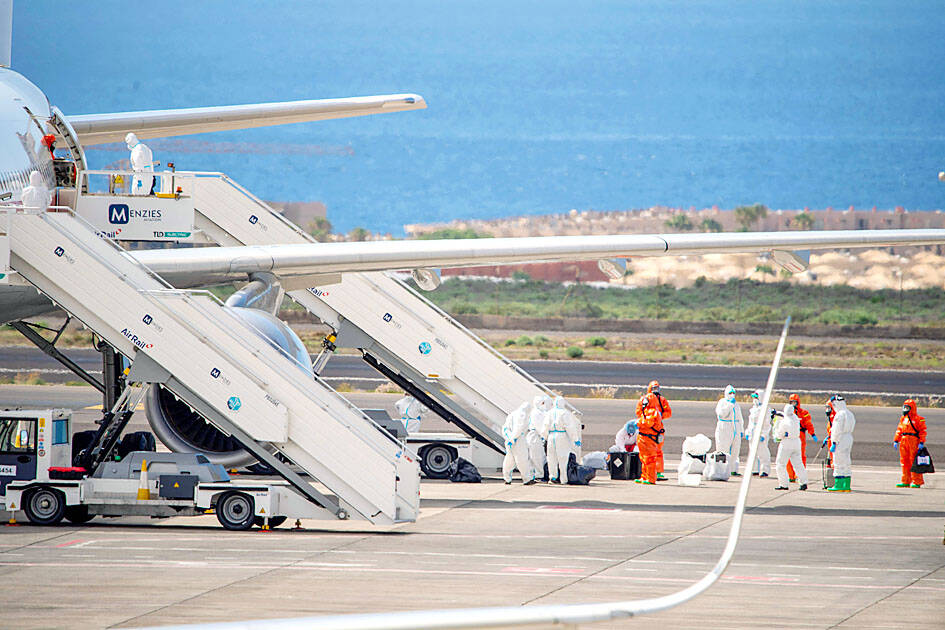
Photo: AFP
However, health officials have stressed that the risk for global public health is low and played down comparisons to a repeat of the COVID-19 pandemic.
The final flight to evacuate most of the ship’s nearly 150 passengers and crew would leave for Australia today, before the ship continues to the Netherlands, Spanish Minister of Health Monica Garcia said.
Passengers wearing blue medical suits began disembarking the Dutch-flagged vessel onto smaller boats to reach the port of Granadilla on Tenerife.
The evacuees then boarded a red Spanish army bus and traveled to Tenerife South Airport in a convoy with Spanish Civil Guard vehicles. A protective board separated the driver from the passengers.
The evacuees changed into new protective equipment before boarding their repatriation flight, the first of which left carrying 14 Spaniards who would observe quarantine at a military hospital in Madrid.
“The operation is going very well,” WHO Secretary-General Tedros Adhanom Ghebreyesus told reporters at the port.
A Dutch flight that would also take citizens from Germany, Belgium, Greece and part of the crew would follow the Spanish departure, Garcia said.
Separate flights for Canadian, Turkish, French, British, Irish and US citizens were also planned for yesterday.
Regional authorities have warned that the operation must be completed by today, when adverse weather conditions would force the ship to leave.
Canary Islands regional authorities have consistently resisted taking in the ship, which was only authorized to anchor offshore instead of docking in the port.
However, all passengers are asymptomatic and underwent a final medical assessment before their disembarkation, Garcia told reporters on Tenerife shortly before the operation began.
Spanish authorities have insisted there would be no contact with the local population in Tenerife.
White tents were erected along the quay, and the police, some in protective medical suits, had sealed off part of the small industrial port.
Spain “is doing what it must do, with technical and scientific rigor and full transparency, with institutional loyalty and with international cooperation,” Spanish Prime Minister Pedro Sanchez said yesterday.

A signaling system malfunction disrupted high-speed rail (HSR) services beginning at 8am today, with trains temporarily reduced to three northbound and three southbound trains per hour as authorities conduct inspections. The malfunction occurred on a section of track in Miaoli County during pre-operation checks early this morning, forcing northbound and southbound trains to use a single track, the HSR operator said. The regular schedule has been replaced with three hourly trains offering only nonreserved seating in each direction, stopping at every station, it said, adding that business class cars would still have reserved seating. Departures from terminal stations are scheduled at the top

Taiwan is still in the process of assessing the possibility of recruiting workers from Eswatini, the Ministry of Foreign Affairs said yesterday, adding that its goal is to help Eswatini upgrade its vocational training centers. If there are plans to recruit workers from Eswatini, safeguarding national security, protecting public health and ensuring the employment rights of Taiwanese would be prerequisites, Department of West Asian and African Affairs Director-General Yen Chia-liang (顏嘉良) told a news conference. Key considerations would also include filling labor shortages in specific industries, and fostering bilateral professional and technical exchanges, he said. Yen was asked about the progress of labor

A US uncrewed surface vessel (USV) encountered multiple Chinese warships during an autonomous transit of the Taiwan Strait, US defense company Seasats said in a statement on Wednesday. Seasats announced that a Lightfish USV had completed the first autonomous transit of the Taiwan Strait. Over five days, the USV traversed the entire length of the Strait while constantly monitoring surface vessel traffic, the company said. The Lightfish encountered multiple Chinese warships, one of which was a Chinese People’s Liberation Army Navy (PLAN) Type 056 corvette, it said. The Chinese vessels were operating “well within Taiwan’s exclusive economic zone without transmitting their identity via the
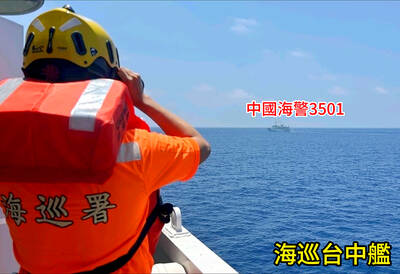
VERBOSE VESSELS: A CGA cutter and a China Coast Guard exchanged verbal barbs for more than a day in Taiwanese-controlled waters before the Chinese vessel left The Taiwanese and Chinese coast guards had a standoff near the strategically located Pratas Islands (Dongsha Islands, 東沙群島) in the north of the South China Sea, the Coast Guard Administration (CGA) said yesterday. The two sides engaged in intense radio exchanges over sovereignty claims during the 33-hour standoff. China Coast Guard vessel 3501 eventually left the restricted waters, 26.6 nautical miles (49.2km) west of the Pratas Islands, at 5pm yesterday, the CGA said. Lying approximately between southern Taiwan and Hong Kong, the Taiwan-controlled Pratas are seen by some security experts as vulnerable to Chinese attack due to their distance — more than


 RSS
RSS