


Taiwan recorded the world’s 20th-highest artificial intelligence (AI) diffusion rate in the first quarter of this year, entering the top 20 for the first time, a report released by a Microsoft think tank showed.
In the AI Economy Institute report published on Thursday, Taiwan recorded a generative AI usage rate of 31.8 percent of its working population, rising from 23rd place in the second half of last year.
Taiwan ranked ahead of the US, Denmark and Germany, which placed 21st, 22nd and 23rd with rates of 31.3 percent, 31.2 percent and 31.1 percent respectively.

Photo: Reuters
Taiwan and Japan posted increases of 3.4 percentage points from the previous quarter, tying for the sixth-largest gain.
South Korea, ranked 16th globally with a diffusion rate of 37.1 percent, recorded the largest increase at 6.4 percentage points.
The report measured the share of people aged 15 to 64 using generative AI across 147 economies.
Globally, the AI diffusion rate reached 17.8 percent in the first quarter of this year, up 1.5 percentage points from the second half of last year, the report said.
A total of 26 economies recorded diffusion rates above 30 percent.
The United Arab Emirates and Singapore were the only two economies with diffusion rates exceeding 50 percent, at 70.1 percent and 63.4 percent respectively.
The two nations were followed by Norway, Ireland, France, Spain, New Zealand, the UK, the Netherlands and Qatar.
The report also said that 12 of the 15 economies with the sharpest increases in AI use since June last year were in Asia, with each recording a minimum growth of about 25 percent in AI users.
South Korea led with a 43.2 percent increase, followed by Thailand at 36.4 percent and Japan at 34.1 percent.
Meanwhile, the gap in AI adoption between the so-called global north and global south was widening.
The diffusion rate in the “global north” rose from 22.9 percent in the second half of last year to 27.5 percent in the first quarter of this year, while the “global south” increased from 13.1 percent to 15.4 percent.
The institute attributed the widening divide to persistent challenges in the “global south,” including limited access to reliable electricity and Internet connectivity, as well as lower digital skills.
“Until these foundational gaps are addressed, the benefits of generative AI will remain unevenly distributed, risking a deepening of existing global inequalities,” the report said.
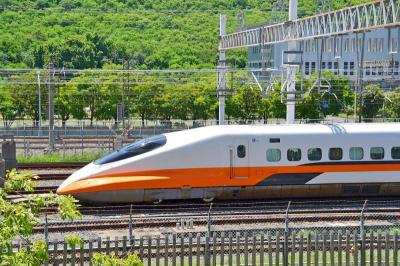
A signaling system malfunction disrupted high-speed rail (HSR) services beginning at 8am today, with trains temporarily reduced to three northbound and three southbound trains per hour as authorities conduct inspections. The malfunction occurred on a section of track in Miaoli County during pre-operation checks early this morning, forcing northbound and southbound trains to use a single track, the HSR operator said. The regular schedule has been replaced with three hourly trains offering only nonreserved seating in each direction, stopping at every station, it said, adding that business class cars would still have reserved seating. Departures from terminal stations are scheduled at the top

Taiwan is still in the process of assessing the possibility of recruiting workers from Eswatini, the Ministry of Foreign Affairs said yesterday, adding that its goal is to help Eswatini upgrade its vocational training centers. If there are plans to recruit workers from Eswatini, safeguarding national security, protecting public health and ensuring the employment rights of Taiwanese would be prerequisites, Department of West Asian and African Affairs Director-General Yen Chia-liang (顏嘉良) told a news conference. Key considerations would also include filling labor shortages in specific industries, and fostering bilateral professional and technical exchanges, he said. Yen was asked about the progress of labor

A US uncrewed surface vessel (USV) encountered multiple Chinese warships during an autonomous transit of the Taiwan Strait, US defense company Seasats said in a statement on Wednesday. Seasats announced that a Lightfish USV had completed the first autonomous transit of the Taiwan Strait. Over five days, the USV traversed the entire length of the Strait while constantly monitoring surface vessel traffic, the company said. The Lightfish encountered multiple Chinese warships, one of which was a Chinese People’s Liberation Army Navy (PLAN) Type 056 corvette, it said. The Chinese vessels were operating “well within Taiwan’s exclusive economic zone without transmitting their identity via the
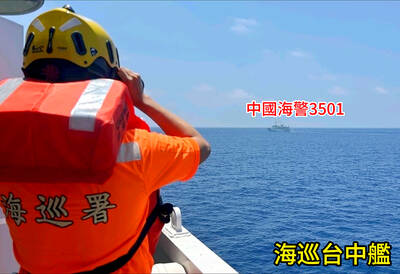
VERBOSE VESSELS: A CGA cutter and a China Coast Guard exchanged verbal barbs for more than a day in Taiwanese-controlled waters before the Chinese vessel left The Taiwanese and Chinese coast guards had a standoff near the strategically located Pratas Islands (Dongsha Islands, 東沙群島) in the north of the South China Sea, the Coast Guard Administration (CGA) said yesterday. The two sides engaged in intense radio exchanges over sovereignty claims during the 33-hour standoff. China Coast Guard vessel 3501 eventually left the restricted waters, 26.6 nautical miles (49.2km) west of the Pratas Islands, at 5pm yesterday, the CGA said. Lying approximately between southern Taiwan and Hong Kong, the Taiwan-controlled Pratas are seen by some security experts as vulnerable to Chinese attack due to their distance — more than


 RSS
RSS